Agenda
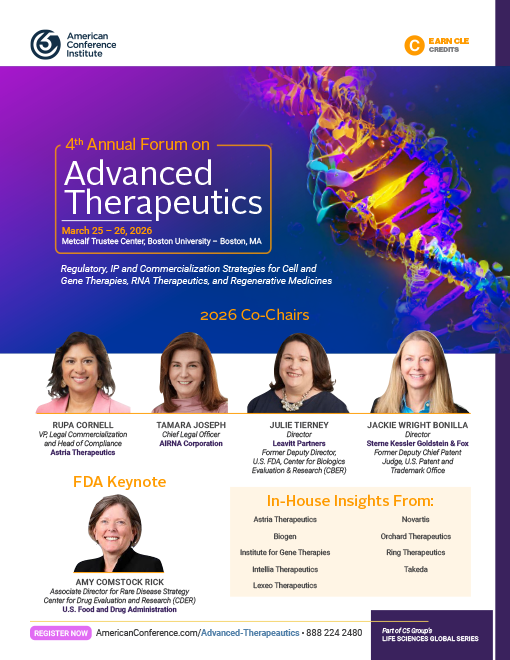
Flip through our conference brochure and discover what’s new this year.
Download Brochure
Day 1 — Main Conference
March 25, 2026
Registration and Continental Breakfast
Co-Chairs’ Opening Remarks

Michael LabsonPartnerCovington & Burling LLP

Julie TierneyPrincipalLeavitt PartnersFormer Deputy Director, U.S. FDA, Center for Biologics Evaluation & Research (CBER)

Rebecca WoodPartnerSidley Austin LLP Former Chief Counsel, FDA
With the second Trump administration initiating changes across healthcare policy, regulatory priorities, and federal funding programs, the advanced therapeutics sector faces both uncertainty and potential opportunity. This session will examine how shifting priorities under the current administration — including the influence of RFK Jr.’s leadership at HHS — is shaping the regulatory, IP, and commercialization landscape for cell and gene therapies, RNA-based treatments, and regenerative medicines.
Discussion points include:
- Examining the latest federal policy shifts impacting FDA approval pathways, clinical trial requirements, and enforcement approaches for advanced therapeutics
- Exploring how a reconfigured HHS under RFK Jr. is reshaping NIH and FDA funding priorities, scientific independence, and public trust in therapeutic innovation
- A look at the future of pricing, reimbursement, and market access under changing CMS policies and budgetary constraints
- Updates on new and pending IP reforms impacting advanced therapeutics, including the REMEDY Act, PREVAIL Act, and RESTORE Patent Rights Act
- Assessing the current and future landscape of government march-in rights and the latest moves by the current administration to invoke Bayh-Dol

Morning Coffee Break
Leveraging Global Markets: Securing Multi-Jurisdictional Approvals and R&D Resilience Amid U.S. Policy Uncertainty

Jacqueline BermanPartnerMorgan, Lewis & Bockius LLP

Marco de MorpurgoPartner, Global Co-Chair, Life Sciences DLA Piper

Xisca BorrasPartner Bristows
As U.S. policy uncertainty continues to raise questions around approval timelines, pricing, and market access, global markets are becoming increasingly critical for the advancement of cell and gene therapies, RNA therapeutics, and other advanced therapies. This session will explore how companies are rebalancing their regulatory and commercialization strategies to secure approvals across the EU and UK, while also addressing the challenges of R&D offshoring and multi-jurisdictional compliance.
Discussion points include:
- Strategic approvals outside the U.S.: Evaluating pathways in the EU and UK to ensure early market entry and risk diversification
- Balancing R&D footprints: Managing the shift toward global R&D hubs, clinical trial sites, and manufacturing networks amid rising U.S. policy and cost pressures
- Navigating the complexities of differing regulatory frameworks, data requirements, and post-market obligations across jurisdictions
- Building resilience through global planning: Integrating regulatory, IP, and commercialization strategies to sustain innovation and protect long-term ROI
Operationalizing Policy Risk: Future-Proofing Corporate Strategies to Protect Pipelines, Timelines, and Value

Tamara JosephChief Legal OfficerAIRNA Corporation

Jenny RobertsonFormer Chief Business and Legal OfficerLexeo Therapeutics
In today’s rapidly evolving policy environment, companies developing advanced therapeutics must be prepared to adapt to shifting regulatory priorities, funding structures, and geopolitical dynamics. From FDA oversight to global market pressures, the ability to anticipate and proactively manage policy swings is becoming a core competency for biotech and pharma leaders. This session will unpack:
- Strategies for embedding policy risk management into corporate planning to safeguard R&D pipelines, commercialization timelines, and investor confidence
- Scenario planning and agility: Building flexible business models and development strategies that can withstand sudden shifts in oversight or funding
- Aligning internal teams and stakeholders: Integrating compliance, legal, R&D, and investor relations into a unified risk management approach
- Protecting long-term value: Using IP strategy, funding diversification, and regulatory engagement to reduce exposure to policy volatility
Networking Luncheon
Balancing Affordability and Innovation: Tackling Pricing and Reimbursement Challenges for Advanced Therapeutics Under IRA and MFN

John FeoreDirector, Health Policy & AdvocacyInstitute for Gene Therapies (IGT)

Sharon SmallDirector, Counsel Market Access, Government Pricing and Policy Novartis
The IRA and recently proposed Most Favored Nation (MFN) pricing model, are reshaping the reimbursement and commercialization landscape for advanced therapeutics. For companies in the rare disease space — where development costs are high and patient populations are small — these policies carry significant implications for market access, deal-making, and innovation pipelines. This session will examine the legal, regulatory, and strategic dimensions of evolving federal drug pricing initiatives and provide practical guidance for managing their impact.
Discussion points will include:
- Breaking down the IRA’s impact on rare disease therapies: Pricing negotiations, coverage challenges, and long-term reimbursement risks
- Decoding the MFN Executive Order: What it means in practice, whether it is legally binding, and potential enforcement or implementation pathways
- Addressing the tension between cost-containment measures and sustaining R&D for rare and ultra-rare conditions
- Preparing your company and pipelines for shifting federal drug pricing landscapes and cross-border ripple effects
- Exploring how the IRA and proposed MFN are influencing patent litigation strategies for advanced therapies

Jennifer J. ChhedaPartnerJones Day

Kelly MorganSenior Vice President, Head of Legal and Corporate SecretaryRing Therapeutics
As the current administration signals a stronger intent to invoke march-in rights under the Bayh-Dole Act, companies in advanced therapeutics must reassess their exposure and obligations tied to federally funded research. For organizations ranging from early-stage start-ups to established biopharma players, understanding how government rights may apply—and how to safeguard product pipelines—is now a critical strategic priority. This panel will tackle topics including:
- Clarifying the scope of government march-in rights under Bayh-Dole and how they may affect cell, gene, and RNA therapy developers
- Assessing the level of risk for companies with past or ongoing federally funded research, including start-ups with early-stage support
- Strategies to mitigate exposure and protect product lines while balancing commercialization goals with compliance
- Preparing for potential government action: proactive steps legal, regulatory, and business teams should be taking now
Afternoon Break
Securing Capital in a Cautious Market: Building Financial Resilience for Advanced Therapeutics Through Creative Funding Solutions

Jennifer FangPartnerWilson Sonsini Goodrich Rosati

Stephanie NowackDirector, Corporate CounselAstria Therapeutics
In today’s cautious capital environment, advanced therapeutics companies face unprecedented challenges in securing sustainable funding. With investors scrutinizing risk profiles, reimbursement uncertainty, and lengthy development timelines, it is more critical than ever to implement resilient financing strategies that balance near-term survival with long-term innovation. This session will explore practical approaches to capital planning, investor engagement, and deal-making that can help companies withstand financial headwinds while keeping pipelines on track. Join our panelists as they provide insights on:
- What current trends signal for early- and late-stage financing rounds
- Leveraging partnerships, licensing deals, and alternative funding models to sustain operations
- Balancing short-term liquidity with long-term growth: Building financial resilience without stalling innovation pipelines
- Case studies and lessons learned: How advanced therapeutics companies are navigating capital scarcity in real-world scenarios
Conference Adjourns
Day 2 — Main Conference
March 26, 2026
Registration and Continental Breakfast
Co-Chairs Welcome Back
From Algorithms to Approvals: Harnessing AI to Accelerate Advanced Therapeutics While Managing Regulatory and IP Risks

Michael HarlinPartnerNeal, Gerber & Eisenberg LLP

Janet XiaoPartnerMorrison & Foerster LLP
Artificial intelligence and data science are reshaping the trajectory of advanced therapeutics, yet the integration of AI also raises novel challenges around regulatory acceptance, data integrity, and intellectual property protections. This session will explore how AI can be leveraged to enhance speed, precision, and scalability in advanced therapeutic development while navigating the emerging legal and policy questions tied to its use. Our panelists will tackle topics including:
- How companies can effectively harness AI and machine learning for target selection, biomarker discovery, and trial optimization in advanced therapies
- Manufacturing innovation: Using AI to predict variability, optimize supply chains, and scale production for cell, gene, and RNA-based treatments
- Regulatory considerations: How FDA and global authorities are approaching AI-enabled therapeutic development and data validation
- IP and ownership questions: Who owns AI-generated insights, and how do they fit into patentability and freedom-to-operate frameworks? What are companies including in their patent filings when AI was used in the drug-discovery process?
- Strategic integration: Best practices for aligning AI-driven insights with existing R&D and commercialization strategies in advanced therapeutics
Exclusivity Under Pressure: Reinforcing IP Protections to Maintain Market Position in Advanced Therapeutics

Briana EricksonVP, Head of Intellectual PropertyIntellia Therapeutics

Mary TillOf CounselFinnegan, Henderson, Farabow, Garrett & Dunner, LLPFormer Policy Advisor, USPTO

Adam GregoryPartner, Patent Attorney (Life Sciences)Mewburn Ellis
With more players entering the cell and gene therapy, RNA, and regenerative medicine arenas, exclusivity protections are facing unprecedented scrutiny. Companies must not only build robust IP portfolios but also defend them against challenges from competitors, regulators, and shifting policy frameworks. This session will provide practical strategies for safeguarding innovation and maximizing the value of IP assets in an increasingly competitive advanced therapeutics landscape.
Discussion points include:
- Building durable exclusivity: Best practices for layering IP protections across composition, methods, platforms, and manufacturing processes
- Navigating challenges: Addressing freedom-to-operate risks, competitor overlap, and evolving patentability standards in advanced modalities
- Litigation insights: Key takeaways from recent disputes involving cell, gene, and RNA therapies and their implications for future cases
- Global alignment: How to strengthen and harmonize IP protections across multiple jurisdictions with varying regulatory and legal frameworks
- Strategic alliances: Leveraging licensing, partnerships, and cross-licensing to expand portfolio strength and reduce litigation exposure
Morning Networking Break

Jackie Wright BonillaDirectorSterne Kessler Goldstein & FoxFormer Deputy Chief Patent Judge, U.S. Patent and Trademark Office

Jonathan S. CaplanPartner, Head of Intellectual Property, U.S.Herbert Smith Freehills Kramer LLP
Recent changes in USPTO policy have made discretionary denials of inter partes reviews (IPRs) more common, altering the risk-benefit calculus for both challengers and patent holders. This session will provide both offensive and defensive perspectives to help stakeholders make more informed IP and business decisions in a rapidly changing landscape.
- Offensive considerations: Key factors in deciding whether and when to initiate an IPR petition against a competitor in light of higher discretionary denial rates
- Defensive posture: Strategies for preparing strong portfolios that can withstand IPR attacks under the USPTO’s updated framework
- Timing and coordination: How litigation, settlement discussions, and parallel district court actions impact IPR viability and outcomes
- Risk management: Assessing costs, reputational implications, and competitive dynamics when using (or defending against) IPRs in advanced therapeutics
Networking Luncheon
Partnering for Progress: Strategic Considerations for Structuring Advanced Therapeutic Collaborations and Licensing Deals

Seema BasuHead of Strategic PartnershipsMass General Brigham

Marcus A. ColucciSpecial CounselHerbert Smith Freehills Kramer (US) LLP

Chia-Feng LuPartner Greenberg Traurig LLP
As advanced therapeutics move closer to commercialization, speed-to-market is often the defining competitive advantage. Licensing and collaboration models are increasingly central to bridging resource gaps, expanding global reach, and accelerating development timelines. This session will explore the evolving deal structures that can help biopharma companies, investors, and partners maximize value while managing risk in a competitive and highly regulated global marketplace.
Discussion topics include:
- Key considerations in academic–pharma and biotech–pharma collaborations, including IP ownership, data rights, publication controls, and translational risk
- Structuring IP rights across different types of deal lifecycles, from joint ventures, to partnerships, to licensing deals
- Allocation of patent ownership, exclusivity and sublicensing rights from discovery through commercialization

Barbara FiaccoPartner, Co-Chair Patent Litigation PracticeFoley Hoag LLP

Ryan HagglundPartnerLoeb & Loeb LLP

Daniel ShoresMemberRothwell Figg
Patent litigation remains one of the most closely watched dynamics in advanced therapeutics, with high-stakes disputes shaping the future of innovation, exclusivity, and commercialization. From ongoing battles over mRNA and lipid nanoparticle (LNP) technologies to the rising wave of litigation surrounding antibody-drug conjugates (ADCs), these cases reveal not only the value of platform technologies but also the pressure points where innovators are most vulnerable. This session will unpack the litigation landscape to clarify what’s really at stake — and what it means for the next wave of advanced medicines.
Discussion points include:
- mRNA and LNP litigation trends: Breaking down the core claims, defenses, and outcomes shaping platform IP battles
- ADCs in the spotlight: Why antibody-drug conjugates are becoming a new IP flashpoint and what disputes signal for innovators
- Freedom-to-operate risks: Practical considerations for companies navigating crowded patent spaces and overlapping claims
- Strategic implications: What ongoing disputes mean for licensing, collaborations, and portfolio-building in advanced therapeutics
Closing Roundtable
Preparing for the 2027 Advanced Therapeutics Landscape: Science, Law, and Strategy
Jackie Wright BonillaDirectorSterne Kessler Goldstein & FoxFormer Deputy Chief Patent Judge, U.S. Patent and Trademark Office

Rupa CornellVP, Legal Commercialization and Head of ComplianceAstria Therapeutics
Tamara JosephChief Legal OfficerAIRNA Corporation
Julie TierneyPrincipalLeavitt PartnersFormer Deputy Director, U.S. FDA, Center for Biologics Evaluation & Research (CBER)
During our closing roundtable, our co-chairs will share perspectives on what lies ahead and how to strategically prepare for 2027. Our panelists will share forward-looking insights on:
- The most transformative innovations expected to define the next phase of cell, gene, RNA and immunotherapies
- The regulatory horizon for advanced therapies
- IP and litigation outlook for this space
- Commercialization considerations for the year ahead and strategies for strategic positioning