Agenda
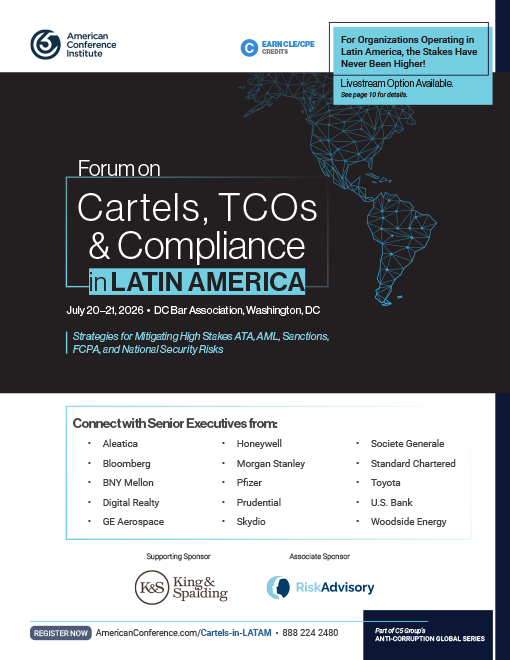
Flip through our conference brochure and discover what’s new this year.
Download Brochure
Day 1 — Main Conference
July 20, 2026
Registration and Continental Breakfast


A Holistic Approach to Compliance in the Region: How Companies Are Staying Ahead of New Complex Challenges

Marco Antonio Padilla MerigoGlobal Chief Compliance OfficerAleatica

Margaret BeasleyPartnerBracewell

Murat DaglitFinancial Crimes LeadRemitly

Ruti SmithlinePartnerMorrison Foerster
- Ensuring that your compliance program includes Anti-Terrorism Act, AML, Economic Sanctions, FCPA, and National Security considerations
- Strategies for assessing risk in light of new forms of cartel-related corporate liability in Latin America business
- Modifying third party due diligence strategies to address new and evolving foreign terrorist organization (FTO), specially designated global terrorist (SDGT) and other risks
- Leveraging FCPA/anti-corruption controls for transnational criminal organization (TCO) risks
- Training employees on emerging risks
- Shaping escalation procedures for cartel risks
Networking Break
Cartel, TCO, Third Party and Supply Chain Red Flags: Strengthening Due Diligence on Your Customers, Vendors, Suppliers and Partners in Latin America

Molly BraeseHead of Global ComplianceSkydio

Christina HudSenior Compliance Counsel, Global InvestigationsPfizer

Alyssa MisnerDirectorThe Risk Advisory Group

Paul J. NathansonPartnerDavis Polk & Wardwell LLP
- How to perform meaningful due diligence when cartel involvement and ultimate beneficial ownership (UBO) are difficult to detect
- What creative ownership structures are used to evade detection and how to identify them
- How far down the supply chain to go with transportation, logistics, and other high-risk providers
- How to manage security risks associated with deep dive due diligence
- How to adjust third party filtering methodologies to respond to new risks

Abelardo Valenzuela HolguínAnti-corruption Prosecutor Office of the State of Chihuahua, México
Vice President
National Convention of Anti-Corruption Prosecutors of México (CONAFA)

Diego Alejandro Cárdenas LujánDirector of the Criminal, Financial, Tax and Anti-Money Laundering Intelligence AgencyAnti-corruption Prosecutor's Office of the State of Chihuahua, México
Technical Secretary
National Convention of Anti-Corruption Prosecutors of México (CONAFA)

Brandt LeibePartnerKing & Spalding LLP

Maria Elisa MadrigalFormer Office of Specialized Prosecutor for Combating CorruptionFiscalía General De La Republica (Mexico)
- Exploring developments in Mexico’s enforcement tools and efforts
- Cooperation developments with U.S. agencies
- Analyzing organized crime risks in different regions and sectors
- Discussing evolving AML risks for financial institutions and companies
Networking Lunch
Inside the Sophisticated Operations of the Cartels & TCOs: What You Need to Know to Strengthen Compliance Decision-Making

Andres OteroPresident LATAMGuidepost Solutions

John ZapponeAssistant Special Agent In-ChargeHomeland Security Investigations
- How cartels infiltrate legitimate businesses
- Key sectors of involvement: Agriculture, energy, tourism
- Cartel penetration into supply chains, logistics, and procurement
- How criminal networks exploit corporate structures and trade flows
- A closer look at criminal networks’ infiltration into unions and government agencies
- How companies can detect risk and actual/potential exposure
AML in High-Risk Jurisdictions: Reporting Suspicious Activity and Understanding New Laundering and Crypto Typologies Unique to Latin America

Michaela ArndtRegional Head, CFCR, Sanctions Compliance, Europe & Americas and Group Head, US SanctionsStandard Chartered Bank

Anthony CookSupervisory Special AgentIRS Criminal Investigations

Gina ParlovecchioPartnerMayer Brown

David WildnerGlobal Co-Head Of FCC; Global Head of AMLBNY Mellon
- New trends in trade-based money laundering (TBML)
- Best practices for filing Suspicious Activity Reports (SARs)
- Suspicious behaviors that are coming to the forefront—and how to detect them
- Detecting cartel financing, particularly targeting money laundering via money services businesses (MSBs)
- The increasing use of crypto rails by cartels
- Use of shell companies, false invoicing, and customs fraud
- Red flag indicators for multinationals operating in the region
Networking Break

Maria González CalvetPartnerRopes & Gray LLP

Brian OngSenior Managing DirectorFTI Consulting

Kevin RosenbergSenior Director, Lead Attorney for Global Regulatory ComplianceLeidos
- Crossover risks—how cartel-affiliated officials engage in corruption implicating risks for companies
- Key differences between bribes and extortion
- Responding to extortion demands, including derecho de piso and derecho de paso
- Lessons learned from Millicom (TIGO), and recent individual FCPA prosecutions
- Meeting FCPA accounting provision requirements
Colombia
Beyond Mexico, Other Latin America Hot Spots: Tailoring Risk Management and Compliance with the Country-Specific Realities

Matteson EllisMemberMiller & Chevalier Chartered

Elizabeth FitzpatrickVice President & General Counsel, Chief Regulatory Officer and Head of Legal TransformationHoneywell

Gustavo Leon Manzano GonzalezVP, Global Head of Financial CrimePrudential

Maria Paula JiménezCompliance Manager CAC-Central America, Andina & the Caribbean Sea AreaMaersk
- How does TCO risk arise hot spots, including: Venezuela, Colombia, Ecuador, Cuba, and Chile
- How do FTO profiles and activities differ in other parts of Latin America
- What is the nature of emerging local enforcement outside of Mexico
- How are companies designing region-wide strategies to address localized risks

Sheb SwettExecutive CounselGE AerospaceFormer Assistant U.S. Attorney, SDNY

Ian RichardsonPartnerPaul, Weiss, Rifkind, Wharton & Garrison LLP
- Material support of FTOs under the Anti-Terrorism Act
- Relevant money laundering statutes
- The mechanisms of Civil Forfeiture
- Use of Economic Sanctions to target organized crime
- Anti-Corruption and FCPA enforcement priorities
- Relevant drug statutes
Networking Drinks Reception Sponsored by:

End of Day One
Day 2 — Main Conference
July 21, 2026
Continental Breakfast

Ray DonovanCEOStack21 SolutionsFormer Chief of Operations, Drug Enforcement Administration

Stuart Jones Jr.Founder and CEOSigma360
- Lessons Learned from Mexico, Venezuela, and Recent Enforcement Actions: Recent actions show that financial crime risk is no longer limited to direct sanctions exposure or known bad actors. Criminal and state-linked networks are increasingly embedded in legitimate trade, logistics, banking, payment, energy, and commodity flows. The panel will explore what these developments reveal about the limits of traditional KYC, sanctions screening, and adverse media monitoring.
- From Kingpin Takedowns to Network Disruption: Ray Donovan will discuss why successful enforcement requires more than targeting individuals. Kingpin takedowns can create immediate disruption, but lasting impact comes from mapping the broader network, including facilitators, financiers, intermediaries, shell companies, and professional enablers. This reflects the whole-of-government approach used in major cartel investigations and now increasingly visible in financial crime enforcement.
- Why Legacy Compliance Struggles with Modern Criminal Networks: Traditional systems were built to screen names and manage alerts. They were not built to detect layered ownership, indirect exposure, cartel-linked logistics, precursor chemical supply chains, trade-based money laundering, or the convergence of organized crime, sanctions evasion, and terror finance. This creates blind spots for financial institutions and corporates operating across high-risk sectors or jurisdictions.
- Human Expertise and AI-Powered Risk Intelligence: The future of compliance is not human versus technology. It is human expertise amplified by trusted AI. Subject matter experts bring investigative judgment, typology knowledge, and context. AI-powered platforms bring scale, speed, entity resolution, network detection, multilingual adverse media, and real-time monitoring. Together, they create the level of due diligence needed to match the speed and sophistication of modern criminal networks.
- Shifting from Storm-Chasing, Being the Calm: Stack21 and Sigma360 are helping define the move from check-the-box compliance to proactive network risk detection. The goal is not simply to generate more alerts, but to give institutions a clearer view of the relationships, behaviors, jurisdictions, and risk signals that matter most.
The SDGT and FTO designations of Brazilian criminal organizations: Understanding and managing exposure after the PCC and CV designations

Carlos AyresPartnerMaeda, Ayres & Sarubbi Advogados

Ricardo Wagner de AraujoChief Governance and Compliance OfficerPetrobras

Tania FloresDirectorHuron
What the panel will discuss:
- Brazil’s enforcement landscape and political dynamics following the PCC and CV designations.
- How PCC and CV have infiltrated the legitimate economy — ports, fuel, logistics, etc.
- What the SDGT and FTO designations legally mean for companies and financial institutions.
- How to map direct and indirect exposure practical steps to build a defensible compliance response.
Networking Break

Iris PilikaSenior Compliance OfficerOffice of Foreign Assets Control,
U.S. Department of the Treasury

Fuat YurekliSenior Enforcement Officer, Enforcement and Compliance Division, FinCENU.S. Department of the Treasury

Nicole ErbPartnerWhite & Case LLP
- New and emerging enforcement trends to watch
- How U.S. agencies are collaborating with each other, and with international authorities
- Current compliance expectations of U.S. regulators
- Which types of investigations are on the rise
Re-Calibrating Risk Assessments: Uncovering Where You are Exposed and Updating Your Risk Ranking Approach

Leigh Anne LeinenHead of Ethics and Compliance InternationalWoodside Energy

Marc BohnCompliance CounselEricsson

Tadeo Leandro FernandezOffice of Institutional IntegrityInter-American Development Bank

Ann SultanSr. Director, Corporate Counsel – ComplianceDigital Realty
- How cartel driven economies are reshaping risk assessments and ranking, and compliance priorities
- Creating an FTO working group internally
- Strategies for leveraging FCPA, business and human rights, and other risk assessments for FTO-related assessments
- Evaluating major contracts and customers for TCO risks
- Detecting the commingling of legitimate business and illegal activities
- Supply chain, human resources, community relations, unions, government affairs and security


Networking Lunch
Security and Extortion Considerations “On the Ground”: How to Deal with Threats, Demands for Money and Physical Safety Challenges

Steven DudleyCo-DirectorInSight Crime

Maria Elena LapetinaMemberMiller & Chevalier Chartered

Nelson LuisPartnerDeloitte

Karlo VillalpandoFormer Global Corporate SecurityFirst Brands Group LLC
- Managing employee safety and ethical obligations
- Strategies to handle threats
- Deciding when to exit a market: Safety, legal, ethical, and operational factors
Whistleblower Reports, Investigations, Self-Disclosure and Crisis Response: Unpacking a Real-World Multi-Jurisdictional Scenario

Jeff KruszewskiAssistant General CounselU.S. Bank

Daniel LinskerRegional Director of Latin AmericanControl Risks

Mark MorrisonPartnerBlakes

John RichterPartnerKing & Spalding LLP
- How companies respond to whistleblower and other reliable information of cartel exposure?
- Modifying the standard internal investigation playbook for FTO material support investigations
- How to incorporate security protocols in TCO investigations
- What are voluntary disclosure calculations in the U.S. for detected organized crime issues
- How should companies interact with Mexico and other regulators
Networking Break
Economic Sanctions Compliance in Latin America: How Regulators are Using Sanctions Tools to Address Cartel Risks

Bahman FarahdelGlobal Head of Sanctions, Trade and ESG ComplianceBloomberg

Cate KlemmeDirectorEvidencity, Inc.

Alice RojasManaging Director, Americas Head of SanctionsSociete Generale

Will SchisaCounselDavis Polk & Wardwell LLP
- Expanding screening to address the risk profiles of customers that may be associated with or have exposure to cartels
- What to do when counterparties appear on sanctions lists
- Coordination of U.S. and Mexican authorities
- FinCEN’s priorities and enforcement activity
- Secondary exposure in Venezuela, Cuba, Nicaragua