Agenda
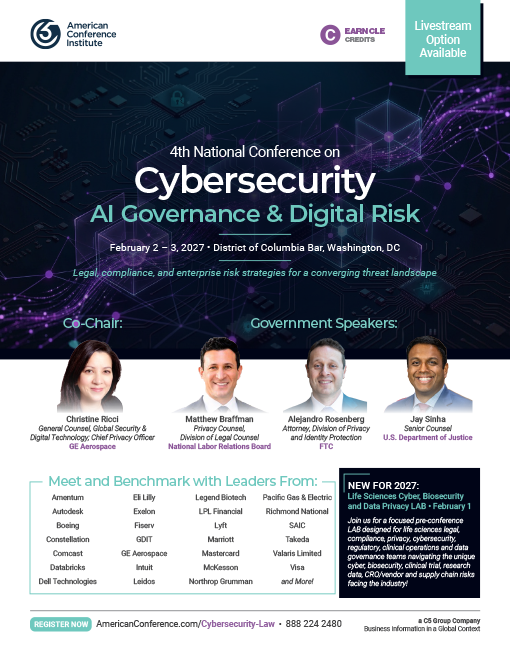
Flip through our conference brochure and discover what’s new this year.
Download Brochure
Life Sciences LAB
February 1, 2027
Life Sciences Cybersecurity, Biosecurity & Data Risk LAB
LEARN ∙ APPLY ∙ BENCHMARK

Brittany BellSenior Counsel- Privacy, AI and Data EnablementMcKesson

Jon WilkinsonSenior Legal Director, Global Data PrivacyIQVIA
- Identifying the clinical trial data, patient data, research data, genomic data, pseudonymized datasets, IP and real-world evidence that create the greatest cyber, privacy, biosecurity and geopolitical exposure
- Strengthening controls around who can access sensitive life sciences data and how that data may be used, shared or repurposed
- Balancing AI, real-world evidence and advanced analytics opportunities with stronger safeguards for patient trust, proprietary information and sensitive research assets
- Reducing downstream risk by tightening oversight of secondary use, vendor access, cross-border transfers and AI-generated outputs before an incident or dispute arises

Anbu DamodaranAssociate DirectorAstraZeneca (remote)

Anita PadmanabhanPartnerSpencer West
- Navigating GDPR, cross-border transfer rules and evolving privacy requirements while enabling secure use of patient, clinical and research data
- Reducing CRO and vendor risk by strengthening due diligence, accountability and oversight across the research ecosystem
- Clarifying sponsor, CRO and third-party responsibilities for vulnerabilities, incidents, data handling and regulatory exposure
- Building scalable third-party risk strategies that support global research collaboration without weakening security, privacy or operational control

Corey DennisChief Privacy Officer & Assistant General CounselLegend Biotech

Emily R. MilanGlobal Head, GRCVeracyte, Inc. Former CISO
- Mapping how FDA, HHS, NIH, BARDA and DoD expectations are converging around cybersecurity, AI governance, data stewardship, research security and biosecurity preparedness
- Aligning AI-enabled medical devices, clinical decision support tools and software-as-a-medical-device strategies with FDA expectations for safety, validation, documentation and lifecycle oversight
- Protecting patient, clinical and research data by strengthening HIPAA compliance, data-sharing controls and responsible AI use across regulated operations
- Preparing for federal funding, public health and biosecurity scrutiny by addressing research integrity, supply-chain resilience and sensitive data governance
- Managing federal contracting and DoD-related cybersecurity obligations by tightening CMMC readiness, supplier controls and protections for sensitive government and research data

William DummettAVP, Assistant General Counsel, Digital Legal Office Attorney LeadEli Lilly and Company

Kimberly GoldChief Privacy Officer, Senior Associate General Counsel and Executive Director, Privacy LawGenentech
- Safeguarding genomic, phenotypic, clinical and real-world datasets that create lasting privacy, cyber, IP and biosecurity exposure
- Tracking state genomic privacy laws, the DOJ Bulk Sensitive Personal Data Rule, research security requirements and growing scrutiny of foreign access to health and genomic data
- Controlling access to sequencing data, biobanks, proprietary algorithms and research collaborations before sensitive assets are reused, transferred or exposed
- Clarifying ownership, licensing, training rights and derivative-use restrictions when genomic datasets are used to build or validate AI models
- Enabling precision medicine and AI-driven research while maintaining defensible governance across legal, privacy, compliance, security and research teams
Networking Break

Jay MitchellVP, Senior Assistant General CounselLeidos QTC

John TaoDigital Ethics & Data Privacy OfficerOncology, Takeda
- Protecting clinical trial data, patient data, research assets and AI training datasets from unauthorized access, cyber threats and data leakage
- Tracking clinical trial data flows across sponsors, CROs, vendors, trial sites and cross-border systems to maintain control over approved uses
- Building scalable privacy and cybersecurity controls for multinational trials while managing country-specific requirements and operational complexity
- Preparing for cyber incidents that could disrupt study timelines, compromise data integrity, affect patient trust or trigger regulatory scrutiny
Corey DennisChief Privacy Officer & Assistant General CounselLegend Biotech
Apply the LAB’s key lessons in a fast-moving life sciences crisis involving cyber risk, sensitive data, supplier exposure, clinical trial disruption, AI governance and biosecurity concerns. Working in table teams, attendees will pressure-test how legal, compliance, privacy, cybersecurity, procurement, clinical operations and business leaders should respond when patient trust, research continuity, contracts and organizational reputation are all on the line.
Each table will work through one scenario and report back with key decisions, blind spots and practical takeaways.
- Assessing a critical supplier flagged under emerging biosecurity concerns while balancing regulatory obligations, contractual commitments and business continuity
- Responding to a suspected CRO data compromise while evaluating notification duties, investigation steps, vendor accountability and legal exposure
- Managing clinical trial disruption while protecting patient safety, preserving data integrity and minimizing delays
- Containing potential exposure of sensitive patient and research data while addressing privacy, cybersecurity, litigation, communications and regulatory risk
End of LAB Day
Day 1 – Main Conference
February 2, 2027
Legal, compliance, and enterprise risk strategies for a converging threat landscape
Breakfast and Registration
Open the conference with timely intelligence from the FBI on the cyber, AI-enabled, data theft, ransomware, fraud and insider threats most likely to impact legal, compliance, privacy, security and risk teams in 2027. This briefing will frame the emerging threat environment and help attendees understand where organizations need to strengthen resilience before the next incident.

David HusbandPrincipal Corporate Counsel, Cyber LegalCisco

Christine RicciGeneral Counsel, Global Security & Digital Technology; Chief Privacy OfficerGE Aerospace
As AI becomes part of core business infrastructure, companies must make harder choices about model providers, cloud environments, data sovereignty, export controls, open-source tools, vendor dependence and long-term control of critical technology. This session will examine how global AI competition and cybersecurity concerns are reshaping enterprise risk, and how legal, privacy, security and business teams can balance innovation with resilience.
- Assessing cyber, privacy and business risks tied to competing AI ecosystems, model providers and deployment strategies
- Navigating export controls, government restrictions and market-access issues that may affect AI adoption and global technology strategy
- Evaluating the tradeoffs between public cloud, on-premises, open-source, proprietary and sovereign AI deployment models
- Protecting sensitive data, intellectual property, critical operations and regulated systems from vendor, infrastructure and geopolitical exposure
- Deciding when to use general-purpose AI models and when to build proprietary capabilities based on risk, cost, control and business need
Networking Break

David CarrollVP-Cyber Capability, Engineering & StrategyGDIT

Sam SingerChief Counsel, Cyber and TechnologyBoeing
- Building incident response playbooks, governance processes and escalation paths that reduce legal, regulatory and financial exposure before a breach occurs
- Negotiating the contract clauses that matter most when incidents happen, including notice, cooperation, audit rights, evidence preservation, indemnity and liability allocation
- Mapping decision-makers, breach-response resources and stakeholder responsibilities before legal, security, communications and business teams are under pressure
- Using AI and data-driven tools to strengthen preparedness while preserving human judgment for legal, regulatory and business-critical decisions
Elevating Board Oversight of Cybersecurity, AI Governance and Digital Risk: From Compliance to Competitive Advantage

Joanna BaltesChief Cybersecurity CounselIBM

John CarlinPartnerPaul, Weiss Former Assistant Attorney General, National Security Division, U.S. Department of Justice

Andrew HoffmanVP, Assistant General Counsel, Global Privacy and Data Usage Legal DepartmentFiserv

Laura Yoeckel-KellyVP, Cyber & Digital SolutionsAmentum
- Clarifying what directors need to understand about cybersecurity, AI adoption, data protection, technology risk and enterprise resilience
- Improving board and audit committee reporting by translating technical threats into legal, financial, operational and reputational risk
- Connecting SEC disclosure expectations, regulatory scrutiny and executive accountability to stronger internal governance practices
- Equipping management teams to brief the board before cyber, AI or digital risk issues become incidents, investigations or litigation
Lunch

Mervin Bourne, Jr.Senior Counsel- Artificial Intelligence, Cybersecurity & PrivacyPacific Gas and Electric Company

Matthew BraffmanPrivacy Counsel, Division of Legal CounselNational Labor Relations Board

Omar KhawajaField CISODatabricks
- Defining who owns AI risk across legal, cybersecurity, privacy, compliance, data, procurement and business teams
- Building governance structures that allow AI adoption while managing security, privacy, regulatory and operational exposure
- Improving visibility into AI systems, use cases, users and machine actors before risks become incidents or enforcement issues
- Documenting decisions, controls, approvals and oversight practices that demonstrate responsible AI management to regulators, boards and business leaders
- Aligning AI governance with existing cybersecurity, data protection and enterprise risk programs instead of creating another silo

Rachael Pashkevich KoontzDirector, Data Security CounselAutodesk

Robert SchmollDirector, Deputy General Counsel- Enterprise PrivacyIntuit
- Anticipating the claims most likely to follow cyber incidents, AI failures, privacy violations, data misuse, fraud and digital risk events
- Preserving privilege, evidence and investigation integrity when legal, security, compliance and business teams are responding under pressure
- Assessing how AI-generated decisions, hallucinations, bias, deepfakes and automated outcomes are creating new theories of liability
- Preparing for regulatory investigations, class actions, securities claims, consumer protection scrutiny and contractual disputes tied to cyber, privacy and AI risk
- Strengthening post-incident defensibility by documenting governance, escalation, decision-making and remediation before litigation begins
Networking Break
Building the Data Control Layer: Visibility, Quality, Permissions, Retention, Lineage and Defensibility

Salvador BarraganDirector of Data Governance and Controls for the Enterprise Data OfficeWesco

Caroline BudnikHead of Global Cyber PolicyNorthrop Grumman
Emily R. MilanGlobal Head, GRCVeracyte, Inc. Former CISO
- Mapping the data assets, systems, permissions and business processes that create the greatest cyber, privacy, regulatory and operational risk
- Improving data visibility, lineage and access controls so organizations know what data they have, where it resides, how it moves and who can use it
- Strengthening data quality, retention, minimization and classification practices to reduce risk, improve decision-making and support defensible outcomes
- Creating a defensible data foundation by connecting legal, privacy, cybersecurity, records management, compliance and business stakeholders around shared policies and controls

Steven GyeszlyChief Compliance OfficerValaris Limited
John TaoDigital Ethics & Data Privacy OfficerOncology, Takeda

Alejandro RosenbergAttorney, Division of Privacy and Identity ProtectionFederal Trade Commission

Lyra CorreaAssistant General CounselLeidos
This interactive session will provide participants with the opportunity to benchmark in smaller group discussions. At the end, the roundtable leaders will recap key insights and offer additional best practices.
- Roundtable 1: Building a Defensible AI Governance Program That Scales
Accelerate AI adoption while reducing risk by sharing practical approaches for governance, accountability, human oversight, policy development, documentation, and cross-functional decision-making that stand up to regulatory, board, and legal scrutiny. - Roundtable 2: Managing Shadow AI, Agentic AI and Employee-Driven Automation
Balance innovation with control by discussing how organizations are governing employee AI use, AI agents, and automated workflows while reducing data leakage, compliance exposure, security risks, and unauthorized use of enterprise information. - Roundtable 3: Strengthening Identity Resilience to Stay Ahead of Emerging Cyber Threats
As identity-based attacks grow more sophisticated, organizations must move beyond traditional security approaches. Learn how modern identity protection strategies help reduce risk, prevent unauthorized access, and strengthen cyber resilience—enabling your business to operate securely, maintain trust, and stay ahead of evolving threats. - Roundtable 4: Reducing Third-Party, Fourth-Party and AI Supply Chain Risk
Strengthen resilience across an increasingly interconnected ecosystem by exchanging best practices for vendor oversight, AI contracting, audit rights, incident coordination, data ownership, and managing the growing risks associated with suppliers, cloud providers, and AI service partners.
Networking Reception
Day 2 – Main Conference
February 3, 2027
Breakfast
William DummettAVP, Assistant General Counsel, Digital Legal Office Attorney LeadEli Lilly and Company

Kimberly J. ShurSVP, & Associate General Counsel, Chief Compliance & Privacy OfficerMarriott International Inc.

David VanalekSVP, Chief Legal and Compliance OfficerRichmond National
Learn where human review meaningfully reduces risk and where it simply creates false comfort. This session will focus on practical controls for ensuring AI oversight is tied to real decisions, consequences and accountability.
- Determining when a human should approve, monitor, audit or be removed from a process based on risk, consequence and decision type
- Designing escalation thresholds, exception handling and intervention triggers that activate human involvement before errors become business, legal or customer-impacting events
- Operationalizing oversight by defining reviewer responsibilities, authority, response times, documentation requirements and audit trails
Corey DennisChief Privacy Officer & Assistant General CounselLegend Biotech

Natallia KarniyevichPartnerMcDermott, Will & Schulte (Germany)

Jason WoolSenior Legal Director- Product & Application SecurityDell Technologies
DORA, NIS2, the Cyber Resilience Act and the EU AI Act are creating overlapping expectations around resilience, product security, third-party risk, AI governance, documentation and accountability. This session will help U.S. companies identify where they can build common controls instead of treating each mandate as a separate compliance project.
- Mapping where DORA, NIS2, the Cyber Resilience Act and the EU AI Act overlap across governance, documentation, resilience and accountability
- Preparing for heightened scrutiny of digital operations, critical ICT providers, subcontractors and supply chains
- Managing the complexity of NIS2 implementation as EU member states move at different speeds and create uneven compliance obligations
- Assessing how the Cyber Resilience Act changes expectations for secure-by-design products, vulnerability management and software lifecycle controls
- Translating EU AI Act requirements into practical processes for AI classification, procurement, oversight and documentation
Networking Break
Lyra CorreaAssistant General CounselLeidos

Ali KarshanFormer Global Head of Information Security and Incident Response LegalTikTok
- Strengthening vendor contracts with enforceable security standards, AI-use restrictions, fourth-party controls and risk-based obligations
- Using audit rights more effectively to verify vendor controls, trigger deeper reviews and avoid disputes after an incident
- Allocating financial risk through indemnity, liability, insurance and recovery provisions that hold up when a vendor failure creates exposure
- Coordinating the first 72 hours of a third-party incident by improving notice, cooperation, evidence access, investigation support and regulatory readiness

Ali AhmadAssistant General Counsel, Cybersecurity and PrivacyExelon

Hensey FentonDeputy General Counsel, Privacy & Digital GovernanceComcast
Organizations increasingly face multiple reporting obligations triggered by the same incident, each with different timelines, thresholds and stakeholders. This session focuses on how to manage overlapping disclosure obligations, coordinate decision-making under pressure and build scalable reporting processes that stand up to regulatory scrutiny.
- Reconciling CIRCIA, SEC disclosure requirements, state breach notification laws, sector-specific obligations and contractual reporting commitments when reporting clocks start simultaneously
- Building escalation and decision-making protocols that help legal, security, privacy, communications and executive teams determine what must be reported, when and to whom
- Managing conflicting definitions of materiality, covered cyber incidents, notification triggers and reporting thresholds across regulatory and contractual frameworks
- Coordinating internal investigations and fact gathering while preserving the ability to meet reporting deadlines as new information emerges
Lunch

Matt BodmanVP, Senior Managing Counsel, Corporate SecretaryMastercard

Megan KayoPartnerFreshfields

Marine MargaryanPrivacy CounselLyft
As AI agents become embedded in business operations, organizations must manage tools that can access sensitive data, execute workflows, interact with third parties and act with increasing autonomy. This session will focus on how legal, privacy, cybersecurity, compliance and business teams can enable agentic AI while maintaining control over security, accountability and liability.
- Defining ownership, escalation paths and decision-making authority for AI agents that can act across enterprise systems
- Reducing security and privacy risk by tightening controls around data access, permissions, identity, monitoring and sensitive information handling
- Negotiating stronger vendor protections around data ownership, model training, sub-processors, audit rights, incident coordination and accountability for agentic services
- Managing the shift from content risk to action risk as AI agents create new concerns around unauthorized decisions, unintended outcomes and operational disruption
FIRESIDE CHAT
CMMC, Federal Contracts and Cyber False Claims Risk: Staying Ready Despite Moving Timelines

Brian CraigVice President & Assistant General CounselSAIC

Michael GrudenPartnerSteptoe
- Reducing enforcement and False Claims Act exposure tied to cyber self-attestations, certifications and contractual representations
- Tracking evolving CMMC timelines while continuing to strengthen cybersecurity maturity and federal contracting readiness
- Strengthening internal oversight of cyber representations before they are submitted to customers, prime contractors or government agencies
- Documenting policies, controls, exceptions and remediation efforts that support defensible compliance positions
- Aligning federal cyber requirements with AI adoption, vendor oversight and operational priorities without creating new contract or certification risk
Networking Break
Steven GyeszlyChief Compliance OfficerValaris Limited

Melanie HarrisSenior Principal Counsel- TechnologyMaximus

Xin (Cindy) TuVice President, Head of Tech & Cyber Governance ComplianceLPL Financial
- Identifying where employees are using AI tools, automated workflows and unauthorized platforms outside approved governance channels
- Protecting sensitive data from unintended exposure through stronger access controls, data segmentation and acceptable-use rules
- Creating practical approval pathways that allow business teams to use AI without bypassing legal, privacy, cybersecurity and compliance safeguards
- Monitoring AI use across the enterprise to detect risky behavior, reinforce accountability and reduce unauthorized data sharing
- Turning shadow AI insights into a more scalable governance strategy that supports innovation without losing control

Eben KaplanSenior DirectorCrowdStrike

Vikas MahajanVice President, Information SecurityAmerican Red Cross
Test your organization’s ability to respond when ransomware, AI-enabled threats, legal exposure, regulatory reporting, insurance, vendor risk and business continuity collide. In this capstone tabletop, attendees will work through high-pressure decisions and benchmark how legal, cybersecurity, privacy, compliance, communications, insurance and business teams should respond in the first critical hours of a modern attack.
- Identifying gaps in escalation, governance, decision-making and response planning before a ransomware incident occurs
- Evaluating how AI-enabled threats are changing attacker speed, sophistication, detection and response strategy
- Managing legal, regulatory, insurance, contractual and indemnity decisions while the facts are still developing
- Coordinating internal and external stakeholders across legal, cybersecurity, privacy, communications, business, vendors, insurers and law enforcement
- Benchmarking practical steps to strengthen readiness, reduce exposure and improve outcomes before the next crisis