Agenda
Virtual Workshop A
November 30, 2026 • 9:00 AM–12:00 PM ET
Virtual Workshop B
December 1, 2026 • 9:00 AM–12:00 PM ET
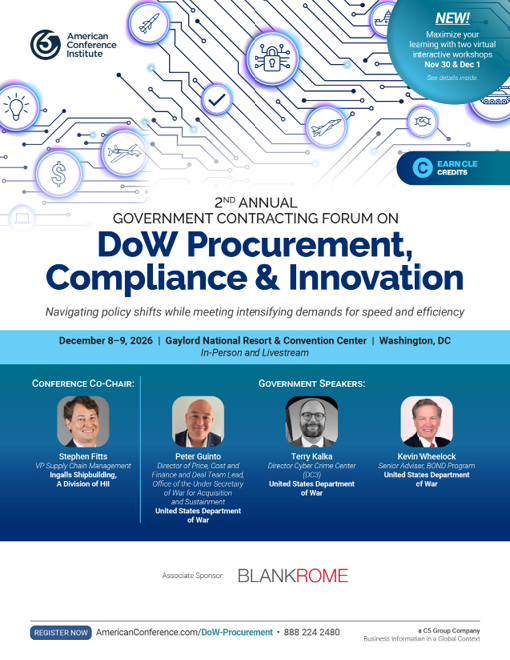
Flip through our conference brochure and discover what’s new this year.
Download Brochure
Day 1 — Main Conference
December 8, 2026
Registration and Networking Breakfast
Keynote Address: Procurement Priorities in Focus
Top Priorities for the FY 2027 Budget: Where Money is Being Spent – from Innovation Efficiency to Mission Success

Sean BamfordVice President & Chief Government Contracts CounselLockheed Martin

Kevin WheelockSenior AdvisorBOND Program, DoW
The 2027 Fiscal Year outlines $1.5 trillion in total budgetary resources for defense spending. The Budget includes a request for $350 billion in additional mandatory resources increasing access to critical munitions and further expansion of the defense industrial base. Key government priorities include maturing technology. This session will delve into government acquisition priorities and how funding is being allocated:
- Navigating the impact of Executive Orders on acquisition priorities, compliance, and procurement strategy
- Aligning with the government’s 2027 transformation strategy to drive innovation, efficiency, and mission success
- Unlocking opportunities through expansion of the Defense Industrial Base to strengthen resilience and competition
- Fostering stronger collaboration among Contracting Officers to accelerate decision-making and improve acquisition outcome
Networking Break
Global and Domestic Supply Chain Impacts: Navigating Tariffs, Disruptions, Economic Pressure and Buy American Act

Stephen FittsVP Supply Chain ManagementIngalls Shipbuilding, a Division of HII

Mike KostiwGeneral CounselElevated Technologies
Navigating Buy American Act (1933) requirements and increasing domestic sourcing priorities with greater confidence
- Mitigating the impact of tariffs and supply chain disruptions to maintain contract performance and delivery timelines
- Examining how rising fuel and material costs are affecting supply chain and sourcing strategies
- Strengthening supply chain resilience amid inflation and shifting economic conditions

Gary CampbellChief Legal OfficerNoble Supply & Logistics, LLC

Jennifer HobikAssistant General Counsel- Government Contract ComplianceHoneywell Aersospace
Reduce contractual and financial exposure by understanding how FAR Part 49 termination requirements apply across different contract types. Session topics include:
- Clarifying the growing number of OTA award challenges and what they mean for procurement strategy and competitive risk
- Improving preparedness and negotiation leverage through practical strategies for developing well-supported, defensible termination settlements
- Enhancing recovery opportunities and protecting organizational interests during contract terminations and settlement negotiations
- Reconciling the impact of AI flagging negative events in Contract Performance Assessment Reporting System (CPARS)
Networking Luncheon

Stephen FittsVP Supply Chain ManagementIngalls Shipbuilding, a Division of HII
This interactive session will provide participants with the opportunity to benchmark on high-stake issues affecting procurement, contracts and the defense industrial base in smaller group discussions. At the end, the roundtable leaders will recap key insights and offer additional best practices.
Discussion Table One: Anticipating Supply Chain Disruption
Discussion Table Two: AI and Tech Adoption
Discussion Table Three: Pain Points of Working with Subcontracts
Discussion Table Four: Evolving Contracting Mechanisms in Practice
Networking Break
Preparing for a Wartime Footing and How to Meet Government Procurement Expectations amid Evolving Revolutionary FAR Overhaul, Guidelines, Strategies and Acquisition Rules

Karolyn GardnerSVP Contracts, Procurement & PricingICF

Jai SpiveySVP ContractsParsons

Kathy Van EverySenior Legal Counsel GKN Aerospace
Defense Industrial Base and Acquisition stakeholders are giving feedback on the Federal Acquisition Regulations (FAR) and Defense FAR Supplement (DFARS) changes, following a statement from the Under Secretary of War, February 2026. Objectives include assessing:
- Field technology and modernizing systems to outpace adversaries;
- Increase production capacity to deliver wartime surge capacity; and
- Achieve a wartime footing for the acquisition system and industrial base.
This session will delve into what this means for contractors moving to a “wartime footing.”
- Assessing impact on contractors, and gaining clarity on the future direction of the FAR Identifying what “right-sizing” the regulatory environment will look like in practice and how it will affect procurement activity
- Evaluating the impact of emerging non-regulatory buying guides on acquisition strategy and competitive positioning
- Strengthening readiness by proactively managing positioning risk, compliance obligations, and operational adaptability
- Evaluating how the DoW intends to buy in the future and what contractors must do to stay aligned with evolving procurement expectations
C-Suite and Executive Industry Perspectives: Overcoming Challenges in an Evolving Defense Procurement Sector

Brian BaldrateVP and Lead CounselBAE Systems

Mike GinsbergVP & Deputy General CounselCACI

Maryann SurrickChief Legal Officer Applied Aerospace & Defense
- Examining top challenges for defense contractors
- Streamlining operations and adopting new tech to gain a competitive edge
- Overcoming supplier challenges
- Due diligence with third-party and subcontracts
- Predicting where future pain points will be in the next 12-months
Cocktail Reception
Day 2 — Main Conference
December 9, 2026
Networking Breakfast
Early Riser Panel: Future Ready Workforce: Adopting AI and Tech Savvy Practices at the Employee and Operational Level

Brittny LovelessSenior Contracts DirectorAleut Federal

Grace Mureithi Compliance Executive- Government Compliance & Internal Audit & ERM Clark Construction Group

John RomanVice President, Contracts, Procurement & Pricing Everforth ECS Federal
- Bolstering the innovation, technology and agility needed to meet evolving mission needs
- Fine tuning leadership effectiveness given shifts in the evolving contract management environment
- Navigating effectively through change, complexity and increased operational demands with fewer resources
- Strengthening collaboration between government and industry contracting officers to provide innovation and efficiency in delivery
- Empowering acquisition teams to confidently leverage technology and AI while preserving human oversight
- Accelerating AI adoption while reducing risk and maintaining mission effectiveness
Keynote Address: New Era of Innovation in Government Procurement and Acquisition
Getting the Contract Awarded under the New Section 847 Requirements and Oversight Expectations – What Uncleared Contractors Need to Know

Justin ChiarodoPartner and Co-Chair Government Contracts PracticeBlank Rome LLP

Steven KoprinceBoard Member Delaware Nation Investments
Previously limited to contractors and subcontractors performing classified work, Section 847 is expected to roll out in 2027 and will extend FOCI reviews to contracts of approximately $5 million or more—covering both classified and unclassified awards, as well as pre-award stages with the Pentagon estimating nearly 40,000 companies being affected by the rule. This shift will likely increase disclosure and oversight expectations, highlighting the need for clear guidance on Section 847 applicability, thresholds, and reporting requirements.
In this session explore:
- Keeping ahead of rollout timing and requirements
- Reducing legal risks and improving defensibility
- Strengthening commerciality determinations and ownership transparency
- Accelerating mitigation and award execution
Networking Break
- Addressing defense procurement fraud through False Claims Act enforcement
- Mitigating risks from foreign influence, compromised components, and supply chain infiltration
- Strengthening compliance with evolving cybersecurity requirements
- Identifying and managing insider threat risks
- Leveraging advanced technologies to detect and prevent fraud
Refining Action Plans for AI and Tech Adoption: Contract Lifecycle Management Tools, Streamlining Company Workflows, Cross Team Considerations and Stakeholder Communication

Pat Acox VP Defense, Robotic ResearchForterra

Peter Herman, CPASenior Director, Strategic Government ComplianceArcfield
Streamline procurement operations and improve contract visibility through advanced e-procurement and contract lifecycle management tools
- Improving contract compliance, cycle times, and stakeholder collaboration with integrated digital solutions
- Driving continuous improvement through AI-enabled insights, automation, and secure digital transformation initiatives
Networking Lunch


Amy Apostol Assistant General Counsel, Cyber & Emerging Technologies Leidos

Ryan FrazeePartnerMayer Brown
The second phase of CMMC set to take effect in November has been paused, with the first phase remaining in effect. Discuss best practices and next steps in the evolving landscape.
- Increasing scrutiny around misrepresentation of cyber compliance, False Claims Act exposure which is part of the first phase
- Strengthening competitive advantage with robust documentation and verifiable controls that empower procurement decisions
- Minimizing downstream performance, compliance, and reputational risk without assuming unnecessary liability for subcontractor cybersecurity failures
- Enhancing acquisition resilience by aligning cybersecurity compliance, pricing strategy, and supplier risk management into a unified procurement approach
Networking Break
Interview: Empowering the Defense Industrial Base with Stronger Security Measures for Controlled Unclassified Information for Robust Defense Contract Support

Terry KalkaDirector Cyber Crime Center DC3United States Department of War

Richard GirouxAttorney Advisor, Cyber Crime Center DC3United States Department of War

Lisa HimesOf CounselRogers Joseph O'Donnell PC
Strengthening compliance and reduce data exposure risk through practical strategies for identifying, processing, storing, and transmitting CUI securely
- Improving protection of sensitive information by leveraging secure enclaves to isolate and control CUI environments
- Increasing operational confidence and cyber resilience through public-private partnerships that enhance threat intelligence and data protection capabilities
- Reducing cybersecurity risk and potential disruptions by proactively identifying, prioritizing, and patching vulnerabilities before they are exploited
- Enhancing audit readiness and customer trust through more disciplined, defensible handling of controlled and sensitive data
- Supporting mission continuity and contract eligibility by embedding stronger cybersecurity and data protection practices into daily operations

Luis AmbroggioVice President Contracting and CompliancePCSI

Sara Crabtree Senior Director of Contracts & Pricing Threat Tec

Kevin J. MaynardPartnerWiley Rein LLP
- Examining flow-down clauses
- Navigating flow-down requirements amid evolving FAR regulations
- Keeping track of what applies to your contracts and what may happen as a result
- Sharing responsibility for supply chain security with Controlled Unclassified Information (CUI)
- Building and delivering a clear compliance plan to manage subcontractor compliance
- Conducting proactive monitoring and audits to ensure compliance