Agenda
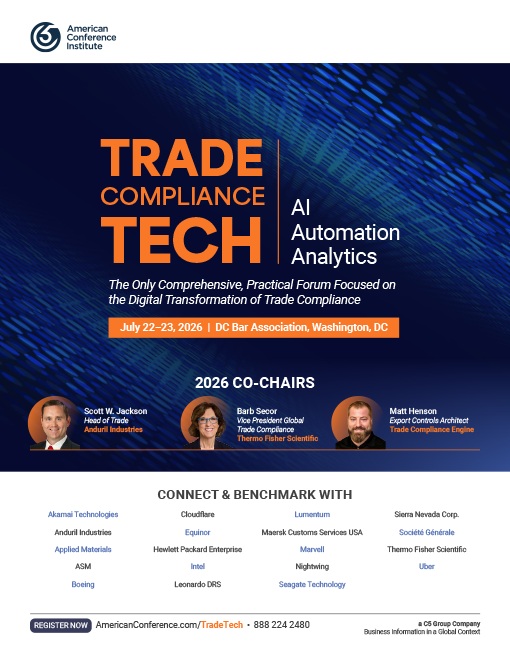
Flip through our conference brochure and discover what’s new this year.
Download Brochure
Day 1 — Main Conference
July 22, 2026
Unpacking the Cutting-Edge AI, Analytics and Automation Solutions Enabling Trade Compliance Modernization: Classification, Screening, Third Party Management, and Beyond

Scott ForbesHead of Global ComplianceASM

Lindsay HammingaSenior CounselEquinor

Jake SchostagSenior Global Trade & Compliance LeaderTrade Connect 360

Todd R. SmithFounder and CEOKYG Trade
- Exploring the landscape of AI, analytics, and automation across key trade compliance application areas today (e.g. classification, screening, third-party management, document processing and content generation)
- Examining the trade-offs between off-the-shelf and in-house development
- Examining how expectations for data visibility, scalability, and real-time risk detection are reshaping compliance solutions
- Candid assessments of how tech providers are responding to evolving requirements
- Benchmarking strategies to navigate a crowded vendor and technology landscape
Exhibit Floor & Networking
Spark Session
From Trade Data to Defensible Decisions: How Akin and Consilio explore Tariff Compliance with AI

Lars-Erik HjelmPartnerAkin

Omid JahanbinSenior Vice President of Product Experience and MarketingConsilio
Mapping Your Workflows & Assessing Trade Risks Across ERP Data Streams: How Selecting & Adopting an AI Solution Changes the Precursors to Implementation

Orisia GammellChief Trade & Compliance CounselLumentum

Karnelle GaillardSr. Trade Compliance & Data AnalystBrooks Automation

John QuinnDirector, GTS Jurisdiction & Classification Service Center, Global Trade Services, Law DepartmentTE Connectivity
- Determining how compliance operates in real-time and what drives decision-making by mapping trade compliance workflow strategies for end-to-end trade compliance across multiple ERP systems and business units
- Identifying gaps, inconsistencies, and redundancies in trade data (e.g., classification, screening, transaction records) that must be resolved before AI can deliver value
- Assessing trade risk exposure across ERP data streams, including denied party screening, ownership structures, and transaction-level red flags
- Exploring challenges created by decentralized systems, legacy infrastructure, and inconsistent product or part numbering that limit visibility and control
- Defining practical steps to clean, standardize, and govern trade data so your organization is actually ready to select and adopt AI solutions
Spark Session
From Classification to Licensing Readiness: Orchestrating Export Control Decisions at Scale

Thariq KaraCEO & Co-FounderBITE Data
Networking Luncheon
AI Journeys
The Quest for the Holy Grail: Trade Compliance Leaders Share the Challenges of Operationalizing AI and Automated Solutions Across Export Classification, Transaction Review, and Internal Audits

Kevin CuddyGovernment & Regulatory Affairs Executive Export Regulation OfficeIBM

Matt HensonExport Controls ArchitectTrade Compliance Engine

Lance StricklinHead of Export Controls & Sanctions ComplianceAirbus
- Sharing real-world experiences building in-house, AI-enabled export classification tools—what worked, what failed, and what teams didn’t anticipate
- Comparing approaches to classification automation (keyword-based, structured data, AI-assisted) and where they break down in practice
- Identifying common challenges, including inconsistent product data, standardization issues, and limits of training AI on internal datasets
- Pressure-testing trust in AI outputs: how teams validate, audit, and take responsibility for classifications in high-risk environments
- Benchmarking your ability to scale and achieve ROI, while exchanging practical insights on moving from pilots to production-ready solutions

Miguel GarciaCorporate Counsel – ComplianceGoDaddy

Joseph MoyerSenior Counsel, Investigations & DisclosuresBoeing

Robert PattersonHead of Sanctions Investigations, DirectorSociété Générale

Charlie HeidlageBusiness Development ManagerKharon
- Leveraging technology to generate, preserve, and analyze evidence across trade data, communications, and system logs when investigating potential violations
- Ensuring explainability in AI-driven compliance tools so investigation findings can be defended to regulators, auditors, and internal stakeholders
- Using continuous controls monitoring to proactively surface anomalies, red flags, and potential violations before they escalate into enforcement risk
- Conducting investigations involving intangible exports (e.g., data transfers, access, and system interactions) and reconstructing activity across digital environments
- Understanding how modern tools are making audits and investigations more manageable— and what solutions to deploy once an issue is identified to support internal reviews and disclosures
Exhibit Floor & Networking
Lost in Translation? Techniques for Creating Common Language and Shared Conceptual Frameworks for Trade Compliance, IT, Cyber, and Other Stakeholders in Your Organization

Kelly HermanDirector, Global Trade Compliance & CounselnVent

Laurence HullSenior Counsel, Global TradeUber

Arthur ShulmanVice President, International Trade ComplianceGeneral Atomics
- Bridging communication gaps between trade compliance, IT, cyber, and data teams by establishing a shared vocabulary for risk, controls, and decision-making
- Translating legal and regulatory concepts (e.g., export controls, data access, jurisdiction) into operational and technical requirements that non-lawyers can execute
- Aligning stakeholders on how to define and assess risk across systems, data flows, and transactions—without talking past each other
- Identifying where misalignment breaks down workflows, delays decisions, or creates hidden compliance exposure across functions
- Benchmarking practical techniques for building shared frameworks, improving cross-functional collaboration, and making trade compliance actionable across the organization

Varun ViraExecutive DirectorC4ADS

Gagan BhasinFounder & CEOVAO

Karen BlandSenior Director and Counsel, Export Controls and SanctionsIntel

Daniel HernandezSenior Manager, Trade Compliance and Trade Data SystemsLeonardo DRS
- Approaches to automating trade document creation (e.g., classifications, export records, shipping documents) for improved efficiency and consistency
- Extracting, structuring, and standardizing data from invoices, purchase orders, and other unstructured sources across global operations with AI
- Managing version control, audit trails, and recordkeeping
- Identifying & mitigating automation and AI-related process risks due to poor data quality, inconsistent inputs, or system fragmentation
- Benchmarking how organizations are integrating document automation into broader trade workflows to improve speed, accuracy, and scalability
Closing Comments from the Co-Chairs and Conference Adjourns
Networking Reception Sponsored by

Day 2 — Main Conference
July 23, 2026
C-Suite Perspectives Panel
A Leadership Perspective on IT & Governance “Transformation = AI + People + Governance”

Shweta SaranDirector IT – AI Advanced Systems and ToolsEaton

Jen-Larie TumminelloGovernance Risk & Compliance Executive
- Embedding controls where the work happens — how IT/AI and governance leaders embed trade controls into AI-enabled ERP systems, cloud environments, and everyday workflows, without slowing the business down.
- AI enforces, culture decides — why AI can enforce trade controls, but tone at the top, human judgment, and compliance culture decide whether they actually hold.
- Governing the human in the loop — where AI recommendations end and human accountability begins on high-risk calls like intangible exports (user access, data movement, system interactions), screening, and licensing.
- One language, one operating model — the shared vocabulary trade compliance, IT, cybersecurity, and risk need to govern AI-driven controls together instead of as parallel silos.
- From deployment to adoption — how governance frameworks plus change management (training, champions, internal communities) turn AI and control investments into behavior people trust and follow.
Spark Session
Don’t Get Fined Millions: How to Accelerate and Automate Export Compliance in the AI Age

Mary Ann NicholsCustomer StrategistConductorAI
- An engineer shouldn’t need to be a USML expert to ship a product. A salesperson shouldn’t be waiting weeks for a classification review before closing a deal. And a compliance team shouldn’t be the bottleneck holding both of them back—yet that’s the daily reality at most organizations today.
- ConductorAI demonstrates how AI can generate end-to-end Jurisdiction and Classification Analysis (JCA) across EAR and ITAR frameworks, automatically review technical data before distribution to flag controlled content, and enforce handling rules for CUI and sensitive materials across documents and organizational boundaries—putting defensible, auditable compliance in the hands of every team, not just the experts.
- The result: a compliance program that operationalizes the rules inside the workflows, documents, and data your organization already uses every day.
Exhibit Floor & Networking
Trade Compliance & Legal Professionals Panel
Troubleshooting: What I Wish I Knew Before I Started Implementing a New Trade Compliance Tool

Julie BanksSenior Global Trade ManagerApplied Materials

Janet LabudaHead of Customs and Trade IssuesMaersk Customs Services USA

April Snyder-BoldenGovernment and Regulatory Affairs
Export Regulation ManagerIBM

Waqas ShahidFounder & CEOLumilex.AI
- Determining how assumptions that fail during implementation shape decisions down the line
- Examining why implementation timelines typically slip and what are the significant sources of delay or friction
- What questions do trade compliance leaders wish they had asked vendors, internal stakeholders, and themselves before moving forward?
- Exploring how the functionality, usability, and integration evolve once a tool is used “in the real world”
- Benchmarking how peers think about sequencing, prioritization, and trade-offs when rolling out new tools under real operational constraints
Cross-Functional Panel
A Closer Look at AI, Analytics, and Automation Adoption for Third Party and Supply Chain Management Frameworks

Rajkumar KuppuswamiGlobal Strategy & Operations | Data Analytics TeamApplied Materials

Jeffery LangerGeneral CounselZoeller Company

Sahra Park-SuChief Legal Counsel, Export Controls & SanctionsSAP North America

Chris LeCo-Founder & CTOPax
- Examining how organizations are prioritizing AI, analytics, and automation within third-party and supply chain risk frameworks
- Exploring solutions for supporting due diligence, ownership analysis, and ongoing monitoring across complex supplier ecosystems
- Determining how data availability, quality, and interoperability shape what is realistically achievable with automation in supply chain risk management
- Identifying weak points in schemes for end-to-end visibility across suppliers, sub-tier vendors, and transactions
- Benchmarking integrating trade compliance requirements with broader enterprise risk priorities (e.g., sanctions, forced labor, AML, ESG) when evaluating tools
Networking Luncheon
AI Journeys
Mapping and Exploring Future States & Requirements: What’s on Your Trade Compliance Tech Wish List?

Jenette PrinceVice President, Trade Control – Import & ExportKuehne +Nagel

Gail WalentynowiczFormer Director of International Trade Compliance Lufthansa Technik Component Services

Michelle WelshGlobal Trade, Senior Counsel, NAMER and APAC Team LeadGoogle
- Identifying what practitioners are seeking in next generation trade compliance tools for classification, origin evaluation, screening, and audit?
- Tariff engineering with AI: product design, sourcing, and routing strategies to reduce duties?
- Forecasting the future of privacy, liability, and governance in AI-driven compliance
Cross-Functional Panel
Purchasing Decisions: Key Considerations When Assessing and Selecting Technology Solutions or When Building a Solution In-House

Barb SecorVice President Global Trade ComplianceThermo Fisher Scientific

Ryan BialasDirector of Trade ComplianceThermo Fisher Scientific

Andrew BoothDirector, International Trade ComplianceSierra Nevada Corp.
- Building vs. buying decisions in practice: how do trade teams think about flexibility, scalability, cost, and long-term ownership?
- Evaluating whether tools can keep pace with rapidly evolving regulatory requirement: how much does adaptability and configurability matter over time?
- Determining what “fit for purpose” really means across stakeholders (trade, legal, IT, supply chain), including usability, integration with existing systems, and impact on day-to-day workflows
- Understanding how maintenance, customization, and system updates influence initial purchasing decisions
- Assessing vendor claims vs. real-world capability, including where tools tend to overpromise or require more internal support than expected
AI Journeys
Leveraging Integrated Solutions to Secure Export Controlled Data and Comply with Overlapping CMMC and CUI Requirements

Stephana HenryGlobal Trade CounselHewlett Packard Enterprise

Jonathan KimDirector, Global Trade ComplianceGlobalFoundries
- Examining why traditional perimeter-based controls (e.g., VPNs, network restrictions) are not enough for export-controlled data in distributed, cloud-enabled environments
- Exploring how overlapping requirements (e.g., export controls, CMMC, CUI) create conflicting or redundant control requirements, and ways to reconcile them
- Discussing the shift toward data-centric security models, including persistent encryption, access controls, and the ability to revoke access after data has been shared
- Pressure-testing assumptions around “control” in digital environments, including how access, storage, and transfer of data are interpreted from both compliance and security perspectives
- Securing export-controlled data across global systems, users, and third parties without breaking business operations
Exhibit Floor & Networking
Cross-Functional Panel
Implementing AI in a Dynamic Trade Risk Environment: Sanctions, Restricted Party and End-Use/End-User Screening

Aaron AnselCIAOKYG Trade

Dylan EtzelSenior Program Manager for Legal Strategy and EnablementCloudflare

Hena SchommerHead of Trade ComplianceMarvell
- Applying AI to screening across sanctions, restricted parties, and end-use/end-user risk—and where expectations are realistic vs. overhyped
- Discussing how definitions of “risk” vary across sanctions, export controls, and business context—and how that impacts screening thresholds, alerts, and decision-making
- Examining challenges with false positives, data quality, and matching logic at scale—and how these issues shape trust in automated screening outputs
- Pressure-testing how AI can (and cannot) surface meaningful red flags, including ownership structures, behavioral indicators, and transaction patterns
- Benchmarking how peers are approaching continuous monitoring vs. point-in-time screening in environments with high transaction volume and evolving risk profiles
Trade Compliance & Legal Professionals Panel
Human in the Loop: The AI-Enhanced Trade Compliance Enterprise

Jae ShinDirector of Compliance, Office of Defense Trade Controls Compliance U.S. Department of State

Scott W. JacksonHead of TradeAnduril Industries

Brent MissimerLegal CounselAnduril Industries

Toochi NgwangaU.S. Trade Compliance CounselIntelligent Manufacturing, Sandvik
- Analyzing how human judgment remains critical in AI-enabled trade compliance—but where should automation take the lead?
- Defining roles, responsibilities accountability for both humans and AI systems: who (or what) owns what decisions?
- Discussing trust in AI outputs: what makes users rely on them, question them, or ignore them entirely in real-world workflows
- Exploring where the “human in the loop” becomes a bottleneck vs. a safeguard
- Benchmarking oversight, validation, and continuous improvement of AI-assisted decisions in evolving compliance environments