Agenda
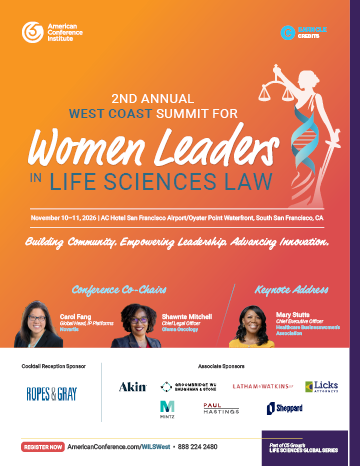
Flip through our conference brochure and discover what’s new this year.
Download Brochure
Day 1 — Main Conference
November 10, 2026
Registration and Breakfast

Carol FangGlobal Head, IP PlatformsNovartis

Junie LimGeneral Counsel (US)Novo Holdings US, Inc.

Shawnte MitchellChief Legal OfficerOlema Oncology
To kick-off the 2nd annual West Coast Women Leaders in Life Sciences Law, the co-chairs will set the tone for the following two days by speaking to the event theme: Building Community. Empowering Leadership. Advancing Innovation.

Networking and Refreshment Break

Jenny AlonsoGeneral Counsel & Chief Compliance OfficerNeurelis

Asina C. GantVice President, Corporate Affairs, Commercial and ComplianceAnnexon Biosciences

Sandra ParkSenior Vice President Legal & Chief Compliance OfficerVera Therapeutics
The FDA is entering a new phase defined by faster approval pathways, greater regulatory flexibility, and heightened scrutiny. For biopharma legal and compliance leaders, this shift is creating both opportunity and complexity as expectations evolve across clinical development, approvals, and post-market oversight.
This session will examine the implications of a more dynamic and less predictable regulatory environment, where policy direction, political influence, and scientific innovation are increasingly intertwined.
Key Discussion Areas:
- Analysis of the most impactful FDA policy shifts in 2026
- Where is the FDA increasing scrutiny – practical insight into emerging regulatory risks and enforcement trends
- Guidance on integrating regulatory considerations into deal-making and strategy
- Tools to navigate increased uncertainty in the FDA environment
Understanding How MFN Drug Pricing Has Changed the Art of the Deal: Assessing Legal Risk, Contractual Pressures, and Deal Structuring in the New Era of Biopharma Drug Pricing

Margaux HallPartnerGibson, Dunn & Crutcher LLP
MFN pricing – acting as both industry catalyst and iconoclast – is now making drug pricing policy a central driver of legal risk and deal structuring across biopharma.
With the intensity of MFN pricing discussions and continued impact from the Inflation Reduction Act, pricing pressure is increasingly embedded in licensing, collaboration agreements, and M&A valuation. In-house counsel are now managing pricing and policy risk directly within transaction terms, reshaping royalties, milestones, and valuation frameworks well before commercialization.
This session will examine how legal teams are adapting to this evolving landscape, including the use of change-in-law provisions, royalty rebalancing mechanisms, and valuation adjustments in response to pricing uncertainty, tariffs, and broader healthcare policy shifts.
Key discussion areas:
- Impact of MFN and pricing reforms on licensing and collaboration agreements
- Allocation of pricing and reimbursement risk in deal structures
- Adjustments to royalties, milestones, and valuation terms under policy uncertainty
- Use of change-in-law and risk rebalancing provisions in contracts
- Intersection of tariffs, trade policy, and pharmaceutical supply chain risk
- Implications for biotech exits and transaction certainty
Networking Lunch – with optional seating by company type, job function

Shanu BajajPartnerDavis Polk & Wardwell LLP

Terry-Ann M. BurrellVice Chairman, Investment BankingJ.P. Morgan

Reena DesaiChief Legal Officer & Corporate SecretaryMBrace Therapeutics
With venture capital tightening and funding pathways becoming more uncertain, biotech companies – particularly pre-commercial players – are rethinking how innovation is financed and advanced. Rising clinical development costs, a challenging IPO environment, and heightened investor expectations are driving new business models, while large pharma increasingly shapes the ecosystem through strategic partnerships, option-based collaborations, venture investments and asset acquisitions.
This session explores how biotech companies are adapting through creative financing strategies, capital-efficient operating models, and collaborative approaches to advancing innovation in a highly selective investment environment.
Key Discussion Areas:
- Examining how the pullback in venture capital has reshaped biotech growth strategies and financing timelines
- Identify where capital is flowing – including AI-enabled drug discovery, precision medicine, obesity and metabolic disease, immunology, cell and gene therapy – and where opportunities may be overlooked
- Strategies to position assets for partnership, investment or acquisition
- Innovative financing structures and evolving operating models

Brenda CrabtreeSenior Director, Commercial Legal & Compliance Kura Oncology, Inc.

Sara McLeanPartner Akin Gump Strauss Hauer & Feld LLP

Julie Ritchie WagnerSenior Assistant General Counsel, Head of Global Ethics, Compliance & Enforcement Legal PolicyPhRMA
The volume of False Claims Act (FCA) whistleblower filings is on pace for a third-consecutive record-setting year, and the Department of Justice has signaled its intention to use the FCA as a key component of its health care enforcement efforts. This panel will examine how DOJ and HHS are collaborating through the reinvigorated DOJ–HHS False Claims Act Working Group, including its stated focus on drug pricing and kickbacks, and what companies can expect. The panel will address emerging risk areas involving customs compliance and country of origin requirements as DOJ expands its interagency partnerships through its Trade Fraud Task Force and enforcement around DEI programs, which has targeted the pharmaceutical industry. The panel will provide an overview of noteworthy FCA matters affecting the life sciences sector and discuss how recent organizational changes within DOJ may affect enforcement activity in the future.
10-minute break to allow for movement to breakout sessions
Concurrent Breakout Sessions
BREAKOUT A
Managing Instability in a Changing Funding Environment: The Rise of Creative Partnerships

Maryam Abdul-KareemChief Legal Officer and Board SecretaryArcellx

Kate HillierPartner Latham & Watkins
With government grants becoming less predictable, venture capital remaining selective, and IPO markets still constrained, many companies are being forced to find alternative ways to advance their technology or assets without relying solely on traditional financing.
Partnership structures that allow for the advancement of assets through shared resources – “sweat equity” – rather than cash investments are on the rise. While these arrangements can be highly effective, they create significant legal complexity. This session will share first hand insights and examples of creative partnerships and the legal considerations for long-term success.
Key Discussion Areas:
- Essential contractual provisions for resilience when funding conditions change
- Ways in which university technology transfer offices adapting to funding uncertainty
- Exploring innovative licensing and co-development models gaining traction
- Protecting IP while collaborating with potential competitors
- The role of legal departments in helping companies advance assets while conserving capital

Elin HartrumVice President, Intellectual PropertyVir Biotechnology

Juliana NevesPartner Licks Attorneys

Lorna L. TannerPartner, Member, Executive Committee and Co-Leader, Life Sciences Industry TeamSheppard Mullin Richter & Hampton LLP

Jennifer Rea DeneaultPartner Groombridge, Wu, Baughman & Stone LLP
This discussion will provide a clear, accessible look at the forces reshaping life sciences IP – and what they mean for the future of innovation and commercialization.

Megan R. BacaPartnerRopes & Gray LLP

Barbara McClungChief Legal Officer & Corporate SecretaryCaribou Biosciences

Jeyshree RamachandranSenior Counsel, Corporate and Business and DevelopmentSumitomo Pharma America, Inc.

Jenny RobertsonFormer Chief Legal Officer Lexeo Therapeutics
As strategic partnerships become a cornerstone of life sciences innovation, legal teams are instrumental in establishing the structures and processes that enable partnerships succeed over the long term.
This session explores practical approaches to alliance management throughout the partnership lifecycle – from designing governance structures, managing IP and data rights, dispute prevention and resolution, and shifting strategic priorities.
Key Discussion Areas:
- Designing governance frameworks that promote accountability and collaboration
- Managing IP ownership, data rights, and decision-making throughout the alliance
- Addressing deadlocks, disputes, and changing business objectives before they derail partnerships
- Supporting alliance success amid funding pressures, restructuring, and organizational change
- Evolving from transaction lawyer to strategic advisor and relationship steward
Networking and Refreshment Break

Vanina de VerneuilExecutive Vice President, General Counsel and Corporate SecretaryVir Biotechnology

Ashley N. Mays-WilliamsPartnerPaul Hastings LLP
AI is not just a technology shift – it’s a leadership shift. As AI becomes embedded in decision-making and operations, the leaders who stand out will be those who think critically, communicate clearly, and navigate complexity with confidence. For women in life sciences, this presents a strong opportunity, as many existing leadership strengths – collaboration, systems thinking, and empathy – align closely with working effectively alongside AI.
This session focuses on using AI as a thinking partner to enhance insight, decision-making, and overall leadership impact.
Key discussions areas:
- AI adoption as a leadership differentiator, not just a technical one
- Critical skills: questioning, synthesis, communication, and adaptability
- Shifting from using AI as a tool to a strategic thinking partner and examples of use cases
- Practical ways to enhance decisions, insights, and team leadership with AI
- Best practices to drive enthusiasm and adoption
Leading through Times of Uncertainty: The Evolving Leadership Paradigm and what is Expected Today in an Unpredictable Macro Environment

Laurie HillGeneral Counsel, Chief Compliance Officer, Corporate SecretaryAltos Labs, Inc.

Celia EckertSenior Vice President, General Counsel & Corporate SecretaryXencor

Melanie GrossAssociate General Counsel and Practice Group LeaderGenentech
In today’s volatile environment – marked by geopolitical shifts, evolving regulations, economic unpredictability and the omnipresence of AI – the role of legal counsel has expanded beyond risk management, and adversity has become the true test of leadership.
It is in these moments that resilient leaders rise, motivating their teams to stay focused, adapt, and push forward. In this fireside chat, two life sciences legal leaders will share powerful lessons in resilience and how they lead with confidence, clarity and influence.
Networking Reception Sponsored by

Day 2 — Main Conference
November 11, 2026
Breakfast and Community Service Activity
Join peers and industry leaders for interactive discussions designed to dive deeper into the most important themes raised during the conference program. These facilitated roundtables provide an opportunity to share key takeaways, exchange perspectives, and explore how insights can translate into future action.

Peggy-Jean (PJ) HarariPartnerMajor Lindsey & Africa

Tam T. T. PhamManaging Director, In-House Recruiting Major Lindsey & Africa
Advancing toward executive leadership in the life sciences industry requires strategic career decisions, enterprise thinking, and the ability to influence beyond the legal function.
In this session, life sciences legal recruiters will discuss how legal professionals can intentionally position themselves for senior leadership roles in an increasingly complex industry.
Key discussion areas:
- Legal talent trends within California and nationwide – identifying the skills currently in demand
- Proactive career development strategies for accessing executive leadership opportunities in an industry being reshaped by AI, geopolitical shifts and pricing pressure
- Navigating career transitions – knowing when to make a change and tips for job searching in a competitive market

Networking and Refreshment Break
Practical Approaches for Effective AI Governance: Balancing Innovation, with Accountability and Business Continuity

Krista CosnerVice President, Legal Structure Therapeutics

Ruchika KumarGeneral Counsel and Head of PeopleN-Power Medicine Inc.

Veronica AscarrunzPartner Sheppard Mullin Richter & Hampton LLP
As AI adoption accelerates, governance is evolving from a control function to a strategic enabler of responsible innovation. This session examines how life sciences companies are implementing governance frameworks that facilitate efficient use of AI, align with regulatory expectations, and maintain enterprise accountability without impeding progress.
Key Discussion Areas:
- Embedding governance structures that promote adoption while managing enterprise risk
- Defining oversight models that are proportionate to risk and use case
- Governing third-party AI within an integrated accountability framework
- Addressing privacy, security, and data integrity considerations in the context of rapidly advancing AI capabilities
- Considerations for CLOs advising board members on AI governance
As tariff uncertainty, geopolitical tensions, and evolving trade policies continue to reshape the global business environment, legal leaders are increasingly being called upon to evaluate supply chain risk, strengthen contractual protections, and ensure operational continuity. This session will examine how life sciences organizations can proactively navigate trade disruption while maintaining compliance, protecting commercial interests, and preserving access to critical products and materials.
Key discussion areas include:
- Assessing the impact of current tariffs on life sciences company supply chains and key considerations for compliance.
- Strategies for supply chain diversification to reduce dependency on high-risk markets.
- How companies are renegotiating trade agreements and leveraging alternative sourcing solutions.
Networking Lunch

YuMing DammannSenior Associate General CounselKite, a Gilead company

Teresa JurgensenExecutive Vice President, General Counsel Parabilis Medicines

Jessica OienChief Legal OfficerBoundless Bio

Tali TuchinMemberMintz, Levin, Cohn, Ferris, Glovsky and Popeo, P.C
China’s emergence as a biopharma powerhouse is reshaping global competition and collaboration, while introducing significant geopolitical and regulatory complexity. Legal and compliance leaders play a critical role in managing cross-border risks spanning IP, data governance, and regulatory alignment.
This session will explore the key considerations for companies engaging with Chinese biotech partners, including IP protection, cross-border data and technology transfer restrictions, foreign investment reviews, national security concerns and evolving trade policies.
Key discussion areas:
- Strategies for structuring cross-border partnerships and licensing with Chinese biotechs
- Addressing the latest developments in IP protection, enforcement, and technology transfer risks
- Navigating data localization, privacy, and cross-border data transfer requirements
- Legal considerations in “China-for-China” vs. global models
- The influence of geopolitical tensions on regulatory scrutiny, investment, and collaboration
Networking and Refreshment Break

Aisha Ghazi BabarGeneral Counsel, Chief Compliance Officer & Corporate SecretaryPierre Fabre Pharmaceuticals USA

Galya BlachmanChief Legal Officer and Head of Business Development Enliven Therapeutics

Caryn McDowellFormer Chief Legal Officer & Corporate SecretaryTerns Pharmaceuticals

Jane Wright-MitchellChief Legal OfficerVera Therapeutics

Neela PaykelGeneral Counsel & PrincipalLaw Offices of Neela Paykel, PC
The most effective CLOs do more than identify legal risk – they anticipate and prepare for pivotal inflection points across the life sciences landscape. Whether guiding a company through a high stakes data readout, M&A transaction, licensing deal, CEO transition, or other critical board matter, the CLO’s value increasingly lies in helping leadership teams recognize what lies ahead and drive outcomes that enhance value and avoid downside risk.
This panel of seasoned CLO’s will share insights and lessons learned in building trust and influence to provide value far beyond the legal department.
Key discussion areas include:
- Repositioning the role of the legal counsel – moving from a traditional legal advisor to a trusted strategic partner helping shape business direction.
- Strengthening alignment and communication with business leaders – building trust to ensure legal priorities are embedded in strategic planning.
- Balancing business leadership with fiduciary responsibility – partnering with management and boards to drive growth while exercising the independent judgment required of the CLO role.
- How to shift the question “Is that your legal opinion?” out of the management team meetings and join the discussion as a business leader.