Agenda
CBP: CBP Accreditation | PM: Practice Management
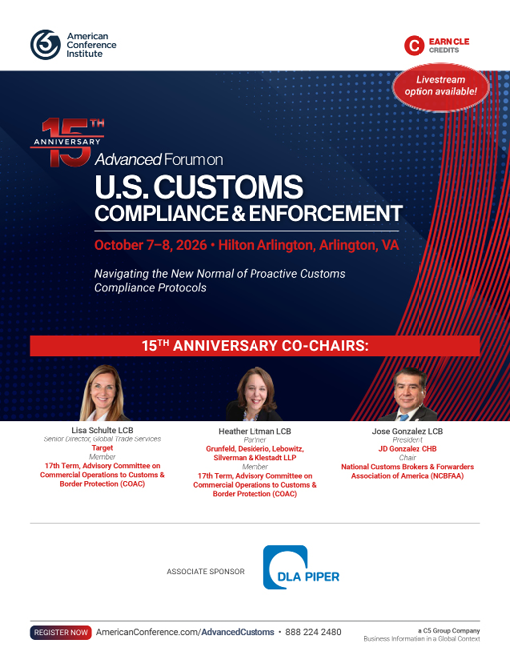
Flip through our conference brochure and discover what’s new this year.
Download Brochure
Pre-Conference Workshops
October 6, 2026
Day 1 – Main Conference
October 7, 2026
Registration and Continental Breakfast

Heather Litman LCBPartnerGrunfeld, Desiderio, Lebowitz, Silverman & Klestadt LLP
Member
17th Term, Advisory Committee on Commercial Operations to Customs & Border Protection (COAC)

Lisa Schulte LCBSenior Director, Global Trade ServicesTarget
Member
17th Term, Advisory Committee on Commercial Operations to Customs & Border Protection (COAC)


Proactive Industry Perspectives: Navigating Refunds, Section 232/301 Tariffs and the Impacts of Increased CBP Enforcement Risks

Cindy Allen LCBCEOTrade Force MultiplierFormer Member, Commercial Operations to Customs & Border Protection (COAC)

Cindy OwensSenior Corporate Counsel, International Trade and Customs ComplianceU. S. Steel

Michael S. SnarrPartnerBaker& Hostetler LLP

Brian White LCBSenior Director - Global Customs & Trade ComplianceIntelFormer Member, Commercial Operations to Customs & Border Protection (COAC)
Heather Litman LCBPartnerGrunfeld, Desiderio, Lebowitz, Silverman & Klestadt LLP
Member
17th Term, Advisory Committee on Commercial Operations to Customs & Border Protection (COAC)
- Examining refunds: Protests, supplier/consumer litigation risks, CIT filing considerations and best practices around navigating the CAPE process
- Submission-to-acceptance timeline trends
- Data formatting and normalization issues
- Tightening internal coordination between compliance, brokers, and finance so that classifications, quantities, values, and supporting docs line up cleanly
- The potential downstream effects of tariffs: Transfer pricing implications and possible refunds to customers, suppliers and quantifying this refund risk
- Implementing Section 232 and Section 301 tariffs horizon planning: Potential new duties on products and forced labor restrictions
- 301 forced labor investigations: Does this signal a new and expanded forced labor regime reaching new industries and trading partners?
- Current dynamics of 301 China tariffs and retaliatory efforts
- 232 investigations into steel, semiconductors, critical minerals, pharmaceuticals, and beyond
- Sector-specific impact analyses: How are industries coping?
- 232 tariff stacking
- Impacts of these investigations on existing trade agreements
- Determining the future of the USMCA and other trade agreements and preference programs under an evolving tariff regime
- Responding to Cross-Agency DOJ/CBP enforcement:
- CBP CF 28/CF 29 questionnaires: How and when CBP issues CF 28s and CF 29s versus a notice of investigation or enforcement action
- Mitigating False Claims Act and AD/CVD violation risk
- Undervaluation, misclassification responses
- Properly prepared prior disclosures
Networking Break

Reexamining How Country of Origin, Classification and Valuation Tactics are Now Being Done Amid the Knowns and Unknowns of Tariff Changes

Ryan BennettDirector, Global Trade Compliance/CustomsFluke Corp.

James FerrySenior Trade Compliance ManagerCanadian Solar

Arim AJ KimAssociateK&L Gates
Customs authorities in the U.S. and globally are intensifying their scrutiny. Origin, classification and valuation are no longer mere technicalities; they carry significant risk and the burden of proof lies squarely with the importer. Examine how proactive organizations are retooling these crucial import compliance exercises to meet a more proactive compliance protocol environment.
- Classification:
- Written procedures using GRIs, ENs, rulings, HTS updates
- Verification process when a classification changes
- Database: Who classified and reviewed, and when
- Valuation:
- Method(s) used and justification
- Additions: Assists, royalties, and more
- Customs transfer pricing study, not a tax study
- Reconciliation, computed value, consignment
- Country of Origin:
- Procedures beyond the supplier’s invoice
- How you verify: Do you audit?
- Recent COO shifts (esp. from China) and FTAs
- USMCA: 301 may apply despite rule of origin
Networking Lunch
Section 232 INVESTIGATIONS & COMPLIANCE | CBP
Preparing for Investigations and Restrictions: Cross Sector Focus on Critical Minerals, Pharmaceuticals, AI, and Semiconductors

Erika Faulkenberry LCBGlobal Head, Trade ComplianceBiogen

Sandra Horan LCB MCSDirector, Trade ComplianceFluor

David NieminenDirector of Sourcing and Supply ChainInmotion US | ZAPI GROUP

Lars-Erik A. HelmPartnerAkin Gump Strauss Hauer & Feld LLP
Part One: Focus on Metals and Critical Minerals: Section 232 tariffs on aluminum, steel, and copper
- Manufacturing drawback conditions under 19 U.S.C. 1313
- Annex classifications
- Zero duty provisions
- Reviewing whether any preferential UK or US-origin metal treatment may be available
-
USMCA preferential tariff treatment
- Procedures for submission and review of documentation substantiating U.S. production capacity
-
Critical minerals: Potential future duties and restrictions on imports of processed critical minerals and their derivatives (PCMDPs)
- Mapping exposure to PCMDPs
- Evaluating alternative or “friend-shored” processing options in case Commerce moves to price floors or tariffs
Part Two: Focus on Emerging Technology
-
Semiconductors and advanced AI commodities: Potential immediate cost and compliance exposure through a 25% tariff on designated “Covered Products” and their derivatives
- Qualifying for exemptions for “non-data-center consumer applications” and “non-data-center civil industrial applications”
- Energy: Polysilicon 232 investigation emergence
Part Three: Focus on Pharma
-
Section 232 tariffs on pharmaceuticals and pharmaceutical ingredients: Assessing exposure, managing compliance risk, and planning for operational disruption
- Key compliance and reporting considerations
- Covered and excluded products
- Navigating a tiered tariff framework with multiple rates depending on the country of origin, the importing company’s status, and the nature of the product
- Onshoring/qualifying for MFN pharmaceutical pricing agreements
Part Four: Focus on Supply Chain
- SME outlook: Practical impacts from having to maneuver supply chains and sourcing and how these unpredictable input costs have clouded any landed price comparisons
- Navigating 232 tariff stacking
- Evaluating drawback opportunities for qualifying products and trade partner sourcing structures
- Document everything: Keep meticulous documentation/proof of supplier values, origin codes, manufacturing documentation, and entry-summary line logic
- Shifting just enough manufacturing operations to other countries so origin is conferred there: Determining if new origin meets substantial transformation rules
- Review shipments from high-risk jurisdictions, especially for goods requiring FTZ treatment

Todd R. SmithFounder CEOKYG Trade, Inc.
Trade compliance teams spend countless hours gathering data, investigating discrepancies, responding to regulatory changes, and preparing for audits. Yet most compliance programs still rely on periodic reviews that identify issues only after they have occurred.
Advances in AI and automation are creating a new approach: continuous compliance. Rather than reviewing a small sample of transactions after the fact, organizations can continuously monitor classifications, duty impacts, forced labor risks, free trade agreement claims, product data changes, and other compliance activities in near real time.
This session will explore how leading organizations are using AI to identify risks earlier, automate routine reviews, improve audit readiness, and focus human expertise where it matters most. Attendees will learn practical strategies for implementing continuous compliance programs that increase visibility and control while maintaining appropriate governance and human oversight.
Key Takeaways
- How continuous compliance differs from traditional audit and review models
- Where AI can automate monitoring and exception detection
- How to focus human expertise on high-risk decisions and investigations
- Best practices for creating an auditable, defensible compliance program
- Steps organizations can take today to move from reactive compliance to proactive risk management
Audience Takeaway: Stop looking for compliance problems after the fact. Use AI to find them before they become violations.
In partnership with:

Networking Break
Mitigating Increased Penalty Risks Amid Intensifying False Claims, Tariff Evasion and Duty Enforcement Environment

Matthew W. CaligurPartnerBaker& Hostetler LLP

Karla M. CurePartnerK&L Gates

Elyssa KutnerPartnerDLA Piper LLP

Janet LabudaHead of Customs and Trade IssuesMaersk Customs Services Inc.
DOJ’s new Trade Fraud Task Force is intensifying civil and criminal enforcement, including tariff evasion, False Claims Act violations and duty enforcement. During this session, gain critically important updates on new, high stakes risks that will inform your compliance decision-making.
- The new DOJ Trade Fraud Task Force: Priorities and expectations
- Enforcement related to the accuracy of products labeled “Made in America” or “Made in the USA”
- Navigating expanded use of AI powered supply chain mapping by CBP to identify transshipment, undervaluation, and other anomalies, resulting in more CF 28s, CF 29s, audits, focused assessments, and civil penalties
- Increased False Claims Act qui tam complaints focused on duty evasion, giving whistleblowers a direct financial stake in (and incentive to bring) customs law-focused cases
- Parallel civil penalty actions and, in some cases, criminal charges against companies and individual executives for evasion of antidumping, countervailing, and special tariffs
- Establishing a cross functional response plan for CBP inquiries, subpoenas, and whistleblower allegations
Delegates are invited to join interactive breakout roundtables, to work through the unique, heightened compliance pain points affecting their specific industries.
- Topic #1: Refund Approach Best-Practices
- Topic #2: Strengthening and Right Sizing Your Compliance Program
- Topic #3: Supply Chain Disruption Mitigation
- Topic #4: Use of AI in Customs Compliance
Networking Cocktail Reception
Day 2 – Main Conference
October 8, 2026
Registration and Continental Breakfast
Heather Litman LCBPartnerGrunfeld, Desiderio, Lebowitz, Silverman & Klestadt LLP
Member
17th Term, Advisory Committee on Commercial Operations to Customs & Border Protection (COAC)
Lisa Schulte LCBSenior Director, Global Trade ServicesTarget
Member
17th Term, Advisory Committee on Commercial Operations to Customs & Border Protection (COAC)
CBP
Section 301 Investigations on Manufacturing Overcapacity: Potential for Trade/Tariff Exposure, Supply Chain Disruption and Enforcement Outlook

Kathy Neal LCBGlobal Trade Compliance DirectorJohnson ControlsFormer Member, Commercial Operations to Customs & Border Protection (COAC)

Ned SteinerManaging Director, International Trade and Governmental RelationsSandler, Travis & Rosenberg, P.A.
The renewed use of Section 301 investigations is expected to result in country-specific tariffs and exemptions that are close, if not identical to, the IEEPA tariffs previously deemed unlawful. For businesses, the takeaway is clear: Higher tariffs are likely. What are the possible outcomes and sector-specific impacts of these investigations? How has industry influenced policymakers amid the Section 301 comment-and-hearing process? What are the key risks for businesses to watch out for?
- Assessing supply chain exposure: Identifying exposure across products, inputs, and business lines, including evaluating direct imports from affected jurisdictions
- Exposing tariff risk: Preparing for ongoing uncertainty around pricing strategies, margin management, and contractual performance
- Evaluating contractual protections: Existing contractual arrangements should be reviewed to determine how tariff risk and cost increases are allocated
- Identifying indirect and downstream potential impacts: Cost increases driven by upstream component pricing, competitive pressures resulting from trade diversion, or shifts in customer demand due to changing market conditions
- Examining enforcement: Heightened scrutiny of classification, valuation, and country-of-origin determinations, particularly in sectors identified as vulnerable to circumvention
Networking Break
Industry Association Think Tank
The Role of Associations in Unprecedented Customs Reform and How they Champion for Your Sector

Ed BrzytwaVice President, International TradeConsumer Technology Association (CTA)

Anne Ruhle CollettSenior Director, International PolicyNational Association of Manufacturers (NAM)

Melissa Irmen AZS CZSDirector of Advocacy & Strategic SolutionsNational Association pf Foreign-Trade Zones (NAFTZ)

Sarah B. W. KerwinPartnerAkin Gump Strauss Hauer & Feld LLP

Dr. Eugene Laney Jr.President and CEOAmerican Association of Exporters and Importers (AAEI)
Regulatory transparency amid today’s customs compliance reforms has become unclear and sometimes contradictory. Discover how companies are working through their industry associations to voice opinion on the impacts of evolving tariff reforms. Where does industry trade group collective action stand in the face of a lack of government communication with industry?
CASE STUDY | CBP
Strengthening Audit Readiness: How Audit Automation is Transforming Import Compliance by Turning Passive, into Continuous, Risk‑Based Monitoring

Jen O’BrianDirector, Global TradeXylem

Fiona SimpkinsAssociate Director, Global Trade Standards & Controls/Ethics & Compliance OfficeMerck & Co.
- Using AI and ERP data to flag origin changes, tariff exposure, FTA eligibility issues
- AI for:
- Classification, and origin: Supporting DOJ and CBP expectations with defensible, documented controls instead of “we trusted the supplier”
- Summarizing CBP rulings
- Exacting data from commercial invoices
- Cleaning and standardizing messy import spreadsheets
- CBP Ruling H350722: Is your AI provider licensed to conduct “customs business”?
- Ensuring that AI-enhanced tax enforcement complies with fundamental legal principles

Networking Luncheon
Section 301 INVESTIGATIONS & COMPLIANCE | CBP
Section 301 Forced Labor Investigations: UFLPA Overlap and What Companies Should Do Now

John BrewPartnerCrowell & Moring LLP

Ania Wierzbowska-Fuller LCBDirector, Regulatory AffairsA.N. Deringer
The Section 301 forced labor investigations elevate forced labor from a compliance issue to a trade policy risk. Companies may face simultaneous exposure under the Uyghur Forced Labor Prevention Act (“UFLPA”), U.S. Customs and Border Protection (“CBP”) actions, and new Section 301 tariffs, all tied to the same supply chains.
Speakers will examine:
- Mapping trade flows and Section 301 exposure: Identify where key products are manufactured, processed, or assembled and how those flows connect to the 60 countries under investigation
- Strengthening forced labor due diligence and documentation: Ensure documented, risk-based procedures to detect and address forced-labor risks across Tier 1, Tier 2, and deeper tiers of the supply chain
- Forced labor provisions embedded in bilateral trade arrangements with partners like Malaysia and Cambodia
- Coordinating with global forced-labor regimes. Align their U.S. strategy with other emerging frameworks, including the EU Forced Labor Regulation, national due diligence laws, and modern slavery reporting regimes
- Preparing investigations and escalation protocols. Companies should establish clear internal escalation pathways for forced-labor red flags, including when and how to trigger a privileged internal review
- A review of the Department of Labor’s forced labor due diligence tools to help map supply chain risks

Jenette Prince LCB CCSVice President, Trade Control – Import & ExportKuehne+Nagel

Kathleen WallenderGeneral Counsel, Supply Chain and TradeResideo
Geopolitical volatility continues to disrupt global supply chains. How are multinational companies re-routing goods, identifying sourcing vulnerabilities and reviewing contractual terms to keep supply chains moving, particularly for advanced technology and raw materials?
- How industry is approaching supply chain diversification for access to advanced technology and raw materials amid increasing geopolitical volatility
- Re-aligning the US/China trade connection: The global impacts of this tense bilateral relationship
- Downstream supply chain impacts from the Iran war
- Demand planning: Managing cost pressures for raw materials supply and finished goods as tariffs continue to change
- Leveraging AI, automation and other technologies as an essential missing piece of the puzzle for competitive supply chains
- Reviewing the contract: Understanding the scope of force majeure clauses, and holding other party to existing pricing terms
- Conducting an audit for sourcing vulnerabilities
Networking Break
Future Proofing Your Import Transaction and Customs Compliance Action Plan: Charting Your Next Steps for Weathering Unpredictability and Crisis Management

J. Eric LangleySenior Manager, Global Trade OperationsAnduril Industries

Lucas A. PiresSenior Legal Counsel, Trade ComplianceMedline Industries, LP

Lian YangPartnerAlston Bird LLP
- Tailoring your customs compliance program to your company’s risk profile – Key factors to consider
- Company size and trade volume
- Product and supply chain complexity
- Use of duty mitigation and special trade programs
- Strategic use of duty savings programs
- Evaluating Free Trade Agreement (FTA) eligibility and usage
- Building an effective tariff mitigation plan
- Valuation transfer pricing approach
- Regular reviews of your classification and valuation practices, highlighting areas where you’re overpaying on import duties and identifying potential refund availabilities
- Tax approach versus customs compliance approach
- Building internal engagement and support
- Raising awareness of your customs compliance program across departments
- Collaborating with key internal stakeholders: Finance, Tax, Legal, and Operations
- Enhancing compliance infrastructure
- Upgrading internal controls to match your company’s risk appetite
- Developing effective written procedures that are both practical and enforceable
- Reviewing sample procedures as real-world examples and discussion points
CBP
Guiding Corporate Stakeholders Through the Ups and Downs of Rapid Tariff and Policy Changes, and Crisis Management

Peter MartinAssociate General Counsel, TradeCoherent

Ted MurphyPartnerSidley Austin LLP

Pleres ChoiProgram Manager, Global Trade ComplianceAnduril Industries
- Understanding which internal stakeholders to engage
- Guiding C-Suite through the ups and downs: The finer points of presenting to C-Suite and the board
- Revisiting tariff related risk factors each quarter, to ensure they reflect current conditions rather than legacy hypotheticals
- Recuring senior management buy-in for increased compliance resources
- Where does General Counsel fit into the compliance picture
- When to retain outside counsel
- How rapid changes in tariffs and compliance can present opportunities for growth and innovation