Agenda
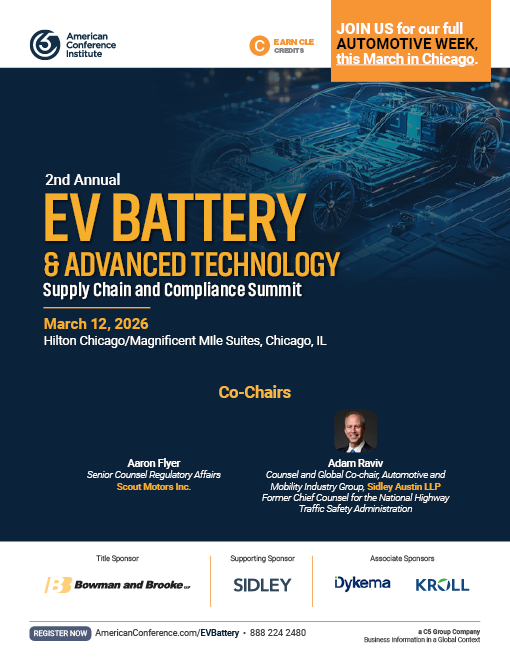
Flip through our conference brochure and discover what’s new this year.
Download Brochure
Day 1 — Main Conference
March 12, 2026
Breakfast and Registration

Evan BelserDeputy General Counsel, Litigation and RegulatoryFord Motor Company

Aaron FlyerSenior Counsel, Regulatory AffairsScout Motors Inc.

Adam RavivCounsel and Global Co-chair, Automotive and Mobility Industry GroupSidley Austin LLPFormer Chief Counsel for the National Highway Traffic Safety Administration
Regulatory Roadmap: Assessing the Current Regulatory Landscape for EV Batteries and ADAS and ADS Systems

Laurie HolmesDirector, Government and Regulatory AffairsHyundai Motor Group
Adam RavivCounsel and Global Co-chair, Automotive and Mobility Industry GroupSidley Austin LLPFormer Chief Counsel for the National Highway Traffic Safety Administration

Amandine SchneickertPrinciplePivot Point Strategies
The United States has long been a proponent for electric vehicles, with tax credits and fleet mandates encouraging manufacturing and consumer purchasing alike. The current administration, however, has reversed course on EV mandates, causing questions and concerns for traditional OEMs and innovators whose processes are well underway. As the disparity between US and international regulations widen, the automotive industry finds itself at a crossroads.
Furthermore, as automated driving systems become standard vehicle tech, the development pipeline threatens to outpace regulations, but legislation wont slow down. Keeping abreast of litigation trends, lobbying efforts, and technological advancement will become fundamental to automotive success.
This session will break down the current regulatory landscape to set you on a winning path. Topics of discussion include:
- Changes to the Infrastructure Investment and Jobs Act and Inflation Reduction Act under H.R.1
- NHTSA guidance
- Electric and Hybrid-Electric Vehicles
- ADAS systems
- Understanding how the revocation of federal tax credits will impact the EV industry and consumer market
- Breaking down EPA’s Endangerment Finding, recission of GHG tailpipe standards, and expected market response
- Examining the state-by-state regulatory patchwork in the US
- Addressing the growing disparity between domestic and international greenhouse gas regulations and its impact on the industry
- Analyzing the Canadian response to the current US deregulatory agenda
- Anticipating the impact of tariffs on the future of EV batteries and ADAS systems
Morning Coffee Break

Nima H. MohebbiPartnerSidley Austin LLP

Christopher NeversSenior Director, Public PolicyRivian

Michael MatenDirector, EV Policy and Regulatory AffairsGeneral Motors
For decades, California has led the way in emissions regulations and EV mandates, with the strictest standards in the nation. As of now, eighteen states and the District of Columbia have adopted California’s light- and heavy-duty vehicle regulations under Section 177 of the Clean Air Act (42 U.S.C. §7507). Over the past year, however, federal efforts have eliminated California’s authority to implement and enforce the state’s toughest requirements.
This session will break down how California is paving the way for EV and ADAS safety regulation, and what the Federal focus means for the future of the industry. Topics of discussion include:
- Analyzing the status and impact of California’s light- and heavy-duty vehicle regulations under Section 177 of the Clean Air Act (42 U.S.C. §7507), and California’s response to the revocation of its 177 waiver
- Addressing the federal revocation of California’s EPA waiver under the Congressional Review Act
- Reviewing California’s possible legal pathways to continued vehicle regulation, including the status of current and future agreements between industry and CARB
- Surveying actions undertaken by Governor Newsom and the California Air and Resources Board to maintain encouragement of EV manufacturing and purchasing
Lunch

Erica EversmanPresidentAutomotive Education & Policy Institute

Nicholas D. PrudenzanoSenior CounselBowman and Brooke LLP
Self-driving cars have long been seen as an image of the future, more expected at Tomorrowland than on neighborhood streets. As automated technologies and ADAS systems have brought these dreams into reality, new challenges and expectations arise. We trust our automated systems to take the wheel and remain infallible, however overreliance on auto-pilot can result in questions as to liability, fault, human contribution, and what we demand from the cars of the future.
Topics of discussion include:
- Reviewing human factors research on automation complacency
- Discussing how plaintiff attorneys argue ADAS encourages distraction
- Understanding how defense attorneys argue that ADAS systems mitigate damages
- Considering whether “overreliance” will become its own negligence theory

Nicholas G. EvenPartnerBowman and Brooke LLP

Hyongsoon KimPartnerMorrison & Foerster LLP

Sergio MendozaMaterials Science and Electrochemistry Senior ManagerExponent

Connor B. WalbyMember/PartnerDykema Gossett PLLC
With rapid innovation and scientific discovery comes the potential for new lanes of liability. Battery fires, for instance, must be handled differently in an EV as compared to a traditional gas vehicle. With third party suppliers and manufacturers in the mix, it’s critical to be aware of the potential safety hazards that can come from EV batteries, and stay ahead of potential liability suits, complaints, and class actions. Topics of discussion include:
- Documenting cell-to-pack safety evidence to defend design and warnings
- Coordinating recall and OTA remedy strategies that narrow class scope and minimize penalties and retrofit costs
- Allocating liability across suppliers by tightening specs, change-control, and testing obligations
Afternoon Networking Break
Evan BelserDeputy General Counsel, Litigation and RegulatoryFord Motor Company
Aaron FlyerSenior Counsel, Regulatory AffairsScout Motors Inc.

Darren ChapmanDeputy Commercial DirectorUS Strategic Metals
Whether EV demand goes up, goes down, or stays stagnant, new challenges for the development of EV batteries and ADAS systems may introduce hiccups to the supply chain. This session will lay out questions and complications impacting the modern automotive supply chain:
- Determining the realities of planning for inconsistent tariffs
- Identifying options for sourcing materials, from state-side mining efforts to critical mineral importation to software development and data pipelines
- Understanding the “Nexperia chip crisis” and what the disruption in production of semiconductors means for your long-term plan
- Assessing the international regulations and national security concerns you need to take into account when sourcing your supply chain
- Complying with diligence requirements on the BIS-ICTS Connected Vehicle Rule
- Finding solutions to the challenge of battery shipping and storage

Nicholas Faenza, Ph.D.Materials Science and Electrochemistry Principal EngineerExponent

Peter HuetherSenior Research Associate for TransportationAmerican Council for an Energy-Efficient Economy (ACEEE)

Juna LeeLegal CounselLG Energy Solution
When EV batteries expire, who is responsible for the safe disposal or reuse of the materials? With material sourcing facing more and more hurdles, increases in demand for energy storage, and international battery regulations, determining end-of-life procedures will become a fundamental piece of laying out your battery development plan. Topics of this session include:
- Establishing processes and procedures for battery recycling
- Assessing the Infrastructure Investment and Jobs Act requirement for EPA and DOE to develop a national Extended Producer Responsibility framework for batteries
- Looking to the EU battery passport as a roadmap for future regulation
- Anticipating and preparing for safe battery repair and disposal
- Identifying opportunities for materials harvesting, battery serviceability, and secondary storage futures