Agenda
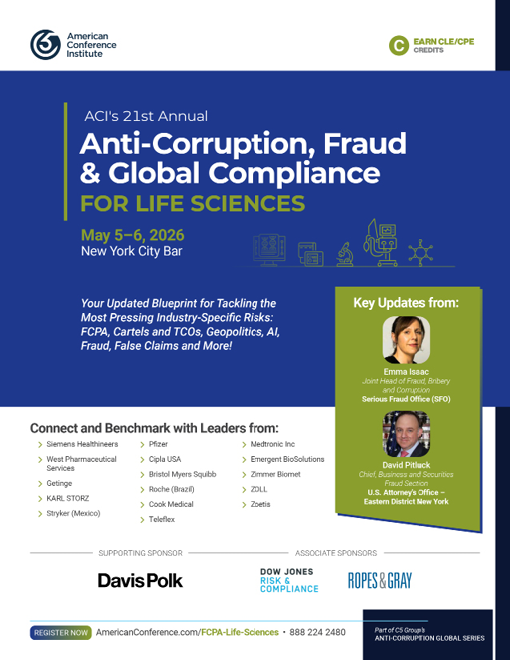
Flip through our conference brochure and discover what’s new this year.
Download Brochure
Day 1 — Main Conference
May 5, 2026
Registration & Continental Breakfast

Navigating Life Sciences Enforcement Realities Under the Microscope: Unpacking New Cartel, TCO, Fraud, False Claims and More High Stakes Risks

Adam FalkowitzHead of Legal, North AmericaGetinge

Becky OrttelVice President Ethics & ComplianceMedtronic Inc

Esther FleschPartnerCescon Barrieu
- The new face of risk ranking: How companies are rethinking priorities for compliance and risk management
- Anti-Kickback: Hotel stays, excessive compensation and more intensifying risk factors
- New Prosecution Theories: The Travel Act, mail/wire fraud, money laundering, and bid-rigging laws in corruption prosecutions
- Navigating the risk of false claims and connected misrepresentations of the value of devices and services
- Balancing strategic, proactive v. reactionary responses: How to calibrate compliance decision-making
- Revisiting third party risk in the wake of new DOJ enforcement priorities
- Making sure clear policies, training, monitoring and escalation pathways exist
Networking Break
The Complex Landscape of Market Access and Operations in China: How Companies are Rethinking Compliance Amid Intensifying Tariff, Trade and Geopolitical Considerations

Eric CarlsonPartnerCovington

Peter HyunFormer Acting Chief for the Enforcement Bureau
Federal Communications Commission

Claudius O. SokenuEVP, Chief Legal and Compliance Officer, and Corporate SecretaryAvantor
Navigating how tariffs and trade policies are reshaping U.S.-China relations with a look at regulatory scrutiny, market access and enforcement risks. Topics will include:
- Examining emerging corruption risks with China’s focus on value-based pricing and the compliance challenges stemming from medical education practices
- Creating priorities with the differing regulatory and enforcement approaches of U.S. and China
- Best practices for upholding ethical business practices and adherence to US and Chinese legal frameworks
- Real world perspectives on managing complex issues from the front lines of the life sciences sector
- Lessons learned from the latest cases involving China and what they reveal about future enforcement trends
CARTELS AND TCOs
Mitigating the Life Sciences-Specific Supply Chain, Distribution and Logistics Risks in the Wake of DOJ’s Latin America Focus: Rethinking Due Diligence, Monitoring and Operations on the Ground
Adam FalkowitzHead of Legal, North AmericaGetinge

Monica GutierrezSenior Compliance Officer - Mexico, Argentina, Chile Stryker (Mexico)

Alex LavSenior Director Risk and ComplianceDow Jones

Renato MartinsLegal & Compliance Director, Latin America Roche (Brazil)
- Navigating how to buy and sell products with heightened due diligence on distributors and the supply chain to avoid possible links and interactions with cartels and TCOs in a high-stakes enforcement environment
- Interfacing between government-owned healthcare interactions (HCPs) in emerging markets and the increasing complexity of clinical trials in volatile regions, a standard compliance playbook is no longer sufficient
- Impact of the Mexican government’s shift from a bid process to working directly with transporters
- Strengthening conflicts of interest and transparency reporting to make sure payments are appropriate
- Honing in on Geopolitical Signals with shifting international relations and trade dynamics act as leading indicators for FCPA enforcement actions
- Precision Oversight when dealing with third-party intermediaries and state-run entities in high-risk jurisdictions including due diligence on logistics and transportation
- Bridging the gap between geopolitical intelligence and traditional anti-bribery/corruption (ABC) programs adding a heightened a focus on patient benefits
Networking Luncheon
The New, Specific False Claims Act Liability Risks in the Life Sciences Context: Revisiting Risk Management and Compliance to Address Potential Exposure

Andrew CliverHead of Compliance- North AmericaSiemens Healthineers

Terri SeguraVP Compliance OfficerZimmer Biomet

Artie McConnellPartnerBakerHostetler
With a heightened DOJ focus on combatting fraud and abuse in the life sciences sector, companies are now operating in a new era of enforcement risk.
During this session, we will discuss how life sciences organizations are proactively reassessing their risk exposure, strengthening compliance policies and procedures, and enhancing internal investigations programs in response.
- How enforcement agencies are using the False Claims Act, Anti-Kickback Statute, and wire fraud laws to target fraudulent misconduct in the life sciences sector
- New, emerging False Claims Act enforcement trends: Insights from recent cases and policy developments
- Practical strategies for life sciences companies to strengthen compliance frameworks and mitigate risk amid a shifting enforcement landscape
FIRESIDE CHAT
Strengthening Your Culture of Compliance in the Current Enforcement and Economic Environments: Future Proofing Compliance Training, Policies and Protocols

Rachel BatykeferVP, CIA and Compliance OperationsMallinckrodt Pharmaceuticals

Keren TenenbaumChief Compliance OfficerZoetis

Brian BurkePrincipalBurke Law & Strategy
In this session, key topics will include:
- Staying the course on effective compliance: Concrete examples of what is and isn’t working
- Exploring the impact of the DOJ’s expanded whistleblower payouts and focus on individual prosecutions
- Cultivating team and cross-functional relationships, strengthening messaging and encouraging internal reporting
- Doing more with less-without compromising the compliance commitment
Networking Break
FIRESIDE CHAT
Self-Disclosure in Practice: New Guidance and Incentives, and the Evolving Disclosure Calculus

Michael PacellaVice President, Chief Ethics & Compliance OfficerDentsply Sirona

Sidney BashagoPartner Davis Polk
- Navigating the benefits, risks and best practices of self-disclosure
- Fine tuning internal reporting and communications ahead of external reporting
- Analyzing policy shifts and enforcement trends to support informed disclosure decisions
- Determining what, why, when and how to disclose considering recent DOJ Guidance
- Analyzing the outcomes of recent disclosures on enforcement outcomes

David LastPartnerCleary Gottlieb Steen & Hamilton LLPFormer Chief, FCPA Unit, Fraud Section, Criminal Division, U.S. Department of Justice

Tim LoperVP, Head of US and Above Market Compliance and EthicsBristol Myers Squibb
In this 60-minute benchmarking exercise, join your peers in a smaller group to discuss industry standards and best practices for regulatory alignment and effectiveness of whistleblower programs. Toward the end of the session, the groups will come back together with each table sharing key takeaways along with additional insights from the speakers.
- Encouraging underrepresented voices through secure reporting mechanisms
- Making sure reports filed across multiple programs work together, not against each other, to get the best outcome
- Sharing what is and is not working and new lessons learned
Networking Cocktail Reception Sponsored by

Day 2 — Main Conference
May 6, 2026
Breakfast
China’s Corruption Crackdown and Guidelines for HCP and Third Party Engagement and Patient Support Programs

Lamia MattaSenior Director ABAC & InvestigationsCook Medical

Chen ZhuPartnerMorrison Foerster
China’s healthcare and life sciences industry is in a new era of policy reform, and global integration. Enforcement is becoming more stringent and robust compliance programs are even more essential. Key focus areas launched by the State Administration for Market Regulation (SAMR) are reshaping how pharmaceutical, biotechnology and medical devices approach key risk and compliance areas, including:
- Mitigating commercial bribery risks in charitable donation and patient assistance programs
- Transparency in healthcare professional (HCP) engagement
- Monitoring engagement with medical associations and foundations
- Best practices for the flow of sensitive data and business operations
Utilizing AI to Strengthen Compliance, Monitoring and Risk Management-From HCP Engagements, Third Party Monitoring to Patient Safety and Privacy

Michael AtkinsonPartnerCrowell & Moring LLP

Traci FosterDirector, Global ComplianceBio-Rad Laboratories

Kershwin SinghHead of Privacy and Compliance, ACT DivisionZOLL
As AI and advanced tech capabilities rapidly advance, life sciences companies are exploring more new ways to leverage analytics, auditing tools and real-time monitoring technologies to better detect and manage compliance risks. During this session, topics of discussion will include:
- Deploying advanced analytics to identify emerging risks and early detection of misconduct
- Utilizing enhanced auditing of high risk activities
- Utilizing digital tools to improve visibility into structured and unstructured data such as chats, expenses and Sunshine reporting
- DOJ guidelines and expectations
- How AI is being deployed to detect fraud
- Ensuring accuracy, compliance, and predictive value of marketing
- Sharing practical examples of incorporating AI in ethics and compliance work streams
Networking Break
Fireside Chat: Unpacking Enforcement in a Life Sciences Context (What the new guidance reflects about the agency’s evolving prosecutorial priorities)

David PitluckChief, Business and Securities Fraud SectionU.S. Attorney’s Office, Eastern District of New York

María González CalvetPartnerRopes & Gray
- The DOJ’s latest expectations for compliance programs, corporate accountability, and ethical leadership
- Key considerations for updating internal investigations protocols and risk assessments in light of the new guidance
- How organizations can align governance, reporting, and remediation strategies with the DOJ’s newly stated objectives
- Navigating grey areas of the guidance which allow for broad prosecutorial discretion
Networking Lunch
CLINICAL TRIALS
Tackling Corruption and Fraud Risks and Compliance Pain Points in Medical Research, Clinical Trials and Healthcare

Christina HudSenior Compliance Counsel, Global InvestigationsPfizerFormer Acting Chief & Senior Trial Counsel, Health Care Fraud Unit U.S. Department of Justice

Leonardo SilvaVP, Chief Compliance & Privacy OfficerFerring Pharmaceuticals

Matt SullivanPartnerHogan Lovells
- New best practices for monitoring and mitigating risks in clinical research and trials conducted in high risk jurisdictions
- Navigating the gray areas surrounding what constitutes “improper influence” over clinical investigators, ethics committee members, trial data integrity, and regulatory approval processes
- Safeguarding against corruption risks unique to clinical trials, including those related to funding flows, patient recruitment, informed-consent procedures, and interactions with third-party research organizations or CROs
FIRESIDE CHAT
Designing a Practical AI and Data Analytics Blueprint Aligned with Your Organization’s Infrastructure, Resources, and Risk Profile

Jolie ApicellaPartnerWiggin

Zheng YangWorldwide Head, AI/ML Strategy and Solutions, Healthcare and Life SciencesAmazon Web Services
- Evaluate your existing data landscape, tools, and maturity to prevent overbuilding or falling short
- Ensure analytics and AI efforts are aligned with compliance objectives, operational workflows, and available resources
- Establish clear ownership of AI initiatives and cross-functional accountability
- Develop internal policies and governance frameworks for responsible use
- Implement guardrails for transparency, bias mitigation, and data privacy
Networking Break

Susan HaertlingCorporate Senior Director of Global Trade Compliance West Pharmaceutical Services

Paul NathansonPartnerDavis Polk
- Managing evolving tariff and sanctions compliance pressures as supply chains are under increased scrutiny
- The increased risk of bribery and intentional misconduct aimed at lowering tariff costs or expediting customs clearance using medical-connected exemptions, especially in high-risk jurisdictions
- Sorting classification, valuation, and country-of-origin decisions amid shifting trade measures, and how misuse of these levers may create FCPA, fraud and sanctions-related vulnerabilities
- Conducting due diligence on trade partners, monitoring for diversion or re-export risks, and building robust customs-focused compliance capabilities
- Navigating emerging import/export risks as companies restructure for resilience—where tariff strategy, sanctions exposure, and corruption risk increasingly converge
Navigating Crisis Management, Deploying Proactive Measures to Counter the Risk of Fraud and Corruption in Billing Practices, HCP Interactions, Patient Support Programs and Procurement

Fabiana Lacerca-AllenChief Compliance OfficerCipla USA

David RhinesmithPartnerOrrick
From heightened scrutiny of billing practices, financial arrangements, and potential kickbacks to the use of a broader range of legislation and regulations, this session will examine emerging fraud and abuse trends and how life sciences companies are reassessing risk exposure, updating processes, and strengthening their internal investigation programs.
- Implementing proactive measures to mitigate the risk of fraud and abuse
- Addressing HCP interactions and speaking engagements
- Identifying and addressing corruption risks unique to patient support programs and marketing access strategies
- Navigating corruption in the procurement process
- Working with third party distributors and CROs
- The intricacies of decision making in crisis, who to bring into the conversations
- Scrutiny around internal programs