Agenda
Virtual Workshop
January 20, 2027 • 1:00–4:30 pm CT
Tariff Strategy Lab: Restructuring Supply Chains to Reduce Duty Exposure—Without Creating Diversion, Origin or Export-Control Risk
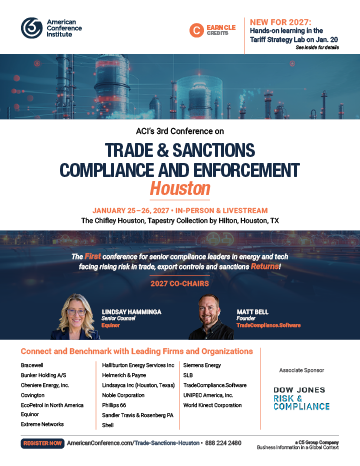
Flip through our conference brochure and discover what’s new this year.
Download Brochure
Day 1
January 25, 2027
Registration Opens and Welcome Coffee

Multi-Agency Keynote Panel: Government Expectations for Energy and Technology Companies in a High-Enforcement Environment

Senior RepresentativeOffice of Foreign Assets ControlU.S. Department of The Treasury
Sponsor Case Study
AI-Enhanced Sanctions Screening: Improving Match Quality Without Surrendering Human Judgment
AI can strengthen sanctions screening by resolving aliases and transliterations, connecting fragmented entity records, surfacing indirect ownership and prioritizing the alerts most likely to require investigation. It can also amplify incomplete data, suppress weak signals or apply a flawed threshold across thousands of transactions before the failure is detected.
Discover how responsible adoption uses AI to enrich and rank potential matches—not replace final judgment—while preserving source-level evidence, trained human review, documented escalation and clear accountability for every clearance or restriction.
Topics May Include
- Using aliases, transliterations, addresses, identifiers and contextual data to improve entity resolution and match quality
- Mapping direct and indirect ownership, aggregate interests, shell companies and changing corporate structures
- Calibrating matching thresholds, alert prioritization and suppression rules without concealing false-negative risk
- Testing data coverage, source provenance, list updates, model drift and performance across languages and jurisdictions
- Defining human review, escalation, override authority and final accountability for potential matches
- Preserving explainability, source evidence, audit trails and the ability to reconstruct why an alert was cleared or restricted
- Integrating AI-enabled screening with onboarding, payments, procurement and transaction monitoring while protecting confidential and proprietary data
Afternoon Networking Break
Audience Benchmarking
Cartels in the Energy Supply Chain: Examining Your Exposure to FTO, Sanctions and Financial Crime across Trade and Logistics

Gabriella NealGlobal Sanctions Counsel & ComplianceHalliburton Energy Services Inc

Daniel OstrowVP, Head of ComplianceWorld Kinect Corporation
Cartel and FTO exposure is not limited to stolen or smuggled fuel; it can create sanctions, material-support, AML, corruption and security risk across a much wider range of energy transactions. For traders and fuel distributors, risk may be concealed in cargo origin, brokers, carriers, storage networks and payment routes. For energy-technology and oilfield-services companies, it may arise through the customers, end users, joint-venture participants, local agents, subcontractors and logistics providers connected to equipment, parts and field services. Direct-counterparty screening is therefore not enough: companies must determine who ultimately owns, receives, uses or benefits from the transaction, where goods and funds are moving, and when U.S.-dollar clearing, bank risk appetite or other red flags require a transaction hold, investigation or exit. This session compares practical diligence, contractual controls and escalation protocols across both business models.
Topics will include:
- FTO, material-support, sanctions and AML exposure—and when standard screening is no longer enough
- Beneficial ownership, hidden affiliations and minority JV interests—determining who ultimately benefits from the transaction
- Equipment, parts and field services—identifying the true end user and when work or support must stop
- Fuel and commodity red flags across origin, pricing, routing and documentation—and when anomalies require escalation
- Agents, brokers, contractors, freight providers and other third parties—closing gaps beyond the direct counterparty
- U.S.-dollar payments, correspondent banking and bank risk appetite—avoiding transactions that cannot actually clear
- Bribery, coercion and extortion involving employees and local providers—coordinating compliance and security response
- Transaction holds, suspension and termination—responding when cartel exposure emerges after performance has begun
- Cross-functional escalation across trade, sanctions, AML, legal, finance and corporate security—getting the right people involved early
Tariff volatility is turning customs data into a direct margin issue. AI and automation can connect product specifications, bills of material, country of origin, valuation, supplier and entry data to calculate the full tariff stack, test lawful mitigation strategies, identify filing errors and recover overpaid duties. But a faster recommendation is not a defensible customs position unless the classification, origin, value and eligibility criteria behind it are accurate and documented.
Learn how importers can retain qualified human review, broker oversight and a clear audit trail before changing sourcing, claiming preferential treatment or filing for refunds.
Topics May Include
- Using product descriptions, specifications, bills of material and customs rulings to accelerate HTS classification and apply Chapter 99 tariffs, exclusions and additional duties
- Modeling total landed cost by SKU, supplier, country of origin and sourcing route before procurement, pricing or product-design decisions are finalized
- Identifying lawful savings through free trade agreements, Chapter 98, foreign-trade zones, temporary importation, first-sale valuation and duty drawback
- Auditing ACE and broker-entry data for classification, valuation, origin, tariff-stack, exclusion and fee errors—and prioritizing corrections, protests or reconciliation
- Testing supplier, manufacturing, routing, product-design and sourcing changes without creating origin, transshipment or tariff-circumvention risk
- Governing source data, regulatory updates, model confidence, human approval and broker accountability under the importer’s reasonable-care obligations
- Measuring duty savings and recovery, error rates, broker variance, clearance time, audit completeness and return on technology investment
Trade and sanctions professionals are under pressure to process more data, investigate deeper supply chains and make defensible decisions faster. Side-by-side, workflow-based demonstrations expose what current platforms can automate, what data they require, how they reach and document results, and where legal and compliance judgment remains indispensable. Effective adoption can strengthen competence, diligence, consistency and audit readiness—but only when users understand system limitations, verify material outputs, protect sensitive information and retain clear ownership of escalation and final decisions.
Invited Demonstration Areas
- Sanctions screening, beneficial ownership and entity intelligence
- Export classification, licensing and compliance workflow automation
- Customs, origin, valuation and tariff analytics
- Supply-chain transparency, forced-labor tracing and risk mapping
- Maritime, vessel, port and cargo intelligence
- AI-assisted regulatory research, investigations and decision support
Closing Remarks & Cocktail Reception
Conference Day 1 Concludes
Day 2 — Main Conference
January 26, 2027
Registration Opens & Refreshments
ETHICS GOVERNANCE
What Trade Compliance Professionals Need to Know about AI Governance from Sanctions Screening Technology and Vendor Risk to Human Accountability

Emily BuchananVice President, Chief Ethics & Compliance OfficerNoble Corporation

Patrick HaysDirector, Compliance and EthicsCheniere Energy, Inc

Eric WilsonDirector, Global ComplianceHelmerich & Payne
Artificial Intelligence is now embedded in sanctions and restricted-party screening, ownership research, export classification, investigations, regulatory monitoring and supply-chain mapping. For CCOs, the key question is no longer whether these tools are used, but where they sit in the control environment and how heavily they are relied on in high-risk decisions. Even at scale, accountability does not shift. Compliance leaders remain responsible for data integrity, confidentiality, false negatives, escalation decisions, and the legal and commercial judgment behind every clearance, restriction or approval.
Effective governance therefore requires a clear inventory of AI-enabled workflows, risk-tiered controls, defined human decision rights, continuous testing, and vendor arrangements that preserve security, auditability and control over company data.
Topics will include:
- Inventorying AI use across sanctions, export controls, customs, anti-corruption, investigations and supply-chain compliance
- Risk-tiering automated workflows based on regulatory consequences, data sensitivity and level of human reliance
- Evaluating screening providers’ data sources, jurisdictional coverage, update frequency, entity resolution and ownership aggregation
- Testing whether platforms can identify aliases, transliterations, indirect ownership, shell companies and changing corporate structures
- Establishing acceptance criteria, quality-assurance sampling, back-testing, drift monitoring and periodic revalidation
- Protecting privileged, confidential, proprietary, personal and export-controlled information entered into AI systems
- Reviewing vendor terms for security controls, incident notification, audit rights, service levels, indemnification, data portability and orderly exit
Audience Benchmarking
Evaluating Risky Operations: How to Navigate Trade and Sanctions in Uncertain Political Environments including Venezuela

Cesar Mata GarciaGeneral Legal CounselLindsayca Inc (Houston, Texas)

Tim MarshmanThird Party Risk AnalystPhillips 66

Nathalia Ramos MattosHead of Compliance – TradingEcoPetrol in North America
Venezuela’s energy sector is reopening through a rapidly changing set of U.S. authorizations, but permission to lift crude, supply services, negotiate a transaction or support existing operations does not necessarily permit new production, unrestricted investment or dealings across the wider PdVSA network. During this session, speakers will discuss how companies are distinguishing what is authorized now from what remains contingent, while preparing for license amendments, payment restrictions, forced wind-downs and capital stranded by another policy reversal.
Topics will include:
- Distinguishing authorized crude trading and oilfield services from production expansion, new joint ventures and long-term investment
- Interpreting the scope, conditions and reporting requirements of OFAC general and specific licenses
- Screening PdVSA entities, joint ventures, beneficial owners and state- or military-linked counterparties
- Evaluating crude lifting, refining, transportation, marketing and infrastructure transactions
- Managing blocked property, payment routing, taxes, royalties and settlement structures
- Applying export controls to drilling equipment, replacement parts, software, technology and technical services
- Structuring contingent contracts where closing or performance remains subject to additional authorization
- Drafting sanctions-change, suspension, wind-down, termination and stranded-asset protections
- Integrating sanctions diligence with AML, anti-corruption and third-party risk controls
- Maintaining documentation and audit readiness as licensing conditions change
Morning Networking Break
Case Study
Export-Control Evasion in Practice: High-Value Technology Diversion Through False End Users, Brokers & Transit Hubs

Jeffery VadenPartnerBracewell
Recent federal charges allege that billions of dollars in high-performance AI servers were diverted to China through a purported Southeast Asian customer, false end-user records, third-party brokers, repackaged shipments and staged dummy servers used to deceive compliance and government inspections.
This case demonstrates why restricted-party screening and end-user certifications are not enough when product capability, purchasing behavior, logistics, financing or post-shipment activity contradict the stated transaction. This session will address how manufacturers of advanced energy, industrial and dual-use technology are connecting sales, channel management, shipping, technical support and post-delivery verification before diversion becomes an enforcement matter.
Topics will include:
- Examining false end-user certificates, shell purchasers, fabricated business records and misrepresented ultimate destinations
- Testing whether the buyer’s business, technical capability, facility, staffing and intended use are consistent with the product ordered
- Reviewing distributors, resellers, brokers, freight-forwarder and transshipment-hub controls, including audit rights and downstream sales restrictions
- Analyzing unusual payment structures, third-party purchasers, split shipments, repackaging, vague delivery instructions and unexplained routing changes
- Ensuring post-shipment verification through installation, service, serial-number tracking, activation data, site access and customer audits
- Preserving evidence, stopping transactions, conducting privileged investigations and evaluating disclosure to BIS or DOJ
- Applying diversion lessons to semiconductors, sensors, industrial automation, subsea systems, drilling equipment, power electronics, software and technical data
Export automation can connect product classification, license determination, restricted-party screening and shipment controls in a single workflow—but it can also scale incomplete master data, outdated rules or poorly governed overrides across thousands of parts and transactions. Effective deployment begins with authoritative engineering and product data, translates regulatory requirements into ERP and global trade management controls, and stops or escalates transactions when classification, destination, end use, end user or license conditions do not resolve cleanly. Compliance leaders must retain accountability for ambiguous decisions, validate regulatory logic, protect controlled technical data and preserve a defensible record showing why each shipment was held, reviewed or released.
Topics May Include
- Building authoritative product master data across part numbers, specifications, bills of material, ECCNs, USML categories and licensing attributes
- Automating jurisdiction, classification and license determination while routing incomplete or ambiguous cases to qualified reviewers
- Integrating ERP, order-management, warehouse, shipping and global trade management systems to prevent unauthorized release
- Configuring shipment holds, exceptions, overrides, escalation thresholds, approval authority and segregation of duties
- Protecting controlled drawings, source code, software and technical data across cloud platforms, remote access and global engineering teams
- Testing regulatory-content updates, screening logic, system changes and false-clear risk before controls move into production
- Preserving audit trails and measuring classification accuracy, first-pass resolution, override rates, clearance time and shipment-control effectiveness

Tony BuschOf CounselSteptoe LLP
The removal of comprehensive U.S. sanctions and repeal of the Caesar Act have created new openings in Syrian power generation, water, telecommunications, transportation, energy services, and infrastructure. Legal relief, however, does not resolve the commercial barriers to entry: most controlled U.S.-origin equipment and technology still require export authorization, targeted sanctions remain in force, and banks, insurers, suppliers, and regional partners may apply different risk thresholds. Companies evaluating Syria must distinguish permitted civilian trade from restricted end users and end uses, determine whether to enter directly or through an established regional platform, and protect against payment failure, political reversal, security disruption, and capital committed before the market can support long-term operations.
Topics will Include
- Syria’s political transition and security outlook and assessing whether current conditions support long-term commercial engagement
- The state of reconstruction and economic recovery and where meaningful opportunities are emerging and where fundamental obstacles remain
- Regional diplomacy and international engagement and understanding how geopolitical developments may shape the investment climate
- Sanctions relief in context and what has changed, what restrictions remain, and why legal authorization is only one part of the business decision
- Banking, insurance and payment channels: determining whether transactions can actually be financed and completed
- Local partners, government institutions and commercial counterparties, and evaluating who can realistically execute and support projects
- Market-entry strategies, from regional hubs and pilot projects to longer-term investment commitments
- Physical security, workforce mobility and operational resilience, and understanding whether projects can be sustained after launch
- Political uncertainty, policy reversals and contractual protections, and reducing the risk of stranded capital if conditions change
Networking Luncheon
Audience Benchmarking
U.S.–China Trade Controls Collide: Contract, Technology Transfer & Supply-Chain Risk for Energy & Tech Operations

Roman GalvanGlobal Technology Trade Control & Compliance ManagerSLB

Eric CarlsonPartnerCovington
Energy companies fabricating equipment, sourcing critical components or operating shipyards, joint ventures and service networks in China face legal obligations that can point in opposite directions. U.S. controls may restrict equipment, software, technology and technical support based on classification, end use, end user and corporate ownership, while China’s Anti-Foreign Sanctions Law, Blocking Rules and export-control regime can complicate contract termination, due diligence and access to Chinese-origin inputs.
Hear how companies are now mapping ownership below the direct counterparty, controlling engineering data and remote access, and building licensing, suspension and exit rights before a designation, countermeasure or critical-material restriction interrupts performance.
Topics will include:
- Preparing for activation, further delay or revision of the BIS Affiliates Rule, including ownership aggregation, minority-ownership red flags and unresolved ownership
- Examining Entity List, Military End-User List and military end-use or end-user exposure involving Chinese energy, shipbuilding, industrial and technology counterparties
- Classifying subsea systems, industrial automation, sensors, semiconductors, encryption, software, technology and technical services
- Determining U.S.-origin content, de minimis and Foreign Direct Product Rule exposure in equipment and components manufactured outside the United States
- Engineering drawings, source code, cloud access, remote diagnostics, onsite support and deemed export or reexport risk
- Analyzing technology transfers involving Chinese joint ventures, fabrication yards, engineering partners, employees and contractors
- Deciphering China’s Anti-Foreign Sanctions Law, Blocking Rules, Unreliable Entity List and export-control restricted name lists
- Rejecting contract clauses that disclaim U.S. sanctions or export-control obligations or restrict due-diligence and audit rights
- Licensing conditions, change-in-law provisions, suspension rights, termination, force majeure, indemnification and orderly wind-down
- Reviewing Chinese export controls affecting rare earths, permanent magnets and other critical inputs used in industrial and energy technology
- Evaluating UFLPA and forced labor diligence across sub-tier suppliers, raw materials, component manufacturers and transshipment points
- Dual sourcing, supplier requalification, inventory planning and manufacturing relocation without creating diversion, origin or circumvention risk
- Examining cross-border escalation among trade compliance, procurement, engineering, IT, data security, legal and business leadership
Afternoon Networking Break
Audience Benchmarking
Ensuring Energy Supply Chain Resilience: Overcoming Chokepoints, Shipping Disruptions, and Sanctions Risk in the Strait of Hormuz

Lindsay HammingaSenior CounselEquinor

Fraz MalikSenior Counsel, Supply & TradingChevron
The Strait of Hormuz is one of the world’s most critical energy chokepoints, carrying a large share of global crude, condensate, refined products, and LNG. Disruptions in the strait have commercial impact: supply chain interruption, reduced flexibility, insurance and financing constraints, sanctions exposure, as well as rapid price and availability shocks. Because alternative routes are limited, storage is constrained, and systems are highly optimized. Even minor disruption can ripple globally.
For energy companies, the key challenge is maintaining supply continuity, managing counterparty and sanctions risk, and ensuring contractual and logistical resilience across trading, procurement, and delivery.
Topics will include:
- Mapping exposure across upstream production, trading portfolios, refining systems, and downstream commitments
- Identifying critical Hormuz dependencies across contracts, terminals, storage, and delivery hubs
- Evaluating constraints of alternative routes, including pipeline capacity, port congestion, and regional bottlenecks
- Managing inventory strategy, stock releases, grade substitution, and supply rebalancing under disruption
- Assessing market impacts including price volatility, basis dislocations, and regional imbalances
- Understanding insurance, financing, and credit implications of elevated war-risk conditions
- Ensuring contractual resilience across force majeure, sanctions clauses, and delivery flexibility
- Managing sanctions exposure from indirect payments, routing changes, and emergency logistics
- Coordinating cross-functional response across trading, legal, compliance, logistics, and leadership
- Scenario planning for partial disruption, sustained risk, or full closure of the Strait
- Ensuring continuity of customer supply while balancing commercial, regulatory, and reputational risk
Audience Benchmarking
Managing Exposure to Iran–China Energy Trade Flows: Enhanced Due Diligence and Sanctions Screening Practices

Alan Moya DupreGroup Compliance OfficerBunker Holding A/S

Randell GeuyHead of Legal and ComplianceUnipec America, Inc.

Robert PattersonDirector, Americas—Head of Sanctions InvestigationsSociété Générale
Independent Chinese refiners are major buyers of Iranian crude, increasing sanctions exposure for firms financing, transporting, insuring, or facilitating these flows. Because cargoes are often obscured through intermediaries, ship-to-ship transfers, and falsified documentation, standard screening may not reveal true origin or counterparties. This requires market participants to strengthen due diligence from vessel to refinery and actively monitor evasion indicators and exposure to designated or high-risk entities.
Topics will include:
- Examining secondary sanctions exposure involving independent Chinese refiners
- Identifying Iranian-origin crude concealed through false or misleading documentation
- Determining ship-to-ship transfers, AIS manipulation, vessel identity changes and other shadow-fleet practices
- Ensuring vessel ownership, management, flag history and beneficial ownership tracing
- Screening of refiners, port terminals, intermediary traders, brokers and front companies
- Assessing trade finance, payment, insurance and correspondent banking exposure assessment
- Reconciling of vessel-tracking intelligence with bills of lading, certificates of origin and transaction records
- Escalating discrepancies involving cargo origin, routing, counterparties or pricing
- Evaluating risk-based decision documentation and audit readiness for high-risk energy transactions