Agenda
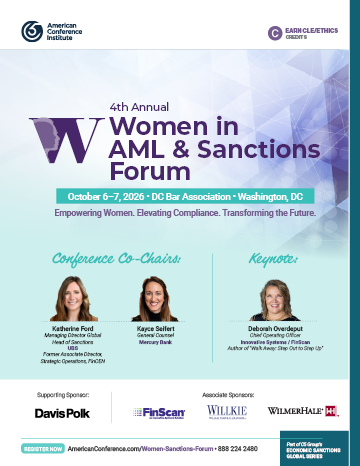
Flip through our conference brochure and discover what’s new this year.
Download Brochure
Day 1 — Main Conference
October 6, 2026
Women in Government Roundtable: Key Policy and Enforcement Initiatives for the Year Ahead and Lessons in Leadership from the Public Sector

Beth DaviesDeputy Director, Office of Financial Sanctions ImplementationHM Treasury

Melissa DuffyPartnerFenwick & West LLP

Amanda JocaActing Associate Director, Global Investigations DivisionFinCEN
U.S. Department of the Treasury

Sara ThannhauserAssociate Director, Sanctions Policy & Implementation
Office of Foreign Assets ControlU.S. Department of the Treasury
During this unique session, our esteemed panel of influential women leaders in government will discuss their agencies’ top priorities and initiatives for the remainder of 2026, as well as what they anticipate on the horizon in terms of investigations and enforcement trends in the AML and sanctions spaces. They will also share personal stories about their roads to government leadership and lessons they learned during their ascent to their current positions in the public sector.

Charlotte Baskin-GerwitzVice President Global Sanctions Advisory JPMorgan Chase

Katherine FordGlobal Head of Financial Crime RiskNubankFormer Associate Director, Strategic Operations,
FinCEN

Neena ShenaiPartnerWilmerHale
- Regime Divergence — A strategic analysis of how EU, UK and US sanctions frameworks are drifting apart in scope, timing and legal architecture, and what this means for institutions operating across all three jurisdictions
- Operational Complexity — Understanding the compliance, licensing and reporting frictions created by fragmentation, including conflicting designations, varying evidentiary thresholds and inconsistent enforcement expectations
- Risk Recalibration — How leading organizations are reassessing exposure across supply chains, counterparties and financial flows as divergence accelerates and cross-border risk mapping becomes more volatile
Leading the Modern Workforce: How Generational Shifts Are Reshaping the Workplace and Adapting Leadership Styles for the Next Generation of Professionals

Mary Ann McCarthyVice President BSA AML & OFAC ComplianceNavy Federal Credit Union

Sidney BashagoPartner Davis Polk & Wardwell LLP

Sahra Park-SuChief Legal CounselSAP America Inc.

Heather EpsteinManaging Director, Global Head of Sanctions Programme & RemediationDeutsche Bank
As generational shifts continue to reshape workplace culture, leaders must adapt to evolving expectations around communication, flexibility, work-life balance, career development, technology-driven efficiencies, and more. This session will explore how organizations can better understand the priorities of emerging professionals while leveraging the strengths of a multigenerational workforce to drive collaboration, innovation, retention, and long-term success.
- Understanding how younger professionals approach workplace culture, communication, flexibility, career growth, and leadership expectations
- Navigating common generational tensions and misconceptions in high-pressure compliance and legal environments
- Strategies for managing, motivating, and retaining talent across multiple generations within AML and sanctions teams
- Leveraging generational diversity to foster innovation, collaboration, mentorship, and stronger organizational culture
Networking Break
AI and the Future of Sanctions Compliance: How Companies Can Leverage the Latest Technologies to Build Agile, Effective & Responsible Compliance Programs

Jen MakiSenior Director - Global TradeXylem

Hon. Manisha SinghSenior Fellow for AI and National SecurityKrach Institute at Purdue University

Elizabeth FitzpatrickVice President & General Counsel, Chief Regulatory Officer and Head of Legal TransformationHoneywell Technologies

Zaib RasoolHead of Compliance Products and MarketsSentiLinkFormer Assistant Director, Office of Terrorist Financing and Financial Crime, U.S. Department of the Treasury
As sanctions regimes evolve at unprecedented speed amid growing geopolitical uncertainty, organizations are increasingly exploring how AI can strengthen sanctions compliance programs, improve efficiency, and enhance risk management. This session will examine how AI is reshaping sanctions compliance operations, governance, and decision-making, while addressing key considerations around ethical use, oversight, staffing, and program agility. Topics of discussion include:
- Exploring how AI can enhance sanctions screening, investigations, risk monitoring, and compliance decision-making
- Centralized vs. decentralized sanctions compliance models and where AI can drive greater consistency and efficiency
- Best practices for responsible and ethical AI governance, oversight, validation, and regulatory defensibility
- Preparing compliance teams for the future: staffing, upskilling, and training considerations in an AI-enabled environment
- Building agile sanctions compliance programs that can quickly adapt to rapidly changing geopolitical and regulatory developments

Conference Adjourns to Networking Cocktail Reception
End of Day One
Day 2 — Main Conference
October 7, 2026
Continental Breakfast
The Future of the U.S. Dollar: Implications for the Global Economy, Financial Crime, and Sanctions Enforcement

Claire McCleskeyCo-FounderClarity Consulting ConsultingFormer Head of OFAC Compliance Division, Office of Terrorism & Financial Intelligence

Jess HoversenChief EconomistThe Column Group, LLC
As geopolitical tensions, shifting trade relationships, emerging payment systems, and digital assets reshape the global financial landscape, the role of the U.S. dollar remains a critical topic for financial crime professionals. While the dollar continues to dominate international trade and finance, growing discussions around de-dollarization, central bank digital currencies (CBDCs), and alternative cross-border payment networks raise important questions about the future of U.S. economic influence and sanctions effectiveness.
This session will explore the evolving role of the U.S. dollar in the global economy and examine what potential changes could mean for anti-money laundering, sanctions compliance, and financial crime risk management.
FinCEN’s Proposed AML/CFT Overhaul: Understanding the New Risk-Based Compliance Framework and What It Means for Financial Institutions

Audra McKayHead of Global Transactions Monitoring & Investigations OversightBlock

Britt MosmanPartnerWillkie Farr & Gallagher LLP

Kayce SeifertGeneral CounselMercury Bank (In Organization)
FinCEN’s newly proposed AML/CFT framework signals one of the most significant shifts in U.S. anti-money laundering regulation in decades, emphasizing effectiveness, risk-based decision-making, and reduced compliance burden. This session will examine the proposed reforms, the evolving relationship between FinCEN and banking regulators, and what compliance leaders should be doing now to prepare for a new era of AML oversight and supervision. Our panelists will discuss:
- Key takeaways from FinCEN’s proposed AML/CFT framework overhaul and shift toward effectiveness-based compliance
- The evolving supervisory relationship between FinCEN and federal banking regulators
- Managing overlapping regulatory expectations, examiner scrutiny, and supervisory coordination
- Rebalancing AML resources and oversight toward higher-risk activities under a risk-based model
- Timeline expectations, implementation outlook, and preparing for potential rule changes
Networking Break
Lessons in Leadership from the Public Sector: Women in Government Discuss Career Journeys, Challenges, and Opportunities

Megan Bartley Chief CounselU.S. Senate, Foreign Relations Committee

Stephanie ConnorPartner Holland & Knight LLP

Maida FurniaVice President
Beacon Global StrategiesFormer Director for Asia and the Pacific, U.S. Department of the Treasury

Anne PeacockAssistant Director of Policy,
Office of Foreign Assets ControlU.S. Department of the Treasury
Hear from women in government as they share personal stories about their roads to government leadership and lessons in power and progress that they learned during their ascent to their current positions in the public sector.

Karen BruntragerDirector, Regulatory AffairsFederal Express

Tatiana MartinsPartner Davis Polk & Wardwell LLP
Audra McKayHead of Global Transactions Monitoring & Investigations OversightBlock

Amy CattleDirector & CounselAmerican Express
Meet with your peers in smaller groups to share views on these important career challenges.
- Expanding Your Professional Footprint through Personal Branding and Self-Marketing
- Networking in a Remote World
- Sustaining High Performance Throughout Your Career: Managing Burnout, Boundaries and Career Longevity
- Strategies for Having Difficult Conversations Internally
Networking Lunch

Vedia EidelmanRegional Head of the Global Trade Law OfficeDHL

Diana IskelovDirector and Senior Counsel, Group Dispute ResolutionBNP Paribas

Maia NikoladzeAssociate Director,
Economic Statecraft InitiativeAtlantic Counsel
- China’s Evolving Legal Landscape — Analyzing recent legislation, enforcement trends, and how China’s counter-measures laws reshape global compliance exposure
- Supply Chain Vulnerabilities — Identifying hidden choke points, high-risk sectors, and the ripple effects of China-based manufacturing dependencies
- Cross-Border Compliance Pressures — Navigating conflicting regulatory regimes, data-localization requirements, and the operational realities of dual-jurisdiction risk
- Strategic Risk Mitigation — Building resilient frameworks for due diligence, vendor oversight, and rapid-response protocols when geopolitical tensions escalate

Ali Rathod-PapierPartner & Compliance Officer, Foreign Expansion & Policy Andreessen Horowitz

Nicole SuccarPartnerPaul Weiss
In today’s increasingly matrixed organizations, influence—not title—often determines impact. This panel will explore how professionals can effectively build credibility, align stakeholders, and drive decisions even when they do not have direct line authority over the teams they depend on. Panelists will share practical strategies for navigating complex reporting structures, managing competing priorities across functions and regions, and earning trust in environments where success depends on collaboration rather than control.
Discussion will focus on how to:
- Establish authority through expertise, communication, and consistency
- Influence cross-functional partners without formal reporting power
- Manage competing priorities in global or matrixed environments
- Build alignment between legal, compliance, and business teams
- Navigate organizational ambiguity while maintaining accountability and momentum
Networking Break
Ethics Credit
From Whistleblower Complaint to Resolution: Strengthening Internal Investigations and Response Protocols
Tatiana MartinsPartner Davis Polk & Wardwell LLP

Liz SoltanCounsel Whistleblower Partners LLP
As whistleblower activity and regulatory scrutiny continue to rise, organizations must be prepared to respond quickly, consistently, and defensibly to internal complaints and potential misconduct allegations. Discussion points include:
- Managing the investigation lifecycle from initial complaint through resolution
- Defining compliance team responsibilities, escalation protocols, and documentation expectations
- Maintaining ethical investigation practices, confidentiality, and anti-retaliation safeguards
- Understanding potential personal liability, whistleblower protections, and reputational risks
- Maintaining clear, appropriate communication throughout the investigation process
- Determining when and how to engage outside counsel and preserve privilege
- Coordinating cross-functional response efforts among compliance, legal, HR, and leadership teams