Agenda
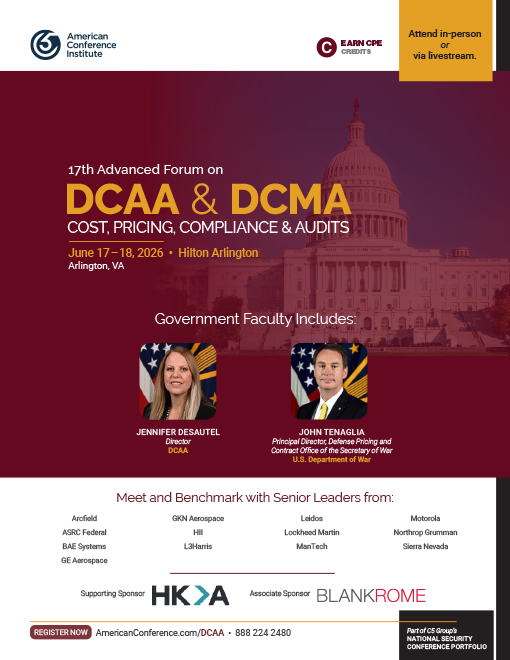
Flip through our conference brochure and discover what’s new this year.
Download Brochure
Pre-Conference Workshops
June 16, 2026
Day 1 — Main Conference
June 17, 2026
Breakfast Buffet Sponsored by

Critical Updates from CAS Board: What You Now Need to Know about Future Rulemaking, Thresholds and Board Composition

Jennifer DesautelDirectorDCAA

Matthew PophamMemberCost Accounting Standards Board
- Updates on Current & Future Rulemaking and Other CASB Initiatives
- The intersection of CAS and GAAP and practical implications for compliance
- Status of new and pending CAS rule rollouts
- Update on Implementation of the FY2026 NDAA CAS Changes
- Thresholds and dollar-value triggers
- Cost Impact Measurement
- CAS Board Composition
Networking Break

Assessing the Impact of Key Provisions in the FY 2026 NDAA: CAS, Thresholds, Commercial Products and More

Kathy Van EverySr. Legal Counsel – DefenseGKN Aerospace

Kim HerringtonVice President, Government Finance and Business InitiativesL3Harris TechnologiesFormer Acting Principal Director, Defense Pricing and Contracting

Jennifer FlickingerPartnerHKA
The 2026 National Defense Authorization Act (NDAA) marks a significant shift in defense acquisition, reshaping how the Department of Defense buys and builds capabilities across more than 3,000 pages of statutory changes. Signed into law on December 18, 2025, the Act emphasizes streamlining, modernization, and structural reform of defense acquisition processes.
Key areas of impact to be discussed during this session include:
- Changes to Cost Accounting Standards (CAS)
- Acquisition Threshold Adjustments
- Matters Relating to Commercial Products and Commercial Services
- Bid Protest Payment Withholds
- Reduced burdens and lower barriers to entry for non-traditional defense contractors
Networking Luncheon Sponsored by


Irene JohnsonDirector of Specialty Pricing, Cost and Pricing Command DCMA
- Modernizing technical surveillance, ensuring high quality product delivery and leveraging data-driven decision making to enhance the defense industrial base
- Strengthening agile, transparent and efficient acquisition life cycle processes that improve the outcome for all stakeholders
- Heightening value and affordability through modern, adaptive and responsive cost and pricing capabilities to maximize return on investment
- Building and sustaining a skilled workforce while aligning resources, infrastructure and technology to meet evolving operational demands
Navigating the Impact of Workforce Management on Audit, Payments, Oversight, Timelines, and Compliance

Barbara MichaelSVP, Government CompliancePeraton

Peter HermanSenior Director, Regulatory Affairs & ComplianceArcfieldFormer DCAA HQ Program Manager, Cost Accounting Standards & IPA Program

Grace MureithiCPA Compliance Executive- Government Compliance & Internal Audit and ERMClark Construction Group
- Assessing the potential impact of workforce changes on audit staffing and resource capacity
- Evaluating effects on audit completion timelines and the timing of related payments
- Implementing best practices to remain agile and adapt to evolving workforce models
- Understanding audit considerations and compliance implications of unlimited PTO policies
- Analyzing the financial and operational impact of changing facility footprints, including remote, hybrid, and return-to-office environments
Networking Break

Neil GardnerDirector, Government ComplianceNorthrop Grumman Innovation Systems

Christopher GeigerVice President, Internal Audit and Enterprise RiskLockheed Martin

John LossingVice President- Industry ComplianceManTech
These breakout roundtables will provide participants with the opportunity to join two 30-minute smaller-group benchmarking discussions on timely topics. At the end, the roundtable leaders will recap key insights and offer additional guidance.
Select 2 Roundtables:
- Managing Compliance Teams Through a Changing Regulatory Environment: Best Practices for navigating the fluid compliance environment, enhancing communications, fostering relationships and keeping up with regulatory changes
- Government Property Audits: Revisiting the time and resources for supporting government property reviews, including best practices and lessons learned
- Deciphering When and How Automation Delivers the Most Value: Practical applications and lessons learned from deploying technology in the audit and compliance landscapes
Cost & Pricing Café Recap
Networking Cocktail Reception Sponsored by

End of Day 1
Day 2 — Main Conference
June 18, 2026
Breakfast Buffet Sponsored by
Revolutionary FAR Overhaul: Assessing the Impacts on Government Contractors, Audits, Cost and Pricing

Darrell HinemanVP of ComplianceSierra Nevada Corporation

Mark SmithChief Government Compliance OfficerBAE Systems
Recent FAR revisions have dramatically streamlined the regulatory framework, removing more than 500 provisions and signaling further retirements ahead. In this session, industry leaders will provide a practical look at how FAR revisions are affecting audits, cost and pricing—cutting through surface-level edits, clarifying the rulemaking process, and calculating real aggregate cost impacts.
Topics of discussion will include:
- Preference for fixed-price contracts under FAR Part 12
- Shifts in contract pricing under FAR Part 15
- Cost impacts of accounting practice changes and CAS non-compliance under FAR Part 30
- Continuous FAR updates influencing cost and pricing decisions
Auditing AI and AI-Enabled Audits: Perspectives on the Evolving Technology Journey in the Contracting Context -from ROI, Responsible Use, Efficiency-and Where to Draw the Line on AI Adoption

Sara CrabtreeSenior Director of Contracts & PricingThreat Tec

George PatelPartnerWiley Rein LLP
Building on the pre-conference workshop, compare notes with your peers on AI and automation, and how they are transforming audit, cost, pricing and compliance, including incurred cost scrubs, audit readiness, and process streamlining to improve efficiency.
- Practical applications of AI in compliance, including where automation delivers the greatest value
- Responsible and ethical use of data, automation, and AI
- Preventing bias and promoting fairness and transparency to build trust in AI-driven insights
- Best practices for adopting AI to reduce costs, increase efficiency, and strengthen compliance
Networking Break
Legal Liability Exposed: Critical Updates on Agency Oversight, False Claims and Recent Court Decisions Impacting the Cost and Pricing Landscape

Stephanie HardenPartnerBlank Rome LLP

Crystal TeedAttorney-Advisor Special Operations Command (USSOCOM)
In this session explore legal updates across the past year and the impact on cost and pricing:
- Heightened Contractor Scrutiny: Managing increased oversight of contractor responsibility, financial viability, and past performance
- Cost Allowability and Allocability Disputes: Exploring common dispute areas and their implications for contractors
- False Claims: Recent enforcement actions related to misrepresentations of cybersecurity compliance and risk management
- The aftermath of the Boeing decision on cost accounting practices and compliance expectations
Networking Luncheon Sponsored by

John HindmanPartnerHKA

Chris PandoDirector of Government EstimatingBoeing
Explore how regulatory changes and government policy shifts are impacting how the government accesses innovative solutions from non-traditional sources. This session will break down the latest happenings in non-traditional procurement, including:
- Non-Traditional Defense Contractors – Strategic implications of additional regulatory exemptions in the FY26 NDAA
- Other Transactions: Latest challenges and best practices for negotiating OTs
- Commercial Acquisition: Impact of executive orders, NDAA provisions, and policy shifts toward prioritizing commercial designation and commercial solutions openings
The Newest Deficiencies Uncovered-from Business Systems, Accounting Systems and More to Post-Audit Considerations
Neil GardnerDirector, Government ComplianceNorthrop Grumman Innovation Systems
John LossingVice President- Industry ComplianceManTech

Christine Williamson, CPA, PMPPartnerCohnReznick LLP
- Accounting System Audit Hotspots: Key areas of auditor focus, including material transfers, borrow-payback practices, and the internal controls contractors must maintain
- DFARS Business Systems Compliance: Which compliance areas should be prioritized
- Common Audit Findings: Recurring deficiencies identified across contractor accounting, estimating, and purchasing systems
- Potential Changes to Business System Rules: Status of proposed or anticipated updates and what they may mean for contractors
- Post-Audit Considerations: What happens after the audit concludes, including findings resolution, corrective action plans, and ongoing monitoring
Networking Break

Christopher CanterPresident and DirectorConsulting Services for The Commpliance GroupFormer Senior Telecommunications Counsel for Services- US, Canada and LATAM, Motorola Solutions

Rob HornbuckleCIO & COOIDT
As we transition through the phased implementation of CMMC 2.0, the framework has evolved from an IT project into a critical business gating mechanism. For government compliance, cost, pricing, and audit professionals, CMMC is no longer just a technical hurdle—it is a significant driver of indirect costs, a major factor in bid competitiveness, and a potent source of False Claims Act (FCA) exposure.
Key topics will include:
- “Phase 2” implementation realities: Building compliant, auditable, and cost-efficient cybersecurity programs that can survive both DCAA scrutiny and the rigorous standards of third-party assessments (C3PAO)
- What to Expect During a CMMC Audit: Key audit phases, assessor expectations, and common focus areas during the assessment process
- Structuring indirect cost pools to account for CMMC investments
- Mitigating personal and corporate liability when affirming compliance in the Supplier Performance Risk System (SPRS)
- Integrating CMMC Costs into Pricing Models: Recovering the costs of cybersecurity upgrades and assessments (C3PAO) through indirect cost pools while maintaining competitive, compliant proposal pricing
- Developing ”flow-down” verification processes that protect your prime contract status without assuming liability for a subcontractor’s cybersecurity failure
- What to expect during a DCAA or DIBCAC interaction regarding your system security plan (SSP) and how to align technical security controls with accounting records

Lisa GiftDirector Government Contracts Compliance, CPARigetti Computing

Matthew HerdmanVice President, Corporate ComplianceASRC Federal

Anthony KimPartner, Government Contracting Advisory ServicesHighspring
This strategy session will provide practical guidance on navigating forward pricing, special audits and incurred cost audits. The discussion will focus on balancing compliance with efficiency.
Key topics include:
- Audit Risk Areas: Identifying and managing high-risk areas in cost accounting and financial reporting
- Incurred Cost Submission Optimization: Best practices for preparing, validating, and submitting incurred cost proposals
- Enhancing Audit Efficiency and Effectiveness: Improving audit workflows while maintaining compliance with stringent standards
- Emerging Regulatory Trends: Understanding evolving rules and their implications for cost, pricing, and audit readiness