Agenda
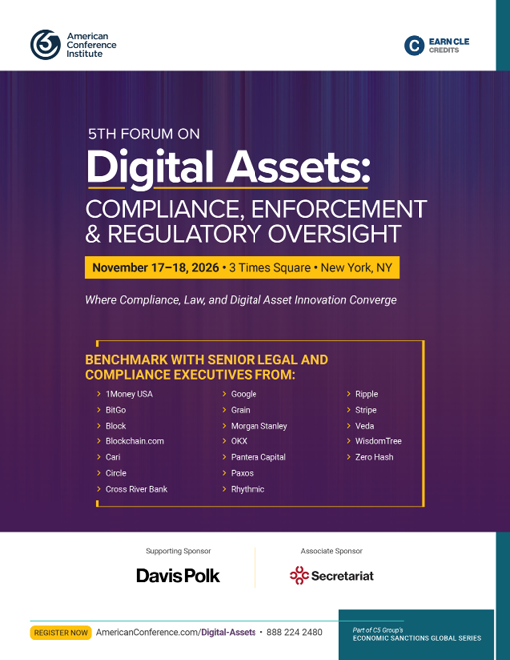
Flip through our conference brochure and discover what’s new this year.
Download Brochure
Day 1 — Main Conference
November 17, 2026
Registration Open

Tara La MorteDeputy General Counsel BitGo Former Chief, Illicit Finance & Money Laundering Unit,
U.S. Attorney’s Office for the Southern District of New York

Amanda WickHead of AmericaVerifyVASPFounder of the Association for Women in Cryptocurrency and Former Federal Prosecutor, US Department of Justice
The Digital Assets Regulatory Reset: What Has Changed, What Has Not, and What Legal and Compliance Teams Need to Watch

Andrée GoldsmithDeputy General Counsel, Head of Global Product LegalOKX

Ryan LouvarChief Legal Officer and Head of Business and Legal AffairsWisdomTree

Katrina PagliaChief Legal Officer, Chief Compliance Officer, Head or HRPantera Capital

Tammy WeinribChief Compliance Officer Veda

Anand SithianPanelCrowell & Moring LLP
- What has changed under the current federal posture.
- What has not changed from a compliance and liability standpoint?
- SEC/CFTC jurisdiction and market-structure uncertainty
- Stablecoins as the near-term implementation issue
- Bank regulator movement and institutional re-entry.
- Global divergence across the U.S., EU, UK, Singapore, Hong Kong, and UAE
- What legal and compliance teams should prioritize in the next 12 months
Financial Institutions Landscape: Regulator Expectations for Custody, Payments, Partnerships and Risk Governance
- What can banks do now in digital assets
- Custody and safekeeping expectations
- Bank partnerships with crypto companies and stablecoin issuers.
- Tokenized deposits and bank-issued digital value
- Payments, settlement, and digital asset product approvals
- Risk governance and board-level oversight.
- Third-party/vendor risk when working with crypto firms.
- What examiners will look for in digital asset activity?
- Where banks should still proceed cautiously
Stablecoin Implementation in 2026: Issuer Obligations, Bank Partnerships, AML/Sanctions Readiness and Operational Controls

Caroline HillSenior Director of Global Policy and Regulatory StrategyCircle

Debra BrookesChief Risk & Compliance OfficerWyoming Stable Token Commission

Ashok PintoExecutive Vice President, Legal and Government RelationsBlockchain Association

Jordan WishSpecial CounselSullivan & Cromwell LLP
- GENIUS Act readiness
- Permitted payment stablecoin issuer obligations.
- Reserve management and redemption rights.
- AML/CFT and sanctions program requirements
- Governance, disclosures, audits, and controls
- Bank partnerships and banking access.
- Vendor readiness for monitoring, screening, custody, and compliance workflow
- Stablecoins versus tokenized deposits
- What smaller issuers need to build before they scale?
- What will regulators, banks, and counterparties expect from issuers?
Networking Break
Agentic Payments and Digital Assets: Compliance, Fraud, Sanctions and Liability Risks in Machine-Driven Transactions

Kendall HowellCounselDebevoise & Plimpton LLP

Jeremy KuesterHead of Financial Crime LegalStripe

Robert MisDirector Secretariat

Rich WidmannHead of Strategy, Web3, Google Cloud Google
- AI agents initiating payments or digital asset transactions
- Machine-to-machine payment flows
- Authorization and consent issues
- Fraud risk in automated transactions
- Sanctions screening for agentic or automated payments
- Liability when an autonomous agent makes a prohibited or fraudulent transaction.
- KYC/KYB challenges for agentic payment ecosystems
- Monitoring real-time, high-volume payment activity
- Vendor risk and model governance in agentic payment tools
- Consumer protection and dispute resolution

Sabrina BrownDirector of Money Services and Consumer Credit SupervisionOffice of Financial Regulation
Maryland Department of Labor

Joseph CiccoloFounder and PresidentBitAML

Kenneth CoghillDeputy Superintendent
Virtual CurrencyNY Department of Financial Services
- State Leadership in Digital Asset Oversight: How states are approaching licensing, custody, stablecoins, consumer protection, and market supervision.
- Enforcement Priorities and Examination Trends: What recent actions reveal about regulator expectations and emerging areas of scrutiny.
- Managing Multi-State Compliance Risk: Practical strategies for addressing divergent requirements across jurisdictions while maintaining operational efficiency.
- What Comes Next: Predictions for state-federal coordination, model frameworks, and the future of digital asset regulation in the United States.
TradFi Meets Digital Assets: Banks, Custody, Tokenized Deposits, Settlement and the Next Phase of Institutional Adoption

Erik KiefelDeputy Compliance Officer and Chief AML OfficerZero Hash
Tara La MorteDeputy General Counsel BitGo Former Chief, Illicit Finance & Money Laundering Unit,
U.S. Attorney’s Office for the Southern District of New York

Donna RedelAdjunct Professor of Digital AssetsFordham University School of Law

Andrea ShawExecutive Director Morgan Stanley
- What TradFi still fears: regulatory exams, reputational risk, custody, cyber, and compliance failures
- Where vendors fit in the institutional adoption stack
- What the next phase of bank/crypto partnerships looks like
- What is actually driving TradFi interest now?
- Bank, asset manager, and payments company digital asset strategies.
- Custody and settlement infrastructure
- Tokenized funds and tokenized collateral
- Tokenized deposits as a bank-led alternative to stablecoins
- Institutional adoption after ETFs and tokenization pilots
- What crypto companies need from banks and TradFi partners
Reception
End of Reception
Day 2 — Main Conference
November 18, 2026
Breakfast Roundtables
Co-Chairs’ Opening Remarks
The New Crypto Enforcement Roadmap: SEC, CFTC and DOJ Priorities Across Market Structure, Derivatives, Fraud and Platform Risk

Stephanie BrookerPartnerGibson Dunn & Crutcher LLP

Robert A. CohenPartnerDavis Polk & Wardell LLP
- What the federal enforcement reset really means.
- What enforcement priorities remain active?
- SEC/CFTC jurisdiction and market structure
- Token classification and platform oversight.
- Fraud, manipulation, market abuse, and consumer protection
- Perpetual contracts/perps and crypto derivatives
- Prediction markets and event contracts
- Customer asset protection and margin issues
- DOJ priorities around fraud, sanctions evasion, and criminal misconduct
- What companies should document now to defend decisions later?
Crypto-Enabled Illicit Finance Exposure: Ransomware, Scams, Sanctions Evasion, Cross-Chain Risk, Drug Cartels, and Law Enforcement Response

Sarah BreslowAssociate General CounselPaxos

Meredith FitzpatrickPartner and Head of CryptocurrencyForensic Risk Alliance

Zachary GoldmanPartnerSullivan & Cromwell LLP

Douglas ZolkindPartnerDebevoise & Plimpton LLP
- Ransomware and extortion payments
- Scams and pig-butchering schemes
- Sanctions evasion typologies
- Terrorist financing and high-risk jurisdictions
- Mixers, bridges, cross-chain hopping, and obfuscation tactics
- Organized crime and international hacker groups
- Red flags firms are still missing.
- Law enforcement collaboration and information sharing
- How bad actors adapt when controls improve.
- What legal/compliance teams need to escalate faster
Networking Break
Following the Funds Across Chains: Bridging, Mixers, Privacy Tools, Wallet Screening and the Future of Blockchain Analytics

Julie LaskerDirector of Policy & GovernmentDigital Asset

Nikhil RaghuveeraCo-Founder and CEOPredicate

CJ RinaldiChief Compliance OfficerKraken Digital Asset Exchange
- Data, Surveillance & Privacy Trade-Offs
- Real-time monitoring and transaction transparency
- Privacy coins, mixers, and anonymity-enhancing tech
- Balancing civil liberties with regulatory mandates
- How cross-chain hopping works in practice.
- Bridges and chain abstraction risks
- Mixers, privacy coins, and anonymity-enhancing tools
- Wallet screening and transaction tracing
- Real-time monitoring and transaction transparency
- Data limitations in blockchain analytics
- Privacy versus surveillance tensions
- Civil liberties versus regulatory mandates
Maintaining a Defensible Crypto AML and Sanctions Program: Monitoring, SARs, Designations, Vendor Oversight and Audit Readiness

Shelby StimacChief Compliance OfficerGrain

Katrina CarrollFinancial Crimes Regulatory Lead Block

Thomas HyunDirector, Cryptocurrency ComplianceForensic Risk Alliance

Nicole A. MurrayFinancial Crimes Director, Virtual CurrencyNY Department of Financial Services

Aseel RabiePartnerDebevoise & Plimpton LLP
- Requirements of a crypto AML/CFT program
- Minimizing Sanctions screening and wallet exposure controls
- Documenting Transaction monitoring and alert escalation
- SAR decision-making and documentation
- Vendor selection, validation, and oversight
- Compliance workflow and audit trails
- Governance, board reporting, and accountability
- How smaller crypto firms build mature controls with limited teams
Networking Lunch
Tokenization Gets Real: RWAs, Tokenized Deposits, Collateral, Securities and the Legal/Compliance Risks Behind Institutional Adoption

Jason P. AllegranteChief Legal & Compliance OfficerRhythmic

Peter MartonChief Risk & Compliance OfficerCari Network
- What tokenization use cases are actually scaling?
- Real-world assets and tokenized funds
- Tokenized collateral and securities
- Tokenized deposits as a bank-led use case
- Settlement, clearing, and market infrastructure.
- Custody and transfer restrictions
- Disclosure and investor protection issues
- Legal treatment of tokenized securities
- Stablecoins versus tokenized assets versus tokenized deposits
- What banks and asset managers need before adoption expands
Artificial Intelligence in Digital Assets Compliance: Transaction Monitoring, Alert Triage, Model Governance, Vendor Risk and Regulatory Comfort

Kristen HechtChief Compliance Officer1Money USA, Inc.

Benjamin MelnickiChief Risk and Compliance OfficerCross River Bank

Fiona MoranPartnerDavis Polk & Wardwell LLP

Andrew RosenbergHead of Financial CrimeRipple
- Future of compliance with AI
- AI-enabled transaction monitoring
- Alert triage and auto close
- False positives and false negatives
- Model governance and validation.
- Explainability and audit trails
- Vendor diligence and third-party risk
- AI used in investigations and blockchain analytics.
- AI risks in fraud, trading, and market abuse
- Regulator comfort with AI-supported compliance decisions
- Human oversight and accountability
Networking Break
Crypto Licensing and Supervision Playbook: Master Accounts, Bit License, CASP/VASP Rules, Exams and Lessons from Failed Compliance

Nawvid AhmedU.S. Head of Compliance & BSA OfficerBlockchain.com

Michelle Ann GitlitzCo-Founder & CEOChange Agents Technologies Inc.
- Applying for master account with the Fed
- Getting a bit license from DFS
- What regulators expect from CASPs/VASPs today
- Preparing for audits, exams, and ongoing supervision
- Lessons from firms that failed compliance.
- Applying for a Fed master account
- Bit License strategy and NYDFS expectations
- CASP/VASP registration and supervision
- State-by-state licensing friction.
- Product approval and internal governance
- Preparing for audits and exams
- Ongoing supervision after licensing
- Remediation after regulatory findings
- Lessons from failed applications or failed compliance programs
- What do regulators expect before firm’s scale?
Global Digital Assets Regulation: One Rulebook to Bind Them All? MiCA, Global Rivals, and the Fight for Crypto’s Future
Amanda WickHead of AmericaVerifyVASPFounder of the Association for Women in Cryptocurrency and Former Federal Prosecutor, US Department of Justice

Carole HouseCEO, Penumbra StrategiesSenior Fellow, Atlantic Council
- European Commission (MiCA architects)
- UK FCA crypto policy leads
- MAS (Singapore), HKMA
- MiCA implementation and global influence
- UK crypto and stablecoin rulemaking
- Singapore and Hong Kong licensing approaches
- UAE VARA and ADGM frameworks
- Latin America payments and adoption trends
- Global custody and stablecoin rules
- Cross-border AML/sanctions expectations
- Market entry and jurisdictional sequencing
- Regulatory arbitrage risk
- How global firms decide where to launch, license, or pause.