Agenda
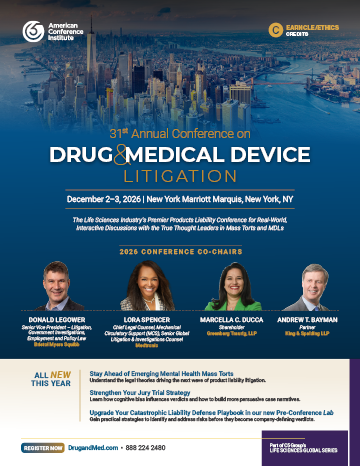
Flip through our conference brochure and discover what’s new this year.
Download Brochure
Catastrophic Liability Defense LAB
December 1, 2026
MODULE 1
The Anatomy of a Nuclear Verdict: Evaluating the True Impact of Distrust and Credibility Challenges for Product Manufacturers
Verdicts are skyrocketing from $10 million to over $100 million, fueled by jury sympathy and societal trends favoring corporate accountability. This session will explore the factors that have fueled these thermonuclear verdicts, examine the effects of plaintiff advertising and third-party litigation funders that widen the gap for settlement, review plaintiff tactics that manipulate juror behavior, and offer strategies to mitigate exposure.
MODULE 2
Finding the Documents and Communications That May Harm Your Case: Conducting Internal Document Audits and Screening Procedures to Identify Problem Areas Before Plaintiffs’ Counsel Does
Internal communications between product development, manufacturing, and safety teams often turn up when they are least expected, and it is difficult – if not impossible – to overcome the negative impacts they can have in product liability matters. As such, it is critical to locate damaging documents, safety reports, post-incident communications, and privilege risks before plaintiffs frame them. Join us in this session as we explore best practices for developing a roadmap to overcome damaging documents and communications in advance of potential injury claims.
Networking Break
MODULE 3
Preparing Witnesses for the Moment the Case May Turn: Winning the Expert and Causation Fight
The burden of proof in product liability matters continues to shift in favor of claimants and will affect how causation and expert testimony may be assessed – especially for complex digital and AI products. As such, it is important to develop “best practice” methods and evidence to prove that client organizations have implemented robust internal quality controls, risk assessments, and safety features that have been built into the design of the products. Your experts and witnesses will need to be well equipped to disprove causation and demonstrate that – even if a defect exists – it could not have caused the specific harm alleged. In this session we will demonstrate how to prepare your witnesses to disprove causation and minimize any potential damages in product liability maters.
MODULE 4
Voir Dire Jury Selection Exercise: Developing Effective Tactics to Select an Impartial Jury and Identify Stealth Jurors
Jury selection is crucial in product liability cases, with much at stake beyond just asking the right questions. In today’s social and political climate, it’s critical to identify and weed out “undesirable” jurors; develop innovative methods and utilize juror questionnaires to overcome juror biases and predispositions; and implement strategies to develop “for cause” challenges. Join us in this session as we engage in a step-by-step exercise to equip you with the tools needed for effective jury selection in product liability matters.
Networking Lunch
MODULE 5
Controlling the Damages Story Early: Overcoming Reptile Theory, Junk Science and Other Novel Theories That Plaintiffs’ Counsel Often Implement
Plaintiff’s bar tactics attempt to recharacterize a defendant’s behavior as “unsafe” or inappropriate from the outset of a claim – often subtly – making it crucial to recognize and counteract early. Claimant’s counsel often utilize literature developed exclusively for litigation (junk science), so prompt case assessment and strong defense theories must be developed immediately to identify the issues that can allow damages to spiral out of control. In this session we will take an interactive look at how and why defense counsel must utilize Motions in Limine (and other pre-trial and trial tactics) to resolve issues outside the eyes and ears of the jury and identify the evidence that must be excluded.
MODULE 6 | Closing Exercise
The Next Wave of Product Liability and Exit Strategies: Practical Tactics for Preventing and Closing Out Complex Mass Tort Product Liability Matters
Preventing and winding down product liability matters is a daunting task when the risk of catastrophic damages is high, and no organization wants to be embroiled in massive, protracted litigation long term. Building a nuclear verdict risk checklist that connects documents, witnesses, experts, damages, settlement, and trial readiness is imperative. In addition, it is also critical to align exit strategies with business goals and develop an early case management schedule to limit potential claims. Join us in this closing segment as we collectively identify common challenges in product liability matters and develop real-world strategies for preventing nuclear verdicts – through comprehensive pre-trial planning and effective exit strategies – by managing timelines, pre-trial motions, and procedural bottlenecks that impact settlements and verdicts.
Catastrophic Liability Defense LAB Concludes
Welcome Cocktail Reception Sponsored by

Day 1 — Main Conference
December 2, 2026
Registration & Breakfast

Andrew T. BaymanPartnerKing & Spalding LLP

Marcella C. DuccaShareholderGreenberg Traurig LLP

Donald LeGowerSenior Vice President – Litigation, Government Investigations, Employment, and Policy LawBristol-Myers Squibb

Lora SpencerChief Legal Counsel, Mechanical Circulatory Support (MCS), Senior Global Litigation & Investigations CounselMedtronic

Mary-Alice BarrettAssociate General CounselGenentech

Sarah RichardsonLitigation LeaderW.L. Gore & Associates

Dan TroyManaging DirectorBerkeley Research Group, LLC (BRG)
This has been another pivotal year in life sciences product liability, marked by updated case law developments that have reshaped the landscape. Our opening session will deliver insights from key in-house and outside counsel on the most important case law developments of the past year. We will explore critical changes, dissect real-world implications, and forecast future litigation trends and strategies.
Topics of discussion will include:
- Surveying the year’s most significant and influential court decisions involving drug and medical device claims
- Analyzing pending decisions that may have the most foreseeable future impact
- Updating practice and litigation strategies in response to the latest case law development
- Assessing the impact of the EU Product Liability Directive and cross-border mass tort coordination
- Coordinating within the defense bar to “level the playing field”
- Reviewing how the recent actions of the FDA impact product liability
The New Mental Health Mass Tort: Product Design, Warnings, and Causation Lessons from the Social Media Litigation

Manuel F. CachánPartnerSkadden, Arps, Slate, Meagher & Flom LLP

TaCara HarrisPartnerKing & Spalding LLP

Jobina Jones-McDonnellVP & Assistant General Counsel Litigation and RiskKeenova

Thomas P. KurlandPartnerPatterson Belknap Webb & Tyler LLP
Social media litigation has emerged as one of the most closely watched developments in the mass tort landscape, raising novel questions about product liability, mental health injuries, and the intersection of technology and human behavior. Plaintiffs’ counsel alleges that social media platforms were intentionally designed to maximize user engagement through addictive product features while failing to adequately warn users and the public about the potential risks of prolonged use.
Join us in this unique session as we examine the evolving legal theories driving these cases, including design defects, failure-to-warn, negligence, and consumer protection claims. Topics for discussion include:
- Examining the principal liability theories asserted in social media and mental health litigation
- Evaluating emerging approaches to proving and challenging causation in psychological injury claims
- Analyzing the role of product design and warnings evidence in mass tort proceedings
- Comparing social media litigation with prior public health and product liability mass torts
- Identifying key developments likely to shape future litigation involving digital products and behavioral harms
Extended Networking Break

Stephen J. McConnellPartner Reed Smith LLP

Zane RiesterAssistant General CounselJohnson & Johnson

Kristen C. RodriguezPartnerDentons
Be sure to join us for our in-house roundtable series that is designed to foster intimate, high-impact discussions among legal peers. Benchmark and share best practices with fellow in-house counsel and their trusted law firm partners in a rotating roundtable format built for real talk and rapid idea exchange on today’s most urgent challenges in drug and medical device litigation. The roundtable hosts will rotate tables every 30 minutes to maximize networking opportunities and idea-sharing on the following topics:
- Navigating Rule 702 Amendments: Strategies for Expert Testimony in Drug and Medical Device Litigation
- The Regulatory and Litigation Landscapes of GLP-1s: Preparing for Pending and Potential Legislation and Litigation Implications
- Mastering Settlement Strategy in MDLs and Class Actions: Advanced Tactics for Vetting Claims, Driving Value, and Navigating Judicial Pressure
- Innovative Tactics for Persuading Juries That Pharma and Med Device Companies Are Not Bad Actors
Networking Luncheon
Artificial Intelligence Litigation Showcase: AI and Accompanying Tools That are Rapidly Transforming the Life Sciences Product Liability Sector

Evan K. JacobsPartnerMorgan, Lewis & Bockius

Byron ShawPartnerMcCarthy Tétrault
Lora SpencerChief Legal Counsel, Mechanical Circulatory Support (MCS), Senior Global Litigation & Investigations CounselMedtronic
The influence of AI is being felt across the spectrum of drug and device development, regulation, and litigation. Litigation strategies, case management, and evidentiary standards are becoming increasingly complex, and are reshaping legal research, document review, predictive analytics, and even courtroom advocacy.
Join us as we examine practical tips on the most effective uses of AI in product liability litigation – and best practices for in-house and outside counsel to remain ahead of the curve. Topics for discussion include:
- Examining the latest AI tools and how they are being used in drug and device product liability litigation
- Document and medical record review
- Motion/brief/pleading development
- Oral argument preparation
- Trial demonstrations
BREAKOUT SESSIONS A
TRACK 1
The Future of Products Liability: Failure to Warn, Duty to Innovate, and Other Novel Legal Theories

Eric L. AlexanderPartnerHolland & Knight LLP

Andrew L. CampbellPartnerFaegre Drinker Biddle & Reath LLP

Janet KwuonVice President, Global Head of Litigation and InvestigationsGilead Sciences

Ryan J. O’NeillPartnerTroutman Pepper Locke LLP

Jean PattersonAssistant General CounselBecton, Dickinson and Company
Join us as we explore pivotal cases featuring both common and increasingly non-traditional plaintiff theories. We will also dissect recent rulings and their potential impact on future drug and device litigation.
Topics for discussion will include:
- Examining and breaking down the “Duty to Innovate”, and the reduction or elimination of the requirement that there be a “design defect”
- Exploring the scope of a “Failure to Warn”, and identifying the characteristics of an adequate warning
- Reviewing the elements of alleged “Design Defects”, including:
- Tracking proposed federal and state legislation impacting access, labeling, and approval pathways
- Important case law developments of the last year impacting the products liability sphere
TRACK 2
One-Year Update on Rule 16.1: Bench and Litigant Approaches to the Different Stages of MDL Matters

Maureen K. BarberAssociateMorgan, Lewis & Bockius LLP

Daniel T. CampbellPartnerCrowell & Moring LLP

John D. GarrettPartnerBowman & Brooke LLP
One-Year Update on Rule 16.1: Bench and Litigant Approaches to the Different Stages of MDL Matters
The new Federal Rule of Civil Procedure 16.1 took effect last December, marking the first rule that was clearly designed for the increasing rise in MDLs. While the new Rule did not “rewrite” the MDL playbook, it’s still extremely consequential. The Rule formalizes best practices for early case management – and beyond – in MDL proceedings, while maintaining discretion for transferee courts.
Join us in this session as our panelists analyze how the new Rule will impact early case management procedures. Topics for discussion include:
- Understanding how the new Rule has been applied differently in MDL proceedings
- Exploring the permissive, rather than mandatory language
- Determining if the Rule limits or expands the discretion that District Judges have?
- Deciding if the Rule can help stem the tide of mass filings of meritless claims
- Reviewing the nonbinding language to determine if perpetuates the uncertainty that exists in the world of MDLs
Networking Break
BREAKOUT SESSIONS B
TRACK 1
The Latest Developments in Third-Party Litigation Funding: Managing Risk and Reclaiming Control Amid Rapid Expansion and Limited Transparency

Candace CamarataDeputy Chief Litigation CounselBecton, Dickinson and Company

Cliff MerrellShareholderGreenberg Traurig LLP
As third-party litigation funding surges, often behind the scenes, drug and device manufacturers are exposed to risks that are difficult to predict and even harder to counter. This session will explore the expanding dynamics of third-party litigation funding, its influence on settlement strategy, and the future of regulatory response.
Topics of discussion will include:
- Tracking the proliferation of foreign-backed funders in drug and device MDLs
- Reviewing the ongoing questions about who is really driving settlement discussions – the parties or the funders?
- Monitoring the creation of a federal subcommittee to address mandatory disclosure of funders and funding terms
- Responding to the growing number of states requiring disclosure of litigation funding arrangements and contracts
TRACK 2
Defect and Causation in the EU and Other Foreign Jurisdictions: Mitigating the Impact of Presumptions

Agata BoutanosChief Executive OfficerEuropean Justice Forum (Belgium)

Simon CastleyPartnerCMS Legal (UK)

John KalasPartnerNelson Mullins Riley & Scarborough LLP

Olivier MignoletPartnerSimmons & Simmons LLP (Belgium)
The new EU Product Liability Directive introduces an updated liability framework that significantly alters how defect and causation are assessed and proven in product liability. By expanding the definition of “product,” lowering evidentiary thresholds, and introducing rebuttable presumptions in favor of claimants, the Directive materially shifts risk for manufacturers and distributors. Join us in this session as we examine strategies to alleviate and rebut allegations of defect and causation under the new PLD and recent developments in other jurisdictions.
Topics for discussion include:
- Demonstrating compliance with mandatory safety requirements and state-of-the-art defenses
- Establishing product design, manufacturing, and warning adequacy in a lifecycle context
- Challenging causal links in complex technical and AI-driven products
- Distinguishing correlation from causation where multiple contributing factors exist
- Leveraging expert evidence, testing data, and real-world performance records
- Establishing intervening misuse, modification, or third-party integration as breaks in the causal chain
Day One Adjourns, Cocktail Reception
Day 2 — Main Conference
December 3, 2026
Networking Breakfast
Opening Remarks from the Co-Chairs
Cognitive Bias and Jury Verdicts: Defending with Empathy and Authenticity to Overcome Social Processes and Pre-Trial Biases

Jessica Benson CoxPartnerFaegre Drinker Biddle & Reath LLP

Rachel A. FarnsworthSenior Corporate Counsel, Litigation & Government InvestigationsBristol Myers Squibb

Eric G. OlshanPartnerMcGuireWoods

Paulette RobinettePresident & FounderJurysync LLC

Katherine M. SwiftPartnerBartlit Beck LLP
Jurors don’t think the way you think, and they often decide cases well before closing arguments – often before opening. The science on this is clear: people form rapid, emotionally grounded judgments and then rationalize them backward. In pharmaceutical and medical device litigation, where the facts are complex, the science is contested, and the defendant is rarely sympathetic on first impression, understanding this dynamic is not optional. It is critical.
This session combines the courtroom instincts of seasoned trial lawyers with the behavioral science of cognitive biases and the expertise of a jury consultant. Attendees will walk away with concrete tools for identifying the jurors who will never hear your case, reaching the ones who will, and framing a narrative that accounts for the biases you cannot strike.
Topics for discussion:
- Examining how juror decision-making actually works
- Why traditional voir dire often fails to surface the biases that decide cases
- What the lawyers who win these cases do differently from the first moments of jury selection – through the final story they tell
A View From the Bench: Judicial Perspectives on Navigating Drug and Medical Device Products Liability Litigation
Andrew T. BaymanPartnerKing & Spalding LLP

Honorable Brian R. MartinottiDistrict JudgeU.S. District Court, District of New Jersey

Honorable Brian H. MayCircuit Judge, Division 1St. Louis County Circuit Court

Honorable Leigh Martin MayChief United States District JudgeUnited States District Court for the Northern District of Georgia

Honorable Nancy J. RosenstengelUnited States District JudgeUnited States District Court for the District of Southern Illinois
Join us for this anticipated judicial panel, as distinguished members of the bench will offer candid, first-hand insights on how the product liability litigation landscape is shifting, and what it means for drug and medical device matters moving forward.
Topics for discussion will include:
- Identifying the arguments they have found most effective and persuasive when presiding over a drug or medical device products liability case
- Highlighting suggestions for speeding up the litigation process for lingering MDLs, class action and mass tort cases
- Offering thoughts and feedback on Rules 702 and 16.1
- Pinpointing what works and doesn’t work in their courtroom regarding jury instructions, voir dire and opening/closing statements
- Describing actual accounts of effective -and poor – witness examination, along with tips and tactics related to effective jury selection
Extended Networking Break
BREAKOUT SESSIONS C
TRACK 1
Labeled as Carcinogens, Litigated as Cause: Building the Defense in Trace-Exposure Cancer Claims

Michael J. SalimbenePartnerReed Smith LLP

Sydney Fairchild WilliamsonShareholder Greenberg Traurig LLP
Chemicals carrying regulatory carcinogenicity labels are increasingly being leveraged in cancer litigation, even where claimed exposures involve trace levels, uncertain pathways, and labels that speak to hazard rather than actual risk. Join this breakout to discuss how defendants build a science-driven, fact-specific defense to allegations that low-level exposure to labeled carcinogens caused disease.
Topics for discussion will include:
- Developing the causation defense: dose, exposure pathway, timing, background risk, and alternative explanations
- Separating hazard from risk: why toxicity, persistence, and detectability do not establish cancer causation
- Countering simplified plaintiff narratives with the regulatory, scientific, and medical context jurors need to evaluate trace-exposure claims
- Using company documents, product history, expert science, and epidemiology to tell a coherent defense story

Lisa M. BairdPartnerReed Smith LLP

Samantha PetersOf CounselDentons
Running the preemption defense is a crucial part of a winning product liability game plan. But has the time come for the life sciences industry to go back on the offense with preemption? This panel will discuss recent preemption decisions and regulatory developments for the purpose of laying out strategies to refine and expand the doctrine.
Topics for discussion will include:
- Determining how medical device and pharmaceutical companies can use the Supreme Court’s FIFRA preemption opinion in Monsanto v. Durnell
- Identifying conditions that just might be ripe for getting courts to recognize that the reasoning in Medtronic v. Lohr has been completely undermined over time
- Reviewing best practices for utilizing an old standby defense in new ways
BREAKOUT SESSIONS D
TRACK 1
Holding Hands Across the So-Called “Enemy” Lines: A Historic Dialogue with Leading Plaintiffs’ Counsel

Richard J. ArsenaultAttorneyNeblett, Beard & Arsenault

Lori G. CohenCo-chair, Global Litigation; Co-Chair, Trial Practice GroupGreenberg Traurig, LLP

Erin CopelandPartnerFibich, Leebron, Copeland & Briggs

Lee A. FloydPartnerFloyd Law, PC

Alexandra WalshShareholderAnapol Weiss
Be sure to join us for this unprecedented, interactive session that will bring together traditional adversaries to explore ways to establish a more efficient litigation ecosystem.
Topics for discussion will include:
- Deconstructing the anatomy of a new mass tort to understand what specific triggers, data, and regulatory actions spark immediate plaintiff interest in filing a case
- Identifying defense actions that inadvertently strengthen the plaintiff’s position to help defense counsel protect clients and better safeguard vital company strategies
- Unpacking proven strategies to avoid costly discovery battles by focusing on transparent, efficient coordination before disputes escalate to the bench
- Examining Plaintiffs Favorite Mass Tort Tools and how the Defense can arm itself in response – advertising, litigation funding, consolidated trials, remands after MDL, Apex testimony, Rule 16.1, Use of Special Masters, privilege logs, and the use of AI combined with predictive coding

Paul J. (PJ) CosgrovePartner UB Greensfelder LLP

Larissa A. EusticeSenior Assistant General CounselBayer
Winding down drug and device litigations is a daunting task, but no company wants to be embroiled in massive litigation long term. This session will address real world strategies for developing and implementing an effective exit strategy and identify common challenges in product liability settlements.
Topics of discussion will include:
- Conducting an early assessment of risk and exposure
- Engaging key consulting experts early
- Aligning exit strategy with business goals
- Developing a case management schedule to limit claims and claimants
- Instituting an effective and targeted motion practice
- Coordinating with parallel proceedings
- Looking at the pros and cons of separate settlement and litigation teams
- Creative mediation and settlement strategies
Networking Luncheon

Brian P. O’DonoghuePartnerSkadden, Arps, Slate, Meagher & Flom LLP
As drug and device litigation continues to grow, in-house and outside counsel are confronted with the complexities of navigating parallel proceedings in both state and municipal courts. These overlapping cases – often involving different procedural rules, discovery obligations, and judicial philosophies – can create significant strategic and logistical challenges.
Our panelists will examine the role of local government actions, forum-shopping concerns, and the interplay with MDLs. Topics for discussion include:
- Analyzing the implications of case law driving MDL claims into state and municipal courts
- Managing overlapping timelines, discovery burdens, and inconsistent rulings across jurisdictions
- Anticipating jurisdictional and venue challenges
- Weighing early resolution options under diverging procedural standards
Networking Break

Marc E. FishmanAVP, General Counsel, LitigationNovo Nordisk

Kristen Renee FournierPartnerKirkland & Ellis LLP

Amy Todd KlugGeneral Counsel & Secretary, DSI / Head of Global LitigationDaiichi Sankyo US
Donald LeGowerSenior Vice President – Litigation, Government Investigations, Employment, and Policy LawBristol-Myers Squibb
As litigation risks evolve at an unprecedented rate, hear directly from senior leaders at the helm of major drug and device companies. This exclusive roundtable will deliver unfiltered insights into how top legal departments are staying agile, proactive, and aligned with the business amid mounting pressure from plaintiffs, regulators, and shareholders.
Topics for discussion will include:
- Aligning legal department activities with the strategic goals of the business – while striving to maintain effective legal and litigation programs
- Evaluating and prioritizing risks for 2025
- Implementing cost-containment strategies that won’t diminish program effectiveness
- Examining the scope of legal exposure amid the increased risks associated with new product development and MDL/class action exposure
- Ensuring that all litigation matters are managed efficiently, with clear timelines, objectives, and resource allocation
- Identifying potential legal risks and implementing strategies to mitigate them through:
- Settlement negotiations
- Alternative dispute resolution
- Vigorous defense strategies

Dorothy CharachPartnerMcCarthy Tétrault
Step into this fast-paced, interactive ethics lab where real-world scenarios will challenge your instincts and decision-making in high-stakes litigation. Using live polling and group discussion, compare your responses to those of your peers, and see how seasoned litigators would navigate the gray areas of the law.
Topics of discussion will include:
- Responding to ethically ambiguous scenarios in discovery, witness prep, and settlement negotiations
- Deciding when to act, and when to escalate ethical concerns in complex litigation
- Collaborating across departments to build a culture of ethical accountability and risk mitigation