Agenda
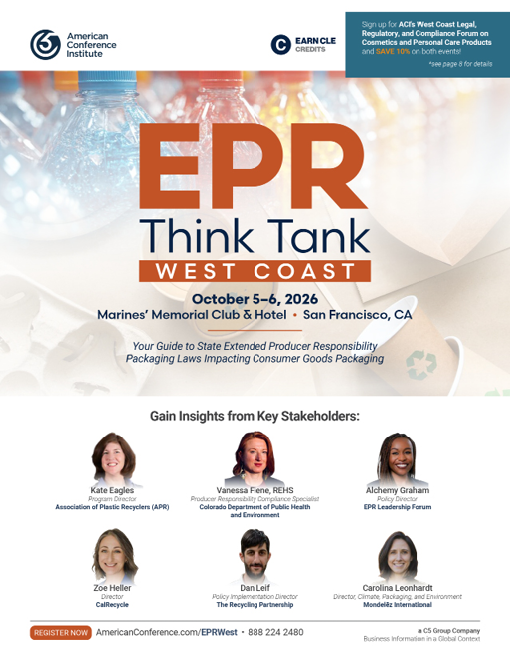
Flip through our conference brochure and discover what’s new this year.
Download Brochure
Day 1 — Main Conference
October 5, 2026
Continental Networking Breakfast and Registration


Dan LeifDirector, Policy ImplementationThe Recycling Partnership

Alchemy GrahamPolicy DirectorEPR Leadership Forum

Shawn J. , ZovodPartner, Environmental and Natural ResourcesTroutman Pepper Locke
Join our speakers as they provide a quick overview of where does packaging EPR stand today, and where is it headed next, looking at the most important regulatory, compliance, and policy developments.
Morning Networking Coffee Break

Sebastian DiGrandeCEOPCX Markets
California’s packaging EPR program is set to launch on January 1, 2027 and producers are entering the final stages of implementation. This session will provide a practical update on where implementation stands and what producers should expect next, in one of the nation’s most ambitious packaging stewardship programs.
- Reviewing key implementation milestones, reporting deadlines, and producer obligations ahead of January 2027
- Understanding the role of CalRecycle, Circular Action Alliance (CAA), and other stakeholders in administering California’s program
- Examining material classifications, covered material categories, and common areas of confusion for producers
- Discussing exemptions and practical compliance considerations across different industries and packaging formats
- Evaluating enforcement expectations and lessons emerging from early implementation efforts in other states

Carolina LeonhardtDirector, Climate, Packaging, and EnvironmentMondelēz International

Leah Batstone-CunninghamProgram Manager- Product & Material ComplianceAndersen Corporation

Allyn Stern, SeattleOffice Managing PrincipalBeveridge & Diamond PC
For many, 2026 marked the first real test of packaging EPR compliance in the United States. Producers have worked to collect data, engage suppliers, submit reports, and prepare for future obligations.
This interactive roundtable will bring together producers from across industries to share practical lessons learned from the first reporting cycle, discuss what worked, what did not, and identify strategies for improving compliance readiness moving forward.
Eco-Modulation and The Future of EPR Fees: Understanding Cost Drivers, Incentives, and Financial Risk

Christine YeagerImpact ConsultantCSY Impact Consulting

Anna KendallClimate Change & Sustainability ServicesErnst & Young LLP
Eco-modulation is emerging as one of the most significant, and least understood components of modern EPR programs. While states share a common goal of incentivizing more sustainable packaging, California, Oregon, and Colorado have adopted different approaches to fee design, material classifications, recyclability criteria, and packaging performance metrics.
One critical question remains- what will compliance actually cost?
- Comparing eco-modulation approaches across California, Oregon, Colorado, and other emerging state programs
- Understanding how recyclability, recycled content, source reduction, and packaging design may influence future fee assessments
- Discussing transparency challenges, data requirements, and how producers can better understand the methodology behind fee calculations
- Developing practical strategies for forecasting EPR costs, budgeting for future obligations, and creating audit-defensible reporting processes
Networking Lunch

Nicole PortleyPRO Program Plan LeadOregon Department of Environmental Quality

Mellik GortonProducer Responsbility LeadColorado Department of Public Health and Environment

Catherine JohnsonPrincipalEnvironmental General Counsel
Hear directly from state regulators as they discuss the latest developments in packaging EPR implementation across the United States. This interactive roundtable will examine key implementation milestones, enforcement priorities, producer compliance challenges, and lessons emerging from states at different stages of implementation. .

Kate EaglesProgram DirectorAssociation of Plastic Recyclers

Rachel Machi WagonerFounder, President | Policy Analysis, Strategic Communications, LegislationRMW Strategies

Trent NorrisPartnerHogan Lovells Cadwalader International LLP
Diving deeper into California’s packaging-related laws, SB 343, i.e. California’s Truth-in-Recycling law, has fundamentally changed the rules governing the use of recycling symbols, recyclability claims, and consumer-facing environmental messaging, creating new compliance challenges for legal, sustainability, packaging, and marketing teams alike.
This session will examine the practical implications of California’s Truth-in-Recycling law and explore how companies can navigate evolving labeling requirements while mitigating regulatory and litigation risk.
- Understanding SB 343’s requirements and how California determines whether a package can be marketed as recyclable
- Reviewing restrictions on the use of chasing arrows symbols, recyclability claims, and other environmental marketing statements
- Exploring the relationship between SB 343, California’s EPR framework, and broader product stewardship initiatives
- Evaluating how companies are adapting packaging, labeling, and consumer communications strategies in response to evolving requirements
Afternoon Break

Olivier JaminCounselDavis Wright Tremaine LLP

Stacey GeisSenior CounselCrowell & Moring LLP
Ongoing legal challenges in Oregon and Colorado are raising important questions around PRO authority, fee-setting processes, due process, and the broader role of states in administering EPR programs.
The outcome of these cases could have significant implications for how programs are implemented, governed, and enforced across the United States.
- Reviewing the status of ongoing litigation in Oregon and Colorado and the potential implications for producers nationwide
- Examining legal challenges involving PRO authority, governance structures, and producer participation requirements
- Discussing transparency concerns and producer access to information used in fee-setting and program administration
- Evaluating producer rights and mechanisms for challenging fee assessments and compliance determinations
- Assessing whether California could face similar legal challenges as implementation approaches
Closing Remarks – Conference Adjourns & Drinks Reception
Day 2 — Main Conference & Post-Conference Workshop
October 6, 2026
Continental Networking Breakfast and Registration

Vanessa FieneREHS, Producer Responsibility Compliance SpecialistColorado Department of Public Health and Environment

Jon-Erik W. MagnusShareholderRogers Joseph O'Donnell, PC.

Karen KayfetzProduct Stewardship Branch ChiefCalRecycle | Division of Circular Economy
EPR programs continue to expand across the United States and producers must navigate an increasingly complex web of state requirements while developing scalable compliance strategies.
This session will examine where EPR policy is heading next, what harmonization efforts are underway, and how producers can prepare for the next generation of packaging stewardship requirements.
- Reviewing key differences among existing state EPR programs, including California, Oregon, Colorado, Maryland, Maine, and Washington
- Exploring opportunities for harmonization across reporting requirements and producer obligations
- Establishing scalable compliance programs capable of adapting to evolving state requirements
Morning Networking Break

Julia ManginDirector of Sustainability & Government AffairsRecology

Jonathan LevyDirector, PlasticsAmerican Chemistry Council

Resa DiminoCo-CEORRS
Managing Partner
Signalfire Group
Packaging EPR programs are designed to improve recycling outcomes, increase material recovery, and create a stronger circular economy. But achieving those goals requires more than producer reporting and fee collection; it requires robust recycling infrastructure, transparent end markets, and reliable access to recycled materials.
- Exploring how EPR programs are driving investment in recycling infrastructure and material recovery systems
- Understanding responsible end-market requirements and concerns surrounding exports and overseas processing
- Examining how stakeholders are working to improve transparency and accountability across the recycling value chain
- Assessing current challenges surrounding post-consumer recycled (PCR) content availability, quality, and affordability

Alison TorbittPartnerNixon Peabody
While many aspects of enforcement remain untested, there is a need for greater clarity around audits, reporting accuracy, fee disputes, producer obligations, and the consequences of non-compliance.
This session will examine emerging enforcement trends, evolving compliance expectations, and practical strategies for reducing regulatory risk in an increasingly complex EPR landscape.
- Reviewing enforcement developments across active EPR programs, including actions involving non-compliant producers and reporting obligations
- Examining common areas of compliance risk surrounding fees, reporting and data quality
- Exploring audit readiness strategies and the growing importance of maintaining accurate and defensible records
- Evaluating how companies are building internal governance structures to strengthen compliance oversight and accountability
