Agenda
Pre-Conference Virtual Workshop
January 21, 2027 • 9:00 am–12:00 pm CT
The First 72 Hours: Responding to a Cross-Border Bribery Allegation Without Losing Control
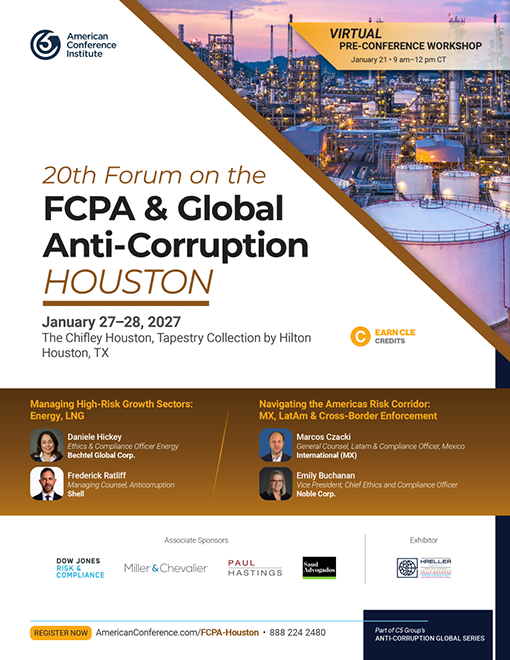
Flip through our conference brochure and discover what’s new this year.
Download Brochure
Day 1 — Main Conference
January 27, 2027
Registration and Networking Breakfast
Co-Chairs’ Opening Remarks
Chief Compliance Officer Perspectives on the New FCPA Enforcement Framework: Translating Policy Signals into Practical Risk Decision-Making
Kick off the morning with an evidence-led opening briefing separating actual enforcement developments from assumptions, with a close look at the conduct most likely to draw scrutiny.
- Assess the post-reset enforcement record and the continuing roles of DOJ, SEC, the FBI, U.S. Attorneys’ Offices and the National Fraud Division
- Examine the emphasis on individual accountability, intentional misconduct, identifiable U.S. interests and national-security-linked corruption
- Identify how cartel and transnational criminal organization exposure can elevate an anti-corruption matter into a broader enforcement priority
- Translate policy signals into practical risk decisions for companies operating in Texas, Latin America and other high-risk markets
Using a developing allegation involving an intermediary, questionable invoices, a whistleblower report and possible trade violations, the panel tests when and how a company should investigate, remediate and engage the government.
- Determine what “reasonably prompt” disclosure means when the facts are incomplete and a whistleblower or media leak may be imminent
- Compare the potential paths to a declination, non-prosecution agreement or other resolution under the Department-wide policy
- Decide who owns the disclosure recommendation across legal, compliance, finance, audit, the board and outside counsel
- Assess how sanctions, tariff, AML, fraud and national-security issues alter the disclosure calculus and choice of government touchpoints
- Document investigation scope, cooperation and remediation so that the company can defend its process even if it does not disclose
Networking Break
The FCPA in 2027: Former DOJ and SEC Leaders New Enforcement Framework Priorities and Expectations
A cross-functional discussion of situations in which bribery demands, extortion, security threats, illicit finance and cartel or TCO exposure converge, especially along the Texas–Mexico corridor.
- Distinguish a bribe, facilitation demand and coercive threat, and understand why the classification matters for response and documentation
- Recognize indicators that a supplier, customs broker, security provider or local intermediary may be connected to a criminal network
- Build escalation protocols clarifying when compliance, legal, security, finance and business leadership take the lead
- Protect employees and country managers while preserving evidence, privilege and reporting options
- Train teams in markets where improper payments may be normalized without stereotyping local employees or weakening controls
Networking Luncheon
Networking Break
This panel will analyze the jurisdiction-specific corruption risks most relevant to multinational projects which touch different parts of Latin America, from market entry through permits, customs, procurement and local partnerships.
- Compare government-touchpoint, public-procurement and third-party risks in Mexico and South America with practical lessons for particular Latin American markets
- Examine scrutiny facing Mexican companies operating in the United States and U.S. companies managing frequent cross-border interactions
- Assess beneficial ownership, influence and control concerns arising from opaque partners, state links and changing energy arrangements
- Coordinate evidence gathering and investigation strategy when local authorities and U.S. or international enforcers may have overlapping interests
- Convert geopolitical developments into a usable country-risk view rather than a static country-rating exercise
- Third-Party Risk Triage: Where Should Limited Resources Go First?
Teams use sample profiles to prioritize onboarding, enhanced diligence, monitoring and exit decisions across distributors, customs brokers, suppliers and local agents.
- Segment by jurisdiction, government touchpoints, payment structure, ownership transparency and cartel or TCO indicators
- Focus diligence on the red flags most predictive of misconduct rather than collecting documents for their own sake
- Set monitoring frequency and transaction-testing depth according to changing risk
- Escalate, suspend or terminate relationships while maintaining an auditable rationale
- Use automation and AI without outsourcing judgment or creating unreviewed false positives
- Records and Controls Under Pressure: Following a Suspicious Payment Through the Enterprise
A transaction-level exercise tracks a suspicious payment through procurement, finance, accounts payable, operations and audit.
- Identify how false invoices, split payments, rebates, credits and miscoding can conceal improper influence
- Clarify the distinct risk views and documentation responsibilities of legal, finance, credit, compliance and audit
- Connect corruption indicators to tariff fraud, sanctions, AML and other financial-crime concerns
- Test approval, exception and reconciliation controls at the points where the payment can still be stopped
- Build an escalation record that supports investigation and government engagement decisions
- Cross-Border Investigations: Data, Devices, Messaging and AI-Generated Evidence
A practical clinic on preserving and testing evidence when allegations span jurisdictions, personal devices, messaging platforms and synthetic content.
- Prioritize evidence in the first hours while considering privacy, localization, employment law and privilege constraints
- Authenticate messages, recordings and documents when deepfakes or AI-generated content may be involved
- Use AI to support review, triage and drafting without overreliance on unvalidated outputs
- Coordinate local counsel, forensic teams and internal stakeholders across borders
- Document investigative decisions so conclusions remain credible to boards, auditors and authorities
A closed-door, peer-focused session on sustaining an effective anti-corruption program while budgets tighten and some stakeholders perceive FCPA risk as diminished.
- Benchmark changes in staffing, budgets, third-party populations, investigations volume and technology investment
- Explain to the C-suite why the FCPA is not “dead” and connect anti-corruption controls to business, financial and national-security risk
- Strengthen tone from the top and country-manager accountability when enforcement messaging appears inconsistent
- Maintain internal reporting, training and government-collaboration readiness with fewer resources
- Clarify cross-functional ownership when organizational changes leave uncertainty over who is responsible for what
Day One Concludes
Networking Reception
Day 2 — Main Conference
January 28, 2027
Registration and Networking Breakfast
When Trade and Corruption Risks Collide: Customs Brokers, Tariff Fraud, Sanctions and Border Payments
A Houston-relevant case study examines how a shipment delayed at the border can trigger anti-corruption, customs, tariff, sanctions, fraud and accounting-control concerns.
- Identify the red flags created by inspection delays, classification changes, unusual broker requests and pressure for unofficial payments
- Determine when a trade issue becomes a corruption, sanctions, AML or criminal-fraud matter
- Design oversight for customs brokers, freight forwarders, distributors and other intermediaries operating at ports and borders
- Coordinate trade, legal, compliance, logistics, finance and investigations teams without duplicating work or losing accountability
- Preserve documents and decision records that allow the company to explain how it responded to a fast-moving cross-border problem
Networking Break
Fireside Chat
Moving beyond AI awareness, this session compares production use cases for compliance with the emerging ways bad actors can use AI to manipulate reporting channels, evidence and payment processes.
- Demonstrate AI-supported investigation triage, transaction monitoring, third-party review and communications drafting
- Validate outputs, manage hallucinations and false positives, and document meaningful human oversight
- Address deepfakes, synthetic invoices and fake hotline or ethics-line submissions designed to misdirect investigators
- Define where AI should accelerate work and where human judgment, corroboration and escalation remain essential
- Establish governance that aligns compliance, audit, privacy, cybersecurity, legal and data teams
Networking Luncheon
Global Anti-Corruption Without a Single Playbook: The Multilateral Enforcement Outlook from SFO, PNF and Swiss OAG
An international enforcers and practitioners panel examines how shifting U.S. priorities interact with increasingly active authorities and evolving anti-corruption frameworks abroad.
- Compare the latest priorities and investigative approaches of DOJ, the UK Serious Fraud Office, France’s PNF, the Swiss OAG and other key authorities
- Assess where cross-border cooperation is converging and where policy fragmentation creates conflicting expectations
- Examine how sanctions, war, reconstruction, national security and geopolitical competition influence corruption investigations
- Plan for evidence sharing, privilege, data transfer and parallel engagement across multiple jurisdictions
- Build a multinational compliance baseline that remains durable even when enforcement priorities diverge
A sector-focused panel tests how anti-corruption controls should change when rapid investment, public approvals, infrastructure, community commitments and opaque counterparties converge.
- Map government touchpoints across permits, land, utilities, customs, procurement, tax, licensing and project finance
- Assess corruption and beneficial-ownership risks in fast-growing data-center and digital-asset ecosystems
- Examine ethics, reporting and third-party controls for LNG, energy and other capital-intensive projects
- Evaluate sponsorships, community investments, emergency relief, gifts and hospitality when requests are connected to official action
- Tailor controls to a sector’s operating model rather than relying on a generic anti-corruption program
Afternoon Break
Conference leaders convert two days of discussion into a prioritized, board-ready checklist for the next 90 days.
- Recalibrate third-party segmentation for high-risk jurisdictions, opaque ownership and cartel or TCO exposure
- Test the voluntary disclosure and crisis-escalation process before the next allegation arrives
- Connect anti-corruption, sanctions, AML, trade, fraud and security governance without blurring accountability
- Validate AI-enabled compliance tools and strengthen defenses against AI-enabled fraud and fabricated evidence
- Reinforce internal reporting, training, tone from the top and the business case for maintaining compliance investment