Agenda
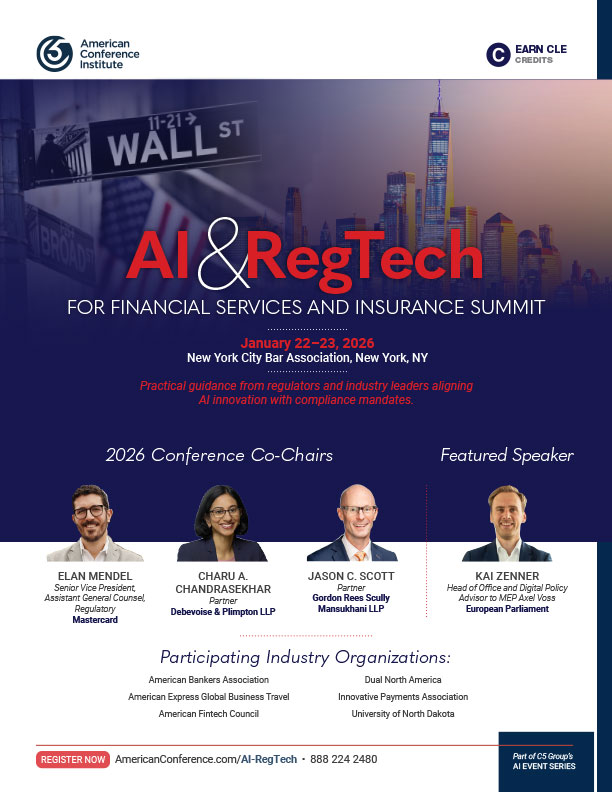
Flip through our conference brochure and discover what’s new this year.
Download Brochure
Day 1 — Main Conference
May 20, 2026
Networking Breakfast and Registration

Trump 2.0 Policy Shift: What This Administration’s Plans Mean for Financial Services Enforcement and Compliance

Ezra GarrettSVP, Public Affairs & ImpactOportun
Board Chair
American Fintech Council

Ian P. MoloneySVP, Head of Policy and Regulatory AffairsAmerican Fintech Council
Banks, insurers, and FinTechs are getting mixed signals from Washington. In January 2025, the Administration ordered agencies to unwind Biden-era AI risk rules, and deliver a national AI Action Plan. The July 2025 plan emphasizes fewer federal constraints, faster data-center permitting, standards-led exports, and procurement guardrails for “frontier” LLMs. Meanwhile, the Senate stripped a proposed 10-year freeze on state AI laws, leaving room for states like New York and Colorado to press ahead as the EU AI Act’s early obligations begin taking effect, inviting mounting obligations from states and abroad that financial institutions cannot ignore. In this opening session, topics of discussion include:
- Enabling innovation by dialing back federal barriers to AI development and deployment
- Partnering with industry ton secure, standards-based export packages for AI models, software, and applications
- Expediting data center and semiconductor-fab buildouts through streamlined federal permitting
- Updating federal procurement so agencies buy only from frontier LLM providers that meet specified objectivity and safety criteria

Matthew E. S. ColemanPartnerOrrick, Herrington & Sutcliffe LLP

Amena RossHead of Global PolicyCash App & AfterPay
Financial services teams are juggling overlapping obligations as state AI laws advance while federal policy continues to shift. The result is real uncertainty about which rules drive exams and which controls must be proven first. This session turns the patchwork into an action plan tied to concrete use cases in lending, underwriting, fraud, and customer operations. Topics of discussion include:
- Mapping state and federal obligations to specific financial use cases so teams scan prioritize what to build and validate first
- Translating examiner expectation into checklists for documentation, reporting, and evidence so audits move faster
- Harmonizing privacy, model risk, and consumer protection controls so one control set satisfies multiple regimes Stress-testing conflicts of law and jurisdiction so global programs do not break when products cross borders
Networking Break

Daniel FloweHead of Digital IdentityLondon Stock Exchange Group (LSEG)

Peter PiatetskyCo-Founder and CEOCastellum.AI

Jason E. PrincePartnerAkin Gump Stauss Hauer & Feld LLPFormer Chief Counsel, U.S. Department of the Treasury’s Office of Foreign Assets Control (OFAC)

Heather TrewSenior Vice President & Counsel (Bank Secrecy Act, Anti-Money Laundering & Sanctions)American Bankers Association
Fraudsters now use synthetic identities, deepfakes, and automated mule networks. In response, banks are piloting models that surface patterns traditional rules miss. Examiners still expect the Bank Secrecy Act fundamentals while asking for proof that AI improves quality and does not create blind spots. This session shows what “good” looks like, from model documentation to SAR workflow evidence and sanctions screening integration. Topics of discussion include:
- Detecting fast-moving red flags with feature engineering and triage playbooks so alerts are more accurate and timely
- Documenting end-to-end SAR processes so automation raises quality and withstands subpoenas and exam review
- Integrating sanctions screening with entity resolution and watchlist logic so false positives drop without raising risk
- Operationalizing model monitoring so drift, bias, and escalation thresholds are visible to both compliance and auditors

Arjun WadwalkarProduct LeaderGlobal Payments Inc.

Tricia Y. WagnerCIPP/US, CISSP, CISALowenstein Sandler LLP
Choosing between buy, build, or co-develop decisions is hard when model performance, cost, and explainability all matter, especially to the Board. This showcase compares real use cases that survived procurement, security, and legal review, including lessons learned from sandbox pilots. Topics of discussion include:
- Selecting high-value use cases with measurable ROI, so early wins unlock budget and sponsorship
- Designing guardrails and acceptance criteria so pilots convert to production without rework
- Evaluating vendor claims with proof requirements and test data strategies so marketing does not outpace reality
- Crafting the board pitch with cost, risk, and control narratives so approvals land on time
Networking Luncheon

Charu A. ChandrasekharPartnerDebevoise & Plimpton LLP

Noah SolowiejczykPartnerFenwick & West LLP
Regulators and law enforcement agencies are sharpening their focus on algorithmic decisioning, predictive analytics, disclosures, and cyber resilience around AI. Expect increasing scrutiny into documentation, policies and procedures, supervision, and AI disclosures. This session translates public statements and recent enforcement actions from the SEC, FINRA, and DOJ into governance frameworks, oversight, and regulatory defense. Topics of discussion include:
- DOJ AI priorities and prosecutions
- SEC’s Division of Enforcement AI priorities and enforcement actions
- SEC 2026 AI examination priorities
- FINRA’s statements on AI deployment, including GenAI and agentic AI
- Best practices for AI policies and procedures, governance, and disclosure risk management
A Serpent Eating its Tail? Using AI for Regulatory Compliance while Complying with Regulatory Expectations for AI

Jamal El-HindiCounselClifford Chance LLPFormer Chief Data Officer, US Treasury Financial Crimes Enforcement Network (FinCEN) Counsel

Grovetta Gardiner, Esq.Senior AdvisorFS Vector

Andrew JacobsonGeneral CounselHalliday
Model risk leaders must show how AI fits inside SR 11-7 and OCC expectations, while preserving performance. The exam room wants independent validation, challenger testing, and clear lines of accountability across the model lifecycle when models are used to make decisions. But how does this look when AI is used to understand and implement the regulations themselves?
This session will make the practical case for incorporating Agentic AI in regulatory compliance processes, while also using it as a paradigm for understanding examination standards applicable to AI in connection with model risk management. Topics of discussion include:
- Application of AI in the context of regulatory change lifecyles
- Practicality of using Agentic AI with respect to changing AML and sanctions requirements
- Meeting regulatory expectations with respect to use of decision making models
Networking Break

Lawrence BaldinoPresident, Cyber and Technology Risk UnderwritingDual North America

Meredith A.C. ChallenderPartnerKissel Straton & Wilmer LLP

Ling Ling AngManaging DirectorNERA
Credit and pricing models face the toughest fairness questions, and new state laws heighten expectations for testing and transparency. Data quality, feature selection, and outcome monitoring all factor into legal risk and examiner comfort. This session shows how programs are proving fairness without sacrificing accuracy. Topics of discussion include:
- Selecting features and mitigation techniques so fairness improves, while strength remains intact
- Generating clear explanations and adverse-action content so customer communications satisfy exam standards
- Validating data lineage and representativeness so drift and legacy bias do not erode outcomes over time
- Running pre-deployment and post-deployment fairness tests so corrective actions are timely and defensible
Agenda

Tien PhamAssistant General Counsel, Enterprise Data Privacy Office, Office of General CounselFINRA

Michael SavickiSenior Vice President Chief Risk & Compliance OfficerAmerican Express Global Business Travel

Jason C. ScottPartnerGordon Rees Scully Mansukhani LLP
Strong AI programs combine policy, role clarity, and privacy-by-design with vendor and product controls. Regulators are also probing consequential decisions in credit and insurance for transparency, access, and appeals. This session delivers the playbook for making governance visible and auditable. Topics of discussion include:
- Forming an AI risk committee and RACI so decision rights and accountability are visible across lines of defense
- Writing vendor clauses for IP indemnity, audit access, service levels, and bias thresholds so contracts carry control weight
- Tightening access, logging, and human-in-the-loop requirements so outcomes are reviewable and correctable
- Synchronizing privacy impact and AI impact assessments so one review satisfies multiple obligations
Closing Remarks from the Conference Co-Chairs
Conference Adjourns
Day 2 — Main Conference
May 21, 2026
Continental Breakfast & Registration
Opening Remarks from the Conference Co-Chairs

Dan Nuñez CohenSVP and Head of Legal – North AmericaCrypto.com

Mark duBoseChief Risk & Compliance OfficerAnchorage Digital

David L. HirschPartnerMcGuireWoods LLPFormer Chief, Crypto Asset and Cyber Unit in the Division of Enforcement, U.S. Securities and Exchange Commission
With a federal stablecoin framework moving forward and state regimes still active, FIs must nail reserves, disclosures, custody, and Bank Secrecy Act obligations without tripping over bank v. FinTech liability splits. Examiners will expect clear documentation, clean control mapping, and provable monitoring across on-chain and off-chain flows. This session clarifies what to implement, how to evidence it, and where opportunities remain for safe growth. Topics of discussion include:
- Complying with the Bank Secrecy Act by mapping KYC, transaction monitoring, sanctions screening, and SAR procedures to the new framework
- Differentiating bank and FinTech responsibilities and allocating liability in contracts
- Verifying issuer status and counterparties including confirming Permitted Payment Stablecoin Issuer (PPSI) eligibility
- Implementing reserves, attestation, disclosure, and custody controls
- Producing examiner-ready evidence so supervisory reviews are satisfied
Networking Break
Global Enforcement Playbook: Meeting the EU AI Act, UK Financial Conduct Authority, and Singapore MAS Expectations

Elena GurevichOwnerEG Legal Services

Anna JacobsonChief Risk & Compliance OfficerPaysend Group

Kai ZennerHead of Office and Digital Policy Advisor to MEP Axel Voss European Parliament
The EU AI Act introduces product-style obligations and penalties, while Singapore and the UK continue principle-based approaches. U.S. stakeholders with global footprints need a single standard that will not crumble across borders. This session explains how peers are building one control stack that works everywhere. Topics of discussion include:
- Mapping global obligations to shared controls to avoid duplicative work
- Setting a global standard so the strictest rules are met
- Aligning incident reporting and recordkeeping so regulators see consistence evidence in each market
- Preparing for on-site and remote audits so documentation and demos land cleanly across jurisdictions

Sean Patrick FultonOf CounselDLA Piper LLP

Erin CassOf Counsel, Litigation DepartmentPaul Hastings

Philip J. PhilliouPartnerPhilliou Partners
Third-party risk now includes model performance, explainability, and data rights alongside the usual cybersecurity and resilience questions. Banks, carriers, and platforms need contracts that make controls enforceable, not aspirational. This session provides the templates and oversight moves that work. Topics of discussion include:
- Structuring SLAs and KPIs for accuracy, fairness, and uptime so vendor performance is measurable and enforceable
- Onboarding vendors under third-party guidance so procurement, legal, and risk move in lockstep
- Allocating liability for data use, IP, and regulatory findings so disputes do not stall operations
- Monitoring vendor models and logs so continuous assurance replaces point-in-time reviews
Networking Luncheon

Michael IngrassiaSenior Managing Counsel, Privacy, AI & Data ResponsibilityMastercard

John V. LevonickLegal CounselMAXEX

Scott McBroomAssociate General Counsel, CommercialFINRA
As AI becomes embedded, disputes over training data, outputs, and audit rights are increasing. Contracts must secure transparency, performance, and continuity without exposing confidential data or trade secrets. This session will show how deal teams are getting it done. Topics of discussion include:
- Negotiating training data rights and generated output ownership so reuse and disclosure are controlled
- Securing audit access to models, logs, and test environments so oversight is real and documented
- Setting performance guarantees and bias thresholds so remedies and credits are triggered automatically
- Building termination, termination, transition, and escrow plans so critical services continue under stress
Networking Break

Ryan P. BlaneyPartnerJones Day

Anna Favour O’ConnorPrivacy, Cybersecurity & Innovation (AI) Lead Counsel for the AmericasSociete Generale
Litigation and enforcement are converging on three themes: overclaiming AI capabilities, biased outcomes in consumer decisions, and misuse of data. This session unpacks recent cases and settlements to isolate the red flags that invite scrutiny and actions. Topics of discussion include:
- Dissecting bias and adverse-action findings so credit and pricing programs avoid repeat issues
- Spotting AI-washing and disclosure missteps so marketing and investor communications stay defensible
- Strengthening copyright and data provenance controls so training and outputs do not trigger claims
- Translating settlements into internal playbooks so remediation is fast and complete

Jocelyn AquaPartnerHWG LLP

Jennie L. CunninghamOf CounselNelson Mullins Riley & Scarborough LLP
The new federal rule restricting bulk transfers of sensitive U.S. personal and government-related data to countries of concern changes how global data moves. Banks and payment networks must classify data, update vendor contracts, and tune controls without breaking products. This session turns the rule into steps your teams cane execute. Topics of discussion include:
- Classifying covered data, countries, and counterparties so transactions are screened correctly
- Updating DPAs, SCCs, and vendor terms so cross-border controls are contractually enforceable
- Segmenting and geo-fencing datasets so sensitive information does not leave approved locations
- Governing sovereign and third-party data centers so oversight meets examiner expectations