Agenda
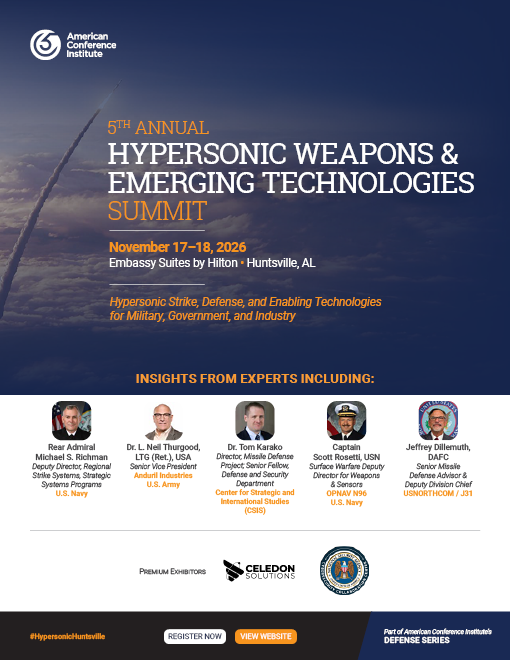
Flip through our conference brochure and discover what’s new this year.
Download Brochure
Day 1 — Main Conference
November 17, 2026
Continental Breakfast
Opening Remarks by Chairpersons


Networking Break
Panel
Operationalizing Golden Dome: What it Takes to Implement the New National Security Infrastructure from AI and Sensors to Onsite Weapons Testing

Jeffrey DillemuthDAFC Senior Missile Defense Advisor & Deputy Division ChiefUSNORTHCOM / J31

Ryan CoopermanDirector of Public Policy & Government RelationsThe American Institute of Aeronautics and Astronautics
Assess what is required to align defensive architecture, modeling and simulation, onsite validation, AI-enabled command and control, sensors, and industry partnership in support of Golden Dome implementation. Panelists will examine the priorities needed to build a layered network for hypersonic, ballistic, and cruise missile threats.
Topics of Discussion:
- Enhancing homeland defense through Golden Dome initiatives and next-generation missile warning capabilities
- Strengthening collaboration between government and industry to deliver resilient, scalable tracking and defense solutions
Amplifying Interoperability Across Joint Sensing Networks to Strengthen Operational Awareness from AI and ML to Interoperable Architectures

Captain Scott Rosetti, USNSurface Warfare Deputy Director for Weapons & SensorsOPNAV N96
Explore how joint sensing networks can strengthen cross-domain awareness by connecting threat detection, tracking continuity, and decision support with greater precision. Topics include sensor integration, AI-enabled data fusion, interoperable architectures, and fire-control-quality information as foundations for faster warning against maneuvering threats.
- Advancing sensor technologies to improve detection and tracking of highly maneuverable threats
- Expanding the role of Artificial Intelligence and machine learning within future warning architectures
Networking Luncheon
Presentation
Resilient MWT MEO Program: Advancing Space-Based Missile Warning and Tracking for Hypersonic Defense
Panel
Maximizing Government-Industry Partnerships to Improve Technology Transition and Deployment from Acquisition to Supporting Rapid Fielding Hypersonic Technologies

Dr. Erica L. CorralDistinguished Scholar Professor of Materials Science & Engineering and Aerospace and Mechanical Engineering Director, Arizona Research Center for Hypersonics (ARCH)University of Arizona
Identify pathways for advancing next-generation missile systems from development to operational employment through closer alignment among defense priorities, acquisition models, and industry execution. Panelists will analyze prototyping, modular design, manufacturability, production scale-up, testing, and fielding, with attention to pace, affordability, risk management, and program accountability.
- Applying lessons learned from recent prototyping, testing, and fielding efforts.
- Balancing speed, innovation, risk management, and program oversight.
Networking Break
Keynote Address
Building the Space Architecture for Hypersonic Detection, Tracking, and Defeat
Keynote Address
Advancing Navy Strategic Systems for Long-Range Hypersonic Deterrence
Closing Remarks; Day 1 Adjourns
Networking Cocktail Reception
Day 2 — Main Conference
November 18, 2026
Continental Breakfast
Opening Remarks by Chairpersons

Presentation
Integrating High-Precision Fires into Future Deterrence Concepts
Networking Break

Major Robert Perez-AlemanyProgram Manager, Space Development Agency LiaisonDefense Innovation Unit (DIU)
Virtual Speaker
Presentation
From Meta-Learning to Self-Improving Autonomy: The Next Frontier in Hypersonic GNC and Decision-Making

Dr. Roberto FurfaroDeputy Director
Space4 Center
Director
UA Space Systems Engineering LaboratoryDepartment of Systems and Industrial Engineering and Department of Aerospace and Mechanical Engineering
University of Arizona
- Establishing secure and trusted data environments that support hypersonic development and testing
- Improving data accessibility while maintaining cybersecurity and mission assurance requirements
- Building governance frameworks that promote interoperability across government, industry, and academia

Dr. Luca MaddalenaCEOHy-SET (Hypersonic Science Engineering and Technology)
Professor of Aerospace Engineering and Director, Aerodynamics Research Center (ARC)
The University of Texas at Arlington
Networking Lunch

Dr. Serhat HosderJames A. Drallmeier Centennial Professor
Director, Aerospace Simulations Lab Mechanical and Aerospace Engineering (MAE) DepartmentMissouri University of Science and Technology

Dr. Michael OliverFacility Manager, 10x10 Supersonic Wind TunnelNASA Glenn Research Center

Tim WadhamsSenior Research ScientistCUBRC VP and Director of Aerosciences Sector
- Leveraging digital engineering, modeling and simulation, and digital twin technologies to accelerate testing, manage uncertainties, and reduce program risk
- Strengthening government-industry partnerships to close critical testing gaps and speed the transition from development to operational capability
- Expanding test infrastructure, range capacity, and flight-test capabilities to support the next generation of hypersonic systems
Panel
In-Depth Operations and Inner Workings of Dark Eagle: The Tech, Manufacturing and Speed-to-Capability Beyond the Blueprint

LTC. Robert (Trent) BlackmanLong-Range Fires Assurance Team
Learn how technical, manufacturing, and speed-to-capability challenges are shaping long-range strike development. Panelists will address the U.S. Army’s precedent-setting 2026 operation, Dark Eagle, and the path from test integration to fielding, including common glide body work, joint-service coordination, production readiness, and scalable delivery.

