Agenda
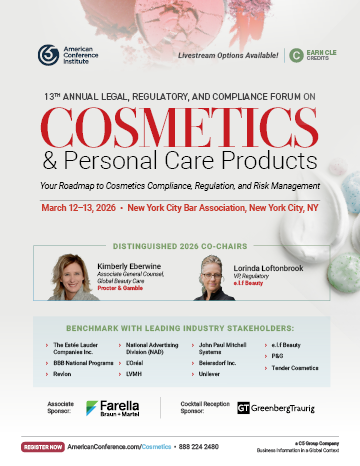
Flip through our conference brochure and discover what’s new this year.
Download Brochure
Pre-Conference Workshops
March 11, 2026


Day 1 – Main Conference
March 12, 2026
Continental Networking Breakfast and Registration


Cathy L. BurgessPartnerAlston & Bird LLP

Bianca BalcaenManager, Customs & Trade ComplianceSol De Janeiro
Tariffs and shifting trade policies continue to reshape the cosmetics and personal care industries, with ripple effects across supply chains, budgets, and consumer behavior. Over the past year, companies sourcing ingredients and packaging from China, Korea, and other Asian markets have grappled with unpredictable tariff costs, FDA import alerts, and longer lead times.
Our panelists will help gauge how these trade-related developments will impact your business.
- Exploring how to best forecast costs when tariff schedules remain uncertain, and strategies for budgeting in an unpredictable trade climate
- Addressing FDA import alerts, customs challenges, and the impact of delayed shipments on product launches
- Highlighting tariff-driven shifts in sourcing strategies, from Asia to Latin America, and what this means for ingredient and packaging procurement

Julia CarbonettiCounselCrowell & Moring LLP

Rebecca H. WilliamsAttorneyRopes & Gray LLP

Giovanni HernandezCorporate CounselBeiersdorf

Antonia WaltersOperations, Legal & ProductBlee
MoCRA marked the most significant reform in decades, and many companies are still finding their footing as FDA guidance continues to take shape. At the same time, the new administration’s “Make America Healthy Again” (MAHA) policy agenda, initially focused on food safety and chemical reform, is raising important questions about what could be next for cosmetics.
- Highlighting the new administration’s approach and how FTC and FDA oversight may shift, particularly as broader rollbacks of EPA and food safety regulations create uncertainty
- With several food dyes recently restricted, could cosmetics be next in line for tighter regulation?
- Addressing the status of cosmetic cGMPs, fragrance allergen labeling, and FDA’s required report to Congress on PFAS
- A quick look at the “Safer Beauty Bill Package” aiming to address MoCRA gaps
- Exploring practical risk management strategies and how you can navigate enforcement risks, pending rules, and the resource burden of federal-state patchworks
Morning Networking Coffee Break

Marcha Isabelle ChaudryCEO & FounderEquity Wellness Co

Sarah Peterman BellPartnerFarella Braun + Martel
With federal enforcement and legislation slowing down, states continue to push forward with their own legislation, often more aggressive and complex than federal requirements. This session explores the latest developments at the state level, how they interact with federal oversight, and what cosmetic and personal care companies need to do now to keep pace.
- Examining how California, Washington, Oregon, New Jersey, and New York are leading the charge on cosmetic ingredient bans, fragrance disclosure rules, and recycled content reporting
- Highlighting how fragrance houses are navigating both U.S. state requirements and EU regulations
- Exploring state-level restrictions on 1,4-dioxane, PFAS, lead, and other chemicals, and how differing impurity thresholds across states are creating harmonization headaches
- Analyzing when (if ever) state laws are overridden by FDA authority under MoCRA, and where legal gray zones are emerging
This guided seated meditation offers a structured pause to reset attention and ease mental fatigue before the afternoon sessions. Through simple breath regulation and guided visualization, attendees will be led through an accessible experience designed to restore clarity, composure, and renewed focus in a professional setting. The techniques introduced can be easily integrated into demanding workdays to support sustained performance and well-being.
Networking Lunch
Afternoon Breakout Sessions
REGULATORY TRACK
Chemical Contamination and Ingredient Safety: Examining Regulatory Developments and Compliance Challenges

Victoria TuSVP, Head of Global Regulatory Affairs, Product Integrity & ClaimsCoty Inc.

Kelly ChoAttorneySidley Austin LLP

David RosenPrincipalRosen Strategies LLC
With heightened regulatory attention on contaminants such as benzene, talc, and PFAS, and growing divergence in international chemical regulations, companies are being pushed to strengthen testing, transparency, and supply chain oversight.
- Are regulators moving toward prohibiting more chemicals, or allowing exemptions for industrial uses that complicate cosmetics oversight?
- Assessing the latest on PFAS restrictions, compliance deadlines, and how small and large companies should react
- Reviewing talc regulation updates and ongoing safety considerations
- Lessons from recent benzene-related recalls and their implications for future product safety and regulatory compliance

Merrit JonesOffice Managing PartnerBryan Cave Leighton Paisner LLP

John GardellaChair of Emerging Practice Groups | ShareholderCMBG3 Law

Ian BarlowOf CounselWiley Rein LLP
The cosmetics and personal care industries remain at the center of class action scrutiny, with lawsuits expanding beyond traditional false advertising claims into new areas such as social media marketing, environmental concerns, and emerging digital compliance risks. In parallel,
Prop 65 litigation continues to pose significant challenges, with increased enforcement activity and heightened attention on chemical disclosures impacting companies of all sizes.
Class Actions
- Examining the rise of class actions tied to social media influencers and digital advertising, including early-stage cases at the motion to dismiss phase
- Understanding the growth of green marketing and sustainability claims litigation, related to “natural,” “organic,” and “vegan” claims
- Analyzing recent disputes over PFAS
- Examining increasing litigation risks tied to microplastics
- Breaking down wiretapping and data privacy litigation involving chatbots and ad tech, with a focus on California-specific risks
- Reviewing trends in false advertising suits, from “Made in USA” and health-related claims to disputes over consumer deception and labeling gray zones
Prop 65
- Identifying the latest wave of plaintiffs’ claims made under Prop 65
- Assessing strategies to mitigate litigation risk and manage warning label obligations in California
- Understanding evolving chemical listing trends and their impact on cosmetics formulations
Afternoon Networking Break
REGULATORY TRACK
Testing Under the Microscope: Finding the Right Partner to Navigate a Fragmented Regulatory Landscape

Kristine Schmalenberg, PhDExecutive Director Clinical and Scientific AffairsThe Estée Lauder Companies Inc.

Marielle Weintraub, Ph.D.Director of Scientific Strategy - OTC & GMP TestingEurofins Supplement & OTC Testing

Augustine Agyekum PhD “Dr. Kwaku”ToxicologistAgyekum Group
Testing sits at the heart of cosmetics and personal care compliance, but with fragmented regulatory frameworks and a lack of clear FDA guidance, companies are often left wondering: what testing is truly required, and what is enough to support claims and ensure compliance across global markets?
In this environment, finding the right testing partner is essential, not only to meet regulatory expectations but also to build consumer trust and protect brand integrity.
- Exploring the evolving expectations around testing, the costs involved, and how brands can make smart decisions when selecting testing partners
- How do you navigate the absence of clear FDA guidance: what’s “enough” testing in the U.S.?
- Reviewing state-specific requirements on testing
- Understanding required testing protocols to substantiate “sensitive skin,” “dermatologist-tested,” and SPF claims in cosmetics
- Efficacy testing vs. safety testing: knowing the difference and when both are needed
- How to evaluate a good testing lab vs. red flags to avoid
LEGAL & BUSINESS TRACK
Reviewing The Next Generation of Product Liability Claims in Cosmetics
*will not be livestreamed

Avril LovePartnerK&L Gates LLP

Dakotah M. BurnsCounselPatterson Belknap Webb & Tyler LLP

Sabrina R. GalloShareholderGreenberg Traurig LLP
With the cosmetics industry facing both legacy liability and new waves of litigation, it looks like talc and asbestos remain costly battles, while the hair relaxer MDL highlights how quickly new product categories can come under fire. PFAS and other contaminants are also driving scrutiny, raising concerns about the next “hard ingredient” crisis.
- Spotlighting the Hair Relaxer MDL and examining how litigation strategies are being shaped by earlier talc/asbestos cases
- Reviewing landmark talc, asbestos, and benzene litigation and their lasting impact on product liability in cosmetics
- Identifying the next “hard ingredient” poised to become the next PFAS or asbestos in cosmetics suits
- Assessing how plaintiffs’ attorneys are adapting tactics to expand liability exposure
- Evaluating defense strategies, including pre-emption and beyond, to contain risk

Ricardo CarvajalDirectorHyman, Phelps & McNamara (HPM)

Rachel RaphaelPartnerMorgan, Lewis & Bockius LLP

Dr. Rick KingstonPresident of Regulatory and Scientific Affairs & Co-founderSafetyCall International
Product safety has always been a cornerstone for cosmetic brands, but with MoCRA’s adverse event reporting requirements, increased FDA oversight and mandatory recall authority, they now have to be fully prepared to respond swiftly.
- Reviewing the FDA’s recall authority under MoCRA and understanding how it differs from prior cosmetic oversight
- Distinguishing between voluntary and mandatory recalls: when each is triggered and how companies should respond
- Identifying events that trigger mandatory recalls and designing procedures for rapid execution
- Developing best practices for recall planning, corrective actions, and crisis management
- Implementing Adverse Event Reporting (AER) protocols: what, when, and how manufacturers are now required to report under MoCRA
LEGAL & BUSINESS TRACK
M&A in Motion: Compliance and Transactional Trends in the Cosmetics Industry
*will not be livestreamed

Sue CollinsGeneral CounselRhode Skin

Ashish TalatiMemberTalati Law Firm PLLC
This year, the industry has seen a surge in mergers, acquisitions, and strategic investments, creating new opportunities and regulatory considerations for buyers, sellers, and investors.
From deal structuring to transactional diligence, companies are navigating a complex landscape of legal, compliance, and operational challenges that can make or break a successful acquisition.
- Examining the recent acquisition of Rhode by e.l.f. Beauty, including compliance and legal considerations during the deal process
- Assessing the broader M&A landscape in beauty
- Which categories are attracting the most activity, and how investors are evaluating growth, brand equity, and regulatory risk
- Reviewing key compliance lessons for companies preparing for a sale
- Taking into consideration pre-exit audits, MoCRA readiness, state and international regulatory considerations, and contractual obligations
- Understanding the importance of transactional due diligence
- What do buyers look out for?
Select your table of choice to benefit from smaller-group benchmarking and discussion. Compare notes with your industry peers on the latest best practices and expand your network. Each table will be led by industry leaders.
- Structuring Successful Licensing & Partnership Agreements
- A Checklist for Successfully Navigating Retailer Requirements
- Borrowed Sounds and Viral Memes: How Cosmetics Brands Can Engage with Pop Culture Without Crossing IP Lines
Day 2 – Main Conference & Post-Conference Workshop
March 13, 2026
Continental Networking Breakfast and Registration

Anahid UgurlayanAssistant DirectorNational Advertising Division

Kimberly EberwineAssociate General Counsel, Global Beauty CareProcter & Gamble

Leanne GabinelliAssistant Vice President – Legal, Advertising & Marketing CounselL’Oréal USA

Randal M., ShaheenPartnerBaker & Hostetler LLP
As consumer expectations rise and regulators sharpen their focus, cosmetics companies face heightened scrutiny over the claims they make. From ‘green’ and sustainability messaging to functional promises like anti-aging, blue-light protection, or hair regrowth, brands must ensure their marketing is both compelling and credible.
- Exploring emerging claim trends and vulnerabilities across cosmetics and personal care
- Devising best practices for substantiating structure/function claims
- Anti-aging, hair-regrowth, and cell-regeneration
- Reviewing the latest guidance from regulators and self-regulatory bodies, including FTC’s anticipated Green Guides and NAD
- Navigating sustainability and environmental claims
- Packaging, recyclability, biodegradability, and lifecycle messaging
- Overlaps between “clean,” “natural,” and “pure” positioning and environmental claims
E-Commerce Corner Talk: How are Cosmetics Companies Adapting to Generative AI and Data Privacy While Safeguarding Consumer Trust?

Cassidy Sehgal-KolbetChief Regulatory and Privacy OfficerLVMH North America

Meryl BernsteinPartnerHogan Lovells US LLP

Ceren Canal AruobaManaging DirectorBerkeley Research Group
As e-commerce brands embrace AI tools, from virtual try-ons and personalized marketing to dynamic pricing, they face fast-evolving privacy laws, aggressive enforcement, and new litigation risks.
With 20+ states passing privacy regulations, increasing scrutiny from AGs, and class action complaints on the rise, your company must reassess how they deploy AI and manage data across platforms.
- Examining laws in New York, Texas, California, and Colorado around automated decision-making and dynamic pricing
- Understanding the risks of personalized pricing models based on device, location, purchase history, and consumer data
- Managing cross-border data transfers, genomic data, and vendor ties to “countries of concern”
- Using generative AI responsibly and disclosing AI use in consumer-facing applications and marketing
- Drafting stronger contracts with vendors and affiliates, to align with privacy obligations
Morning Networking Break

Steven RosenthalVice President & Assistant General Counsel, Global Intellectual Property & Licensing Revlon

Laure SawayaOf CounselPryor Cashman

Laurine Janin ReynaudAttorney-at-Law and PartnerTAoMA Partners
From counterfeit products and trademark infringement to the booming market for “dupes,” cosmetics brands are facing mounting threats to their IP and brand integrity. This session will examine practical strategies to safeguard intellectual property, enforce rights, and defend against copycats in an increasingly competitive landscape.
- Highlighting best practices for protecting against counterfeits and knock-offs
- Reviewing enforcement strategies for trademarks, patents, and design rights
- Exploring non-traditional trademarks in cosmetics, including colors, shapes, scents, and packaging designs
- Leveraging your IP offensively and defensively by using design patents and non-traditional marks to deter infringement
- Best practices for monitoring, documenting, and defending your brand globally

Carolyn H. RosenbergPartner, Insurance Recovery GroupReed Smith LLP

Kenneth C. Hegel JrManaging Principal/EVPEPIC Insurance Brokers & Consultants
As enforcement actions broaden under MoCRA and regulatory scrutiny intensifies, we’ll take a look at how companies are managing their legal and financial exposure. From defense costs and indemnities to product recalls and bodily injury claims, the role of insurance is becoming increasingly central to risk management strategies.
- Exploring how companies can better leverage insurance, contracts, and risk allocation to minimize cost, uncertainty, and reputational harm
- Examining how insurance policies respond to legal fees, claims resolution, and product recalls
- Assessing opportunities to transfer risk beyond the company, including indemnification strategies
- Best practices on aligning insurance coverage with reputational and litigation risk
- Understanding the evolving role of in-house counsel and risk managers, in collaborating on insurance placement and defense strategies
- Best practices on aligning insurance coverage with reputational and litigation risks
- Reviewing how insurance factors into the rise of product liability suit, and what coverage gaps companies need to anticipate
Co-Chairs Closing Remarks and Recap of Day Two
Conference Adjourns

Sheila MillerPartnerKeller & Heckman LLP

Giulia MaiorinoSenior Analyst, Sustainable Packaging DevelopmentThe Estée Lauder Companies Inc.