Course Calendar | Eastern Standard Time
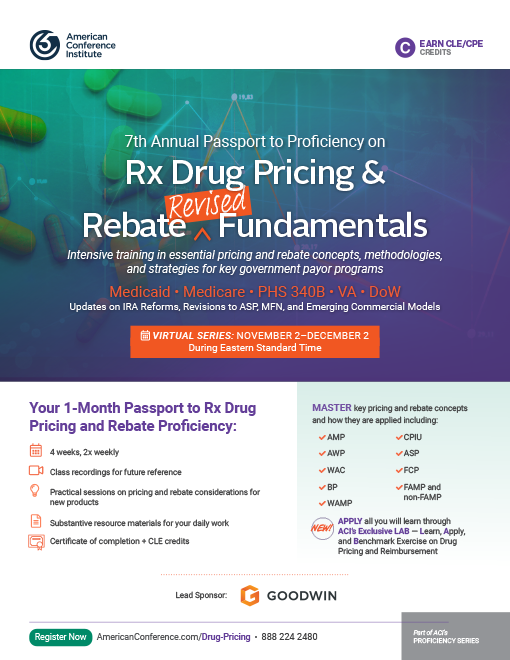
Flip through our conference brochure and discover what’s new this year.
Download Brochure
Week 1 – Day 1
November 2, 2026
Drug Pricing and Rebate Essentials and Introduction to Medicaid

Trevor WearPartnerSidley Austin LLP
In this session you will learn about the numerous government drug price reporting programs, at a higher level, including what is different, what is similar, and even what is connected across programs in terms of purpose and operation to establish the foundation for understanding as well as strategy development. This session will cover:
- Surveying key drug pricing programs
- Examining the roles each program plays in drug pricing
- Distinguishing the differences and similarities among the programs
- Understanding the Interconnectivity of the programs
- Reviewing key focus areas for deeper dives throughout the Passport to Proficiency Series

Stefanie DoeblerPartnerCovington & Burling LLP
Of the several government price reporting programs, the Medicaid Drug Rebate Program (MDRP) has the most comprehensive set of laws, regulations, and guidance of any program, and as a result, understanding MDRP’s terms and requirements are critical to working with all price reporting programs, which is why there are multiple sessions diving into its details. This session will analyze the MDRP’s key terminology and components:
- Best Price: what it is and how it is determined
- When its relevant and when its not
- Key court decisions and regulatory developments
- AMP: what it is and how it is calculated
- Relevance of “retail community pharmacy” class of trade
- How the calculation may differ for certain drugs
- URA: what it is and how it is calculated
- CPIU: what it is and how it is calculated
- When it is triggered
- Can it be reset
- WAC and AWP: what they are and how they are used
Break
Medicaid Pricing and Rebates
Role of the National Rebate Agreement (NDRA) and Analysis of the Mechanics of the Rebate System

T. Reed StephensPartnerWinston Taylor PLLC
In this session you will learn about the central role the Medicaid Drug Rebate Program (MDRP) plays amongst the government price reporting programs, including an analysis of the National Rebate Agreement and the many rebate system mechanics. This session will cover:
The National Drug Rebate Agreement
- The agreement’s terms and purpose
- What is required to participate in the MDRP
- How the PHS program is linked to the MDRP
- What the relationship is between the MDRP and Medicare
- What the expectations are for affiliated manufacturers
Rebate System Mechanics
- Survey applicable drug pricing legislation (e.g., BBA, DRA, ACA)
- How the rebate system works
End of Monday Session
Week 1 – Day 2
November 4, 2026
Drug Pricing and Rebate Essentials and Introduction to Medicaid

Marijo BustosHead of Government Pricing and ReimbursementUCB Inc.

Kristin HicksPartnerArnold & Porter
This session will cover the complexities and challenges of the MDRP relating to:
- Validating transactional data essential to the calculations
- Analyzing transaction types included and excluded from AMP and BP:
- Customary Prompt Pay Discounts (CPPD)
- Chargebacks
- Rebates (commercial customers v. government and state programs)
- Government and state program rebates
- Manufacturer PAPs, coupons, vouchers, and their impact on AMP, Best Price, and government pricing calculations
- Free goods
- Nominal price sales
- Invoice adjustments
- Identifying what constitutes a bundle arrangement and when and how to unbundle them
- Understanding required and optional smoothing methodologies for lagged data
- Knowing when and how to employ the “5i” AMP calculation

Stephen ForsterPartnerJones Day
This session will cover additional complexities and challenges of the MDRP relating to:
- Line extensions
- Authorized generics
- AMP cap removal
- New definitions for CODs, manufacturer, and market date
- Time limits on manufacturer restatements
- Possible suspension from the National Drug Rebate Agreement for late reporting
- PBM accumulator and maximizer programs, patient affordability considerations, and emerging legal and regulatory developments
- Value-based purchasing arrangements
- GENEROUS model and calculations
- Other complexities and challenges
Break

Rachel LamparelliLife Science Attorney Morgan, Lewis & Bockius LLP

Felecia ManningSenior Director, Pricing and Government Programs, Market Access United Therapeutics Corporation
State drug price transparency laws continue to proliferate across the country and bring with them additional work for government price reporting teams and risk of penalties for manufacturers. Key topics include:
- Identifying states with current and pending drug price transparency laws
- Manufacturer notification and justification requirements
- Enforcement actions taken under existing laws
- Addressing challenges with finding solutions for reporting under non-uniform and sometimes conflicting state laws
- Providing tips for developing a system to track and respond to these laws
- Discussing the impact of these laws on Medicaid and other state pricing
- Evaluating recent litigation, enforcement actions, and judicial developments shaping state transparency requirements

Merle M. DeLancey Jr.PartnerBlank Rome LLP

Andrew YorkExecutive Director Maryland Prescription Drug Affordability Board
Prescription Drug Affordability Boards (PDABs) are state-established bodies that evaluate the affordability of high-cost prescription drugs. Their powers vary by state and may include conducting affordability reviews, issuing nonbinding recommendations, and in some cases, establishing binding Upper Payment Limits (UPLs) to cap drug prices or reimbursements. PDABs are similarly proliferating across the country and pose a real risk of creating a pricing and reimbursement landscape that varies state-by-state. This session will:
- Clarify the role of PDABs
- Survey states with PDABs and those with pending legislation
- Identify PDABs with UPL authority
- Review PDAB litigation to date
End of Wednesday Session
Week 2 – Day 1
November 9, 2026
PHS 340B, VA and DOD Rx Pricing and Rebates

Catherine Burton-MezaAssociate DirectorGilead Sciences

Constance WilkinsonBoard of Directors & Member of the Firm Epstein Becker Green
The discounts under the 340B Program are tied to the calculations under the MDRP, but the discounts are available on most utilization, whether the patient pays cash or has commercial or government insurance. It is necessary to understand the 340B Program and any given drug’s exposure to the Program to properly manage the drug’s gross-to-net. This session will lay the groundwork for understanding the 340B Program and cover:
- What is a 340B covered entity and why do they receive special pricing on drugs
- Who qualifies as a 340B covered entity
- What steps does a 340B covered entity need to take to qualify for the program’s benefits
- What is the relationship between the 340B Program and MDRP
- What impact do GPO arrangements have on covered entities access to 340B prices
- How does orphan status affect a drugs 340B pricing

Scott HoffmanCo-Founder & Head of Client Services Woven Data

Heath R. IngramPartnerGoodwin Proctor
The 340B Program is closely tied to the MDRP, but has many distinct operational requirements, considerations, and challenges not seen in the MDRP or any other government drug pricing program. This session will discuss:
- How the 340B price is calculated, including how it is set for new drugs
- The meaning of “penny pricing” and how it happens
- The meaning of a “limited network” and the role the play in 340B pricing
- The need to validate customer eligibility for 340B pricing
- The importance of distinguishing 340B from non-340B utilization from the same customer
- The prior, and possible future, cuts to Medicare reimbursement in the OPPS setting for 340B utilization
Break

Daryl BerkeAssistant General Counsel, Specialty Care Market Access Lead Sanofi

Christopher JacksonManaging MemberLaw Office of Christopher S. Jackson LLC
The 340B Program has a very significant impact on the different groups of stakeholders in the pharmaceutical ecosystem (e.g., covered entity providers, manufacturers, state and federal governments, not to mention pharmacies, wholesalers, and group purchasing organizations. The significance of the impact has led to numerous legal challenges brought by each group of stakeholders. This session will explore the following and where things stand after legal challenges:
- HRSA’s authority to enforce the 340B program
- Manufacturer’s ability to restrict use of contract pharmacies
- Manufacturer’s use of rebates, rather than upfront discounts, to offer 340B pricing
- Covered entities ability to access GPO pricing
- State’s ability to prohibit manufacturers’
- contract pharmacy restrictions,
- collection of claims data,
- use of rebates to offer 340B pricing, and use of limited networks
End of Monday Session
Week 2 – Day 2
November 11, 2026
340B, VA and DOD Rx Pricing and Rebates

James KimShareholderPolsinelli P.C.
Manufacturers of innovator drugs must, and those of generic drugs may, agree to participate in the Federal Supply Schedule (FSS) and Veterans Health Care Act (VHCA) programs. While these programs may not have underwent significant change in recent years, they remain important programs to manufacturers and carry with them detailed program requirements. This session will cover:
- The overall obligations of manufacturers contracting with the federal government with respect to:
- General Services Administration (GSA) FSS
- VA (Veteran’s Affairs)/DOW (Department of War)
- Tricare
- What entities are entitled to the FSS price
- The significance of being of single v. dual pricer
- How the Federal Ceiling Pricing and FSS price are determined
- How non-Federal Average Manufacturer Price is calculated
Break

Allison PugsleyPartnerHogan Lovells Cadwalader
This session will cover additional complexities of the contracting with the VA and DOW, including:
- Specialized arrangements for personalized medicines
- Criteria for a drug to be eligible for consideration under the FSS
- How drugs are chosen by VA/DOW/IHS/BOP for joint national contract targets
- General requirements for issuing a drug contract
- Factors for creating the requirements in the estimated volume of purchase
- Contracting process
- Process for renewed drug contract
- Factors considered by the agencies when a drug is up for renewal
- Differences in the processes used by the VA National Acquisition Center and Defense Logistics Agency
- Trade Agreements Act (TAA) requirements and the evolving impact of Made in America initiatives on pharmaceutical contracting, sourcing, and country-of-origin compliance
LAB – Learn, Apply, and Benchmark: A Step-by-Step Walkthrough of the FSS Application Process (Will Not Be Recorded)

Greg MaddenManaging MemberOrlaithe Consulting LLCFormer Chief of Contracting, VA NAC

Cheryl MiddletonPrincipal & Co-Founder Revolve Access
Through a guided, hands-on walkthrough of the FSS application process, this interactive session will help participants understand key submission requirements and prepare complete and compliant applications with confidence.
End of Wednesday Session
Week 3 – Day 1
November 16, 2026
Medicare Pricing and Rebate Essentials and Advanced CMS Pricing and Rebate


Andrew RuskinPartnerK&L Gates LLP
Medicare Part B has historically provided reasonable coverage and fair reimbursement for drugs not usually self-administered by patients. The program has underwent relatively modest changes since adopting the Average Sale Price (ASP) methodology for reporting and reimbursement in the mid-2000s. Understanding and properly managing a Part B drug’s ASP was and remains critical to the success of any of Part B drug. However, the IRA shuttled in major new requirements for Part B drugs and CMS’s annual rulemaking finalized major changes to the way ASP is calculated. This session will focus on:
- Identifying coverage under Medicare Part B
- Understanding Part B reimbursement, including the role of:
- ASP
- Coding
- Temporary pass-through status
- Recognizing the differences in coverage and reimbursement in the various outpatient settings
- Examining ASP calculation fundamentals:
- Inclusions and exclusions
- Exempt and non-exempt sales
- Smoothing
- The two-quarter lag
- Bona fide service fees, including the new certification requirement
- Reasonable assumptions, including new documentation requirement
- Distinguishing between manufacturer-submitted ASP and the ASP used by Medicare for reimbursement
- Reviewing ASP reporting and submission requirements
- Addressing unique aspects dealing with
- Specialty generics
- Biosimilars
- Analyzing the Medicare Part B Drug Wastage Rule

Preeya PintoPartner DLA Piper
- Identifying coverage under Medicare Part D
- Understanding the mechanics of Part D
- What subsidies and payments do Part D plans receive?
- Interaction with Retiree Drug Subsidy and commercial rebates
- Reporting of Part D rebates and PBM administrative fees
- Examining Part D formulary requirements
- Developing rebate contracting strategies under Part D
- Accounting for specialty pharmaceuticals
- Assessing potential legislative changes
- Understanding the CMS program design relative to the Part D Coverage Gap Discount
- Managing the logistics of payments to multiple plan sponsors
Break

Veronica Jordan-DavisAssociate Senior Counsel, Market Access Eisai Inc.

Ross MarguliesPartnerManatt, Phelps & Phillips, LLP
The IRA brought about the government’s first ability to negotiate Medicare prices directly with manufacturers, in establishing a drug’s Maximum Fair Price. This session will provide an update on the Medicare Drug Price Negotiation Program and how Maximum Fair Price is working in practice:
- CMS’s negotiation of maximum fair prices (MFP) under Medicare Parts B and D
- Drugs chosen thus far
- MFP calculations
- Results of negotiations
- Examples of how this pricing reform is playing out, including its intersection with other government programs
- Status of legal challenges

Stephanie TrunkPartnerArentfox Schiff LLP

Amanda SmithCounselK&L Gates LLP
Beyond the Medicare Drug Price Negotiation Program, the IRA ushered in other significant changes under Medicare. Manufacturers historically were not directly penalized under Medicare for price increases. However, the IRA developed inflation penalty regimes under Medicare Parts B and D similar to those under the other government price reporting programs, changing the ways manufacturers think about and plan for price increases. And, the IRA significantly changed the Part D program, in ways that shifted the burdens on payors, manufacturers, and patients. This session will examine:
- Inflation rebates payable under Parts B and D, including a look at:
- The calculations and their relationships to ASP and AMP, respectively
- What utilization is and is not subject to the rebate requirements
- Part D re-design and manufacturer discounts
- Implications of IRA for manufacturers
- Ability to take price increases
- Impact on launch prices
- What is different under the Trump Administration
End of Monday Session
Week 3 – Day 2
November 18, 2026
Medicare Pricing and Rebate Essentials and Advanced CMS Pricing and Rebate Topics

William SarrailleFounder Sarraille & Associates
- Reviewing Key provisions of the Consolidated Appropriations Act (CAA)
- Analyzing FTC enforcement settlements involving PBMs
- Tracking state PBM legislation trends
- Fee delinking, spread pricing and pass-through rebate requirements
- Assessing the impact of transparency and reporting obligations on manufacturers
- Evaluating the Implications for government price reporting calculations
- Exploring the future of contracting strategies and formulary negotiations

TJ GarriganSenior Advisor Covington & Burling LLP

Chris WeiserAssociate General Counsel, Value & Access and Pricing Teva Pharmaceuticals
As policymakers continue to explore Most Favored Nation (MFN) pricing approaches to lower drug costs, manufacturers must assess the potential impact of emerging models including Medicare models GENEROUS and GUARD and Medicaid model GLOBE, on global pricing strategies, launch sequencing, and international reference pricing dynamics. This session will examine the challenges associated with MFN policies and the broader implications for market access and commercialization.
Break
LAB – Learn, Apply, and Benchmark: Pricing and Rebate Exercise Under Medicaid, Medicare, and 340B (Will Not Be Recorded)

Joseph MetroCounselReed Smith LLP
This hands-on session uses realistic, hypothetical scenarios to demonstrate how key pricing and reimbursement concepts come together in practice, helping participants translate theory into real-world decision-making.
End of Wednesday Session
Week 4 – Day 1
November 30, 2026
New Product Launches, Emerging Commercial Models and Strategic Financial Planning

Margaux HallPartnerGibson, Dunn & Crutcher LLP

Jenny RobertsonBoard MemberThe MED13L FoundationFormer Chief Business and Legal Officer, Lexeo Therapeutics
This session will explore how organizations are adapting launch strategies while balancing access, reimbursement, profitability, and compliance.
- Identifying key factors that influence launch pricing decisions
- Assessing the role of Medicare Drug Price Negotiation and IRA-related considerations
- Evaluating payer expectations for innovative and specialty therapies
- Examining contracting and access strategies for new product launches
- Understanding the impact of launch decisions on government pricing metrics
- Anticipating policy developments that may affect future launches
Break
Special Considerations for New Therapies and Biosimilars: Government Pricing, Reimbursement, and Market Access Challenges

Melissa WongPartnerHolland & Knight LLP
As manufacturers expand investments in innovative therapies and biosimilars, traditional pricing, reimbursement, and market access frameworks continue to evolve to address new treatment modalities, payment structures, and competitive dynamics.
- Evaluating reimbursement and payment models for cell and gene therapies, personalized medicines, and other high-cost innovative treatments
- Evaluating alternative payment and contracting models, including outcomes-based arrangements and value-based purchasing strategies
- Assessing government pricing implications for AMP, Best Price, ASP, and other reporting obligations
- Understanding Medicare, Medicaid, and commercial coverage and reimbursement considerations for innovative therapies and biosimilars
- Reviewing biosimilar adoption trends, competitive dynamics, and policy developments shaping future reimbursements
End of Monday Session
Week 4 – Day 2
December 2, 2026
New Product Launches, Emerging Commercial Models and Strategic Financial Planning

Mariah HinesDirector, Corporate Counsel, Commercialization and Market AccessJazz Pharmaceuticals
Trevor WearPartnerSidley Austin LLP
This session will examine the growing shift toward direct-to-consumer (DTC), direct-to-patient (DTP), and direct-to-employer (DTE) approaches, as well as the emergence of TrumpRx and its potential implications for manufacturers, payers, employers, and patients. Manufacturers such as Eli Lilly, Novo Nordisk, and Pfizer have expanded direct purchasing platforms, while policymakers have promoted direct purchasing arrangements as part of broader drug pricing reforms.
- Examining the TrumpRx initiative and its policy objectives
- Analyzing the growth of manufacturer direct-to-consumer platforms
- Understanding direct-to-employer contracting models and employer demand
- Evaluating opportunities and risks associated with bypassing traditional intermediaries
- Assessing implications for government pricing, rebates, and contracting strategies
- Exploring how these models may reshape patient access and affordability
Break

Sabrina AeryFounder and PrincipalAery Policy & Access Partners, LLC

Christopher H. SchottPartnerLatham and Watkins LLP
As the drug pricing landscape continues to evolve, organizations must understand not only the individual forces affecting revenue, but also how they interact to influence financial performance, forecasting, and business risk. This session will connect the key concepts explored throughout the series, examine what organizations should be watching now, and discuss how manufacturers can prepare for emerging risks and opportunities in 2027 and beyond.
- Evaluating the cumulative impact of rebates, discounts, fees, and chargebacks on gross-to-net performance
- Assessing how commercial and government pricing decisions influence enterprise profitability
- Examining the financial consequences of launch pricing, contracting, and reimbursement strategies
- Identifying forecasting challenges in an increasingly complex pricing environment
- Developing executive-level strategies to balance compliance, patient access, and revenue objectives